Gibraltar GSX is excited about Crypto

One of the prominent guests at BlockShow Asia 2017 was Nick Cowan, the managing director and founder of GSX, Gibraltar’s first regulated stock exchange. Cowan is an fervent supporter of the Fintech market so I was interested to discover what he said in the numerous interviews he gave following the show about his personal position and what this might mean for a financial centre like Gibraltar.
gibraltar

It is important to note that Cowan loves networking the crypto communities and admires their dynamism. As far as he can see there are two very important dynamics operating in the crypto market at the moment: the first is distributed ledger usage and the ways in which blockchain platforms can transform a range of businesses and second, the trade in cryptocurrencies. He told Cointelegraph that during one trip to one Asian country, he met about 500 people with an average age of 60 who were all cryptocurrency traders. Considering the perception is that the cryptocurrency market targets those in the 25-45 age range, it would seem that the traders are somewhat older, at least in Asia.

However, Cowan also pointed out that there are significant differences between jurisdictions. For example, in the next country he visited (he didn’t say which one) the focus was more on crypto fund management and institutional engagement with this emerging market. He also answered some questions about what are the drivers behind the interest in crypto. He said: “A lot of it is driven by regulation, in terms of the acceptance of the technology and cryptocurrencies in general.” But what impressed him most was the level of knowledge in each country he has visited.

As he said, and it is evident to anyone who is curious about this market, the interest in everything crypto is snowballing and the perception that it is going to go mainstream is growing. Cowan said: “You are seeing more and more companies, Fintechs that are looking to start their business or grow their business tapping into token sale space as a way of raising money.” He described the sector as being “on fire.”

Gibraltar GSX got involved in crypto about two years ago and the fact that it is a small jurisdiction enables it to be a bit more flexible than other stock exchanges. It got involved by launching a Bitcoin asset-backed security approved by the European Union. As Cowan, explained, when they started on the project Bitcoin was $300, but they knew little about it and the whole team had to dive in and find out everything possible about this whole new world.

The Gibraltar government is also interested in blockchain and has been talking to various communities globally about whether or not there should regulations for operators of blockchain-based financial services. As a result, Gibraltar is introducing regulations in January 2018. Cowan sees this as an opportunity and GSX is applying for a license so that it is in a position to explore the ICO token space to its fullest and use all the knowledge its team has acquired. In fact, watch this space because GSX is launching its own security token next year on its main exchange.



Cleaning up ICOs

icokey

This year has been the year of the ICO and whilst these have brought a breath of fresh air into the marketplace of funding startups and other ventures, the speed at which ICOs have gathered momentum has raised some eyebrows and some questions about just how ‘clean’ this new Fintech mechanism is.

There are two sides to the ICO debate: one the one hand it is positive for the innovators who can raise funds through fairly simple token sales and reach a global market. The popularity is clear for all to see, because the funds raised by ICOs grew from $200 million in 2016 to $2 billion in 2017.

On the negative side, there are those who are concerned about the lack of regulatory controls over these ICOs. That is one reason the mainstream financial authorities are reluctant to accept them as a legitimate method of capitalisation. Add some shady ICOs into the mix and their concerns are understandable.

There are some other issues around ICOs that need to be resolved as well and these involve the technology, which is still in its infancy. Some argue that there are insufficient reporting standards, no exchange regulation and little or no regulation in a number of countries. The result is a clash of standards when those entities using conventional financial systems start adopting the blockchain.

Resolving ICO problems

How can these issues be resolved? There are several ways to solve the transparency problem. One is to define standards of reporting for companies using ICOs and it easy for participants to view the internal workings of the ICO via the exchange interface. This will provide investors with more detailed information about the company behind the ICO.

Second, more due diligence by investors is needed. There needs to be a proper assessment of the proposed business models to ensure they are viable. Investors should also be provided with more information about the company’s legal status.

Greater understanding of the financial markets will also help. It is widely agreed that most financial instruments will migrate to the blockchain in the not too distant future and preference should be given to projects that are using time-tested instruments and are understood by conventional investors, over experimental utility token economy models.

A clean up of the ICO marketplace is needed, because they are not going to disappear. Governments may try to ban or restrict them, but decentralisation is the way forward and rather than ignore ICOs and pretend they are some kind of digital bubble, what is required is a “clean investment system.”

However, this cannot come from central authorities, because that would betray the whole basis of the blockchain, which is decentralisation. What is required is that the companies and investors involved in the ICO market “embrace systems that will promote credibility within the ecosystem,” as CoinTelegraph suggests. Transparency and openness from the company side, and more in-depth research by investors will greatly contribute to a more legitimate and trustworthy ICO marketplace.


The latest Ethereum roadmap

MzjdsYApwW_MQogkN1GltP9r7maIzrODQUocbdlINCI

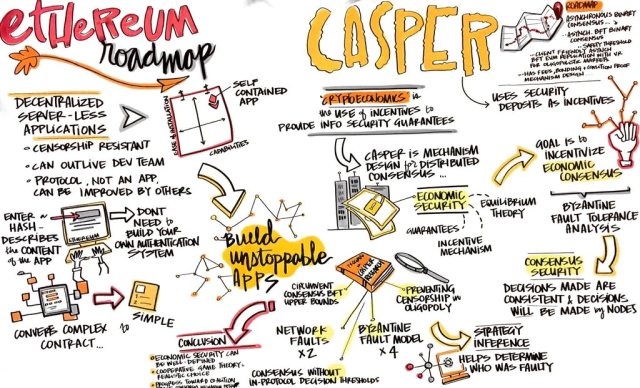
I’ve been heavily invested in Ethereum since it appeared, so I was very interested in Vitalik Buterin’s recent talk at Devcon (he’s the creator of Ethereum), which he called “a modest proposal.” He told his audience that he has been “quietly working on a new long-term plan for the future of the blockchain network.” It is a essentially a three to four year roadmap outlining his vision of the potential technical developments that Ethereum can achieve, and as anyone who owns ETH will have noted, the value of the coins showed some upwards movement after his speech.

Enter ‘sharding’

What does his vision include? At the heart of it is something called ‘sharding’.  Without getting too technical, this is defined as: “A database shard is a horizontal partition of data in a database or search engine. Each individual partition is referred to as a shard or database shard. Each shard is held on a separate database server instance, to spread load.” This was something that Ethereum watchers had expected to happen, but Bueterin finally solidified his strategy for using the shard technique.

Expanding Ethereum’s scalability

His roadmap points to problems with the platform and solutions for fixing them. His focus in the talk was on scalability, as Ethereum nodes need to store everything that ever happened on the network. Buterin emphasised the need for solutions that mitigate expensive storage costs that could escalate exponentially as the system expands.

It was clear from his presentation that he wanted to encourage Ethereum developers to think about this aspect when he said: “The amount of activity on the blockchain is orders of magnitude larger than it was just a couple of years ago,” and pointed to daily transaction rates and the 20,000 nodes plus that are now part of the network.

Buterin’s view of sharding

Buterin seems to see ‘sharding’ as the most probable solution to the problem. This way of partitioning data into subsets means that each node would only have to store a small amount of data from the entire network. But, Buterin wants a system where “the underlying math would hold the system accountable, and if they need it, nodes could rely on other nodes for data.” How to execute this in practice and ensure security, i.e. no nodes sending other nodes false information, is something that researchers have been looking into.

From the talk we now know that Buterin has a less conventional approach to using sharding. He is proposing to split Ethereum into different types of shards- there will be a main shard comprising the current Ethereum network, and there would be other shards, which Buterin calls other “universes.”

Most importantly, Buterin believes the partitioning would allow for more aggressive changes on the smaller shards, and more cautious changes on the main blockchain. This will ensure Ethereum’s platform maintains stability while developers can test new changes.

Other announcements included upgrading the smart contract technology and progress on eWASM, his project for running Ethereum on a web browser. He also hinted that a lot of the work in progress is much more advanced than anyone guessed when he finished hi stalk by saying, “Basically we’re just inches away from a proof of concept in python.”


Beyond the Blockchain

Blockchain

Most people assume that Bitcoin was the beginning of the blockchain, but in fact there were versions of crypto coins in existence before its arrival. BMoney and BitGold are a couple of examples. However, they didn’t have much success, partly because Bitcoin became the one to buy and put every other coin in the shade. But, there is another reason for their lack of success – they were on a centralised structure, whereas the key selling point for BTC was, and remains, the “decentralized, immutable, transparent” ledger in which transactions could be recorded.”

This aspect of the blockchain gave Bitcoin a huge advantage, but now it looks like developers are searching for another way to create crypto. The first one to emerge is the Direct Acyclic Graph (DAG). In mathematical and technical terms, this is a finite directed graph with no directed cycles. DAGs can model all kinds of information – a spreadsheet is one example and they are very handy for data processing networks. It can also be used to create a decentralised ledger, and one of its advantage sis that it has the capacity to solve old problems and add new features. Some believe it will even replace the blockchain eventually.

Back in 2013, Yonatan Sompolinsky and Aviv Zohar introduced the GHOST protocol, which proposed a change to Bitcoin’s structure from a blockchain into a tree, thus reducing confirmation times and improving security. Although this change has not been implemented in Bitcoin, other cryptocurrencies are using the DAG-based system successfully.

Byteball is one. This is a DAG-based currency without any blocks. Instead, transactions are linked directly to each other and each transaction contains one or more hashes of previous transactions. The set of links between the transactions forms what is known as the DAG, as opposed to the block system used in Bitcoin and other cryptocurrencies.

There is still a lot of work to be done on Byteball and its DAG-based system, but one thing is clear: this system is a viable alternative to blockchain technology and can even solve some of the most prominent problems found in the technology, such as such as speed, sustainability, scalability, security, privacy and legal compliance. However, and this is of particular interest to me; when compared with Ethereum, Byteball smart contracts are not as powerful, but they are simple, allowing them to be displayed in user-readable form.

Will DAG-based cryptocurrencies replace blockchain? It’s hard to tell right now, but we need to keep an eye on this development as some projects are making a bit of noise in the cryptosphere, which suggests DAG-based coins will be more popular in the future.