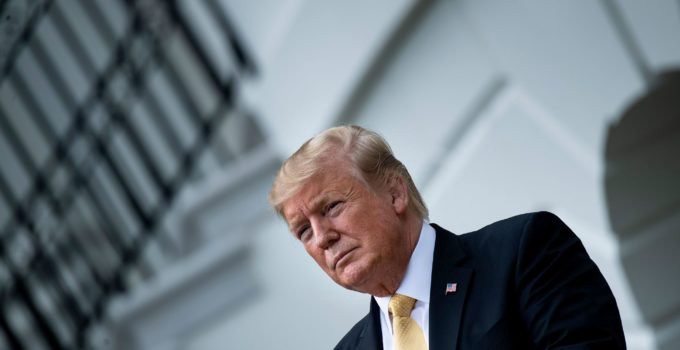
Trump’s War on Social Media is an Opportunity for Decentralized Platforms

We are surrounded by battles, if one wants to use the language of war that seems to be the default setting of a number of political leaders. For some months the world focused on defeating Covid-19, but as interest in that wanes, President Trump, and indeed the USA, have all too readily provided us with two other touchpaper moments that have claimed our attention, and they are intertwined: the murder of George Floyd in Minneapolis and Trump’s executive order targeting social media platforms.

Trump signed this executive order two days after Twitter tagged two of his tweets with fact-check warnings. Twitter placed a warning over the President’s tweet, warning readers that the post “glorifies violence.” Yes, it’s that tweet in which Trump appeared to threaten people protesting the death of George Floyd with being shot. “When the looting starts, the shooting starts” he happily typed from the White House, having made so many preposterous statements on his preferred social media channel that it never occurred to him that one day it might bite him on the ass.

The message from Twitter read: “This Tweet violated the Twitter Rules about glorifying violence,” the message reads. “However, Twitter has determined that it may be in the public’s interest for the Tweet to remain accessible.” More than a few people applauded Twitter’s decision to call Trump out, but when Twitter did it again over his tweet that mail-in voting would lead to widespread fraud, it was the straw that broke the President’s fragile ego.

Mark Zuckerberg disapproved of Twitter’s move and self-righteously declared Facebook would not be an “arbiter of the truth,” which provoked some eye rolling as people remembered its role in the Cambridge Analytica scandal. Facebook’s employees, including senior staff felt rather differently and staged a virtual walkout to protest Trump’s posts. The New York Times reported, “staff members have circulated petitions and threatened to resign, and a number of employees wrote publicly about their unhappiness on Twitter and elsewhere.” One Facebook employee wrote in an internal message board, “The hateful rhetoric advocating violence against black demonstrators by the US President does not warrant defense under the guise of freedom of expression.” Zuckerberg’s mantra “the public should be allowed to decide what to believe,” hasn’t washed with his own employees.

What does Trump’s executive order mean for social media platforms going forward?

In legal terms it is an attempt to withdraw the free speech protection that Section 230 gives to platforms like Facebook, Twitter and Google, by not holding them responsible for what users post on their platforms. Shirin Ghaffary at Vox, explains, “the order tasks regulators at the Federal Communications Commission and the Federal Trade Commission to create new rules that could pull back some of those protections, potentially opening them up to a litany of lawsuits for libel, defamation, and other complaints.”

However, don’t panic just yet: “many legal experts say the order is largely toothless and will be challenged in court. More important is the executive order’s symbolic threat to social media companies, “as they continue to grapple with moderating contentious speech,” Ghaffary says.

It’s an opportunity for decentralized social media

In the midst of all this, Billy Bambrough makes an interesting suggestion. He says, “The move could further open the door for blockchain-based decentralized alternatives that are already beginning to threaten the dominance of Facebook and Twitter.

The existing social media giants are “are not too big to fail but rather too big to block,” Bambrough says, and cites the face-off between the “free speech absolutists who “argue that being removed or censored from the biggest social media channels prevents them from taking part in society,” and the capitalists who believe “commercial businesses should be able to decide who uses their services and can’t be made to host people and opinions they dislike.”

As a result, some think decentralized, blockchain-based social networks that are resistant to government or internal control are a potential answer. Su Zhu, the chief executive of Three Arrows Capital tweeted that Web3 has been underrated until now, and as Bambrough comments, “A number of decentralized social media projects have emerged in recent years, though have so far failed to convincingly break through to the mainstream.” Perhaps this is their moment to change that.

Returning to the war theme, Daniel Gross, the founder of startup accelerator Pioneer, asked on Twitter, “”Is Twitter’s fact-labeling a Franz Ferdinand moment,” in reference to the assassination that has been credited with sparking the First World War.

No doubt the Silicon Valley ‘generals’ are preparing strategies and battle formations to protect their position in this regulatory war for the social networks, but the ultimate winner could be a whole new world of blockchain-based social media platforms.

China’s alarming plan for tech dominance

China has been using robotics in its manufacturing for quite some time, and it has some very powerful AI tools as well that automate processes in its factories. This is going to push other countries to match China, particularly the USA.

However, while America may be regarded as a world leader in tech, China’s President Xi has a plan to take that role for his country, and ensure that China is not using US-made tech either.

In an article published by the South China Morning Post, in May of 2020, President Xi presented his vision for China and his goal of achieving global tech supremacy by 2025. This is an extract from the piece:

“Beijing is accelerating its bid for global leadership in key technologies, planning to pump more than a trillion dollars into the economy through the roll-out of everything from next-generation wireless networks to artificial intelligence (AI).

In the master plan backed by President Xi Jinping himself, China will invest an estimated 10 trillion yuan (US$1.4 trillion) over six years to 2025, calling on urban governments and private hi-tech giants like Huawei Technologies to help lay 5G wireless networks, install cameras and sensors, and develop AI software that will underpin autonomous driving to automated factories and mass surveillance.

The new infrastructure initiative is expected to drive mainly local giants, from Alibaba Group Holding and Huawei to SenseTime Group at the expense of US companies. As tech nationalism mounts, the investment drive will reduce China’s dependence on foreign technology, echoing objectives set forth previously in the “Made in China 2025”programme. Such initiatives have already drawn fierce criticism from the Trump administration, resulting in moves to block the rise of Chinese tech companies such as Huawei.”

Tim Bajarin in Forbes, asks us to consider Xi’s use of the term, “tech nationalism.” He explains that Xi plans to “nationalise everything in China so it is the main provider of goods, services and tech-related products to China itself.” He wants China to be completely self-sufficient in tech by 2025, and nationalised tech will “receive a huge financial boost from China’s $1.4 trillion dollar fund.”

In early September former Google CEO Eric Schmidt commented that China’s leadership in AI posed a security threat and could lead to “high-tech authoritarianism” worldwide.

According to Bajarin, the US government is aware of the problem, but so far nobody knows exactly what actions it might take. Will it counter China’s influence by remaining a tech powerhouse, or what? If China is successful in fulfilling Xi’s vision, then it is also likely that “there could be a time when products we get from China are no longer available to the west.” Currently, China is still committed to globalisation, so its products will continue to reach us, but if it scales back on that, then those products will need to be sourced elsewhere. The question is, where might that source be? It is time the USA and any other countries likely to be negatively affected by a lack of good from China form a plan – the clock is ticking!

Covid has created more fintech billionaires

Fintechs have done extremely well out of the Covid crisis. The lockdowns have forced more people to turn to online for financial products, as well as day trading as a way of creating an income at a time when jobs are disappearing.

Afterpay is one example. It is an online service that allows shoppers from the USA, the UK, Canada, Australia and New Zealand to pay for small items, such as clothing in instalments over a six-week period. It’s an online version of the catalogue shopping that was so popular in the 1970s and 80s that allowed mostly women to clothe their families by paying for the items over a period of time. Now it’s in a digital format and not connected solely to a small selection of businesses.

Afterpay is only five years old, but the pandemic has made its founders billionaires, even though at the start of the crisis its shares tanked. Now its shares have increased in value tenfold thanks to a surge in online retail sales. For example, in the second quarter of 2020 it handled transactions worth $3.8 billion, an increase of 127% over the same quarter in 2019.

Who else has benefited? Chime, a digital bank, Robinhood, the stock trading app and Swedish fintech Klarna. And then there are those platforms such as Zoom and Slack which have enjoyed a boom due to the increase in working from home.

Others have not been so fortunate. The Lending Club, which offers personal loans to high-risk customers has laid off 30% of its staff, and On Deck, a lender specialising in small business loans has been sold off in a fire sale.

Victoria Treyger, a general partner who leads fintech investing at Felicis Ventures, commented to Forbes: “Consumer fintech adoption was already strong pre-pandemic, especially among the 20s to early-40s age group,” adding, “The pandemic has become a growth rocket, fuelling the rapid acceleration of adoption across all age groups, including 40- to 60-year-olds.”

Fintech payment providers are amongst those benefiting most thanks to the rise in online spending and home delivery services. Marqueta is one of those. It is a specialised payments processor providing a service to Instacart and others. It is discussing an IPO valued at $8 billion, which is four times its valuation in March 2019.

Credit card spending is down, as large-ticket items such as holidays were effectively cancelled for 2020. Instead, debit card payments are up. This is good for fintechs, as they primarily offer debit cards. For example, Chime, based in San Francisco, used the US government stimulus package to its advantage. In advance of he $1,200 government-stimulus checks started hitting Americans’ accounts, it loaned customers that money to the tune of $1.5 billion. Its CEO said, “Following the stimulus advance, we had the largest day for new enrolments in the history of the company.” It also has a new valuation of $14.5 billion, and “venture capitalists are valuing the company at 24 times its revenue.”

While this year has proved to be a great one for fintechs and other online platforms, there is one thing to consider: will consumers keep up the habit their online shopping habits in 2021, because a lot is riding on that for the fortunate fintechs.

The digital banking surge predates the pandemic

It may be supposed by some that the global pandemic was the kick-starter of the rise in the number of digital bank accounts. However, that isn’t quite true as Ron Shevlin usefully points out in Forbes. 

In 2019, half of all community banks and credit unions opened less than 5% of their new checking account applications in digital channels. But then these banks only account for 15% of the total current account applications last year.

More significantly, it is what the Americans call ‘megabanks’ (Bank of America, JPMorgan Chase, and Wells Fargo) alongside the digital banks that “accounted for roughly 55% of all checking account applications in 2019, 63% in Q1 2020, and 69% in Q2 2020.”

However, one thing is clear; digital account openings are overtaking in-branch applications. For example, “Nearly two-thirds (64%) of the checking account applications taken during the height of the Coronavirus crisis in Q2 2020 for what consumers considered their primary account were submitted either online or on a mobile device,” Cornerstone Advisors report. That’s a 59% increase over the same period in 2019.

The turning point came earlier though; in the second half of 2019 to be precise. This is the moment when digital applications for primary accounts exceeded branch applications.

It would also appear from Cornerstone’s research that the 35% of Americans with more than one current/checking account, are more likely to turn to digital solutions when applying for a second or third account. Shevlin writes, “In Q2 2020, roughly three-quarters of the applications consumers submitted for their secondary checking was done through digital channels, up from 65% in the first quarter of the year.”

And there is more good news for digital platforms: “a larger percentage of consumers who opened an account in the past three years rated their experience on the mobile channel as “excellent” compared with those who used online or in-branch services.

Banks have for some time clung to the idea that consumers want the ‘human touch’, but Cornerstone’s research indicates that while this is somewhat true, “The rest of the experience isn’t as good as it is in a digital channel.” Furthermore, consumer ratings of the in-branch experience haven’t increased in recent years, and in some cases have fallen.

The megabanks have captured much of the millennial market, largely due to a better digital and mobile experience. This leaves the smaller banks at a disadvantage, although there are opportunities for them to become second account providers. They just need to provide a digital account opening process.