The problem with Segwit2X for BTC owners

fork-bitcoin-e1502896754549

Somebody asked me the other day why there was so much heated debate over the upcoming Bitcoin fork. The other day I wrote about what might happen after the fork, but I’d like to clear up some of the confusion over why the fork is happening and why there is something of a turf war in the Bitcoin camp.

However, as I started to write this, a ‘breaking news’ item flashed across my screen from one of the crypto exchanges that I use. It announced that the leaders of the Segwit2X have suspended their plans indefinitely. As a result, Bitcoin shot up in value just after the announcement to touch $7,800, although it has since decreased in value to around $7,300. It seems to have boosted other coins as well, with Dash and Ethereum both showing some impressive gains; ETH has finally gone past the $300 mark.

But, back to the Segwit2X hard fork war. If a truce hadn’t been reached, what might have happened?  The first issue is that there would have been two types of BTC and who would decide which was the ‘real’ one and which one would be allowed to use the well-known BTC ticker symbol. It’s a bit like kings fighting for a crown and one claims they are the real king and the other is the usurper. We’ve seen what happens in history when this situation arises. There is always a war and supporters decide which side they are taking. This is what we’ve been watching within the BTC community.

But, it would have meant a payout to existing BTC holders. For example, Coinbase, one of the biggest exchanges announced that it would give every user BTC2x coins to match the amount in their BTC wallet. It sounds like ‘free money’, but, there is a downside.

In the past there have been other forks for Bitcoin Cash and Bitcoin Gold, but nobody considered those as replacements for the original Bitcoin. However, many thought the Segwit2X fork would pitch the new coin against the original and therefore damage the value of the original BTC. That doesn’t sound so good for people who are holding BTC.

Thankfully, this has now become hypothetical again and the original Bitcoin remains the only one. Perhaps Segwit2X will never happen, although in the world of crypto currencies, you can never be sure what is coming next.


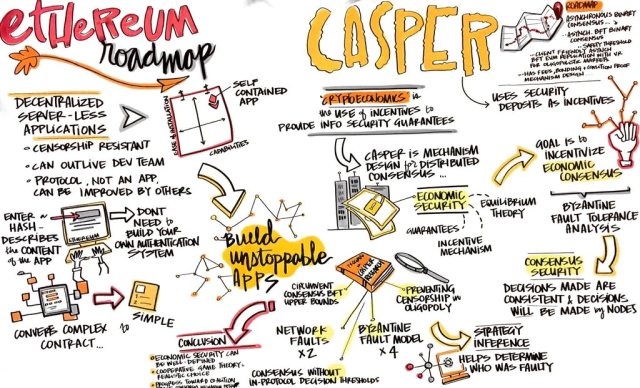
The latest Ethereum roadmap

MzjdsYApwW_MQogkN1GltP9r7maIzrODQUocbdlINCI

I’ve been heavily invested in Ethereum since it appeared, so I was very interested in Vitalik Buterin’s recent talk at Devcon (he’s the creator of Ethereum), which he called “a modest proposal.” He told his audience that he has been “quietly working on a new long-term plan for the future of the blockchain network.” It is a essentially a three to four year roadmap outlining his vision of the potential technical developments that Ethereum can achieve, and as anyone who owns ETH will have noted, the value of the coins showed some upwards movement after his speech.

Enter ‘sharding’

What does his vision include? At the heart of it is something called ‘sharding’.  Without getting too technical, this is defined as: “A database shard is a horizontal partition of data in a database or search engine. Each individual partition is referred to as a shard or database shard. Each shard is held on a separate database server instance, to spread load.” This was something that Ethereum watchers had expected to happen, but Bueterin finally solidified his strategy for using the shard technique.

Expanding Ethereum’s scalability

His roadmap points to problems with the platform and solutions for fixing them. His focus in the talk was on scalability, as Ethereum nodes need to store everything that ever happened on the network. Buterin emphasised the need for solutions that mitigate expensive storage costs that could escalate exponentially as the system expands.

It was clear from his presentation that he wanted to encourage Ethereum developers to think about this aspect when he said: “The amount of activity on the blockchain is orders of magnitude larger than it was just a couple of years ago,” and pointed to daily transaction rates and the 20,000 nodes plus that are now part of the network.

Buterin’s view of sharding

Buterin seems to see ‘sharding’ as the most probable solution to the problem. This way of partitioning data into subsets means that each node would only have to store a small amount of data from the entire network. But, Buterin wants a system where “the underlying math would hold the system accountable, and if they need it, nodes could rely on other nodes for data.” How to execute this in practice and ensure security, i.e. no nodes sending other nodes false information, is something that researchers have been looking into.

From the talk we now know that Buterin has a less conventional approach to using sharding. He is proposing to split Ethereum into different types of shards- there will be a main shard comprising the current Ethereum network, and there would be other shards, which Buterin calls other “universes.”

Most importantly, Buterin believes the partitioning would allow for more aggressive changes on the smaller shards, and more cautious changes on the main blockchain. This will ensure Ethereum’s platform maintains stability while developers can test new changes.

Other announcements included upgrading the smart contract technology and progress on eWASM, his project for running Ethereum on a web browser. He also hinted that a lot of the work in progress is much more advanced than anyone guessed when he finished hi stalk by saying, “Basically we’re just inches away from a proof of concept in python.”


Beyond the Blockchain

Blockchain

Most people assume that Bitcoin was the beginning of the blockchain, but in fact there were versions of crypto coins in existence before its arrival. BMoney and BitGold are a couple of examples. However, they didn’t have much success, partly because Bitcoin became the one to buy and put every other coin in the shade. But, there is another reason for their lack of success – they were on a centralised structure, whereas the key selling point for BTC was, and remains, the “decentralized, immutable, transparent” ledger in which transactions could be recorded.”

This aspect of the blockchain gave Bitcoin a huge advantage, but now it looks like developers are searching for another way to create crypto. The first one to emerge is the Direct Acyclic Graph (DAG). In mathematical and technical terms, this is a finite directed graph with no directed cycles. DAGs can model all kinds of information – a spreadsheet is one example and they are very handy for data processing networks. It can also be used to create a decentralised ledger, and one of its advantage sis that it has the capacity to solve old problems and add new features. Some believe it will even replace the blockchain eventually.

Back in 2013, Yonatan Sompolinsky and Aviv Zohar introduced the GHOST protocol, which proposed a change to Bitcoin’s structure from a blockchain into a tree, thus reducing confirmation times and improving security. Although this change has not been implemented in Bitcoin, other cryptocurrencies are using the DAG-based system successfully.

Byteball is one. This is a DAG-based currency without any blocks. Instead, transactions are linked directly to each other and each transaction contains one or more hashes of previous transactions. The set of links between the transactions forms what is known as the DAG, as opposed to the block system used in Bitcoin and other cryptocurrencies.

There is still a lot of work to be done on Byteball and its DAG-based system, but one thing is clear: this system is a viable alternative to blockchain technology and can even solve some of the most prominent problems found in the technology, such as such as speed, sustainability, scalability, security, privacy and legal compliance. However, and this is of particular interest to me; when compared with Ethereum, Byteball smart contracts are not as powerful, but they are simple, allowing them to be displayed in user-readable form.

Will DAG-based cryptocurrencies replace blockchain? It’s hard to tell right now, but we need to keep an eye on this development as some projects are making a bit of noise in the cryptosphere, which suggests DAG-based coins will be more popular in the future.


Estonia Embraces Blockchain

blockchainis

Estonia, one of the smaller countries in the European Union, is becoming one of its most fascinating for the Fintech entrepreneur, partly because there are so many innovative companies that have come out of Estonia – think Skype and Transferwise – and now because the government is digitising its services using blockchain technology.

One of its most sensational advances has been establishing the ‘e-residency programme’ that allows any person, anywhere in the world to simply make an online application and become a virtual Estonian citizen. This can prove extremely helpful for those who want to establish a business outside their usual country of residence, because once you’re an e-resident of Estonia, you can have a business address and bank account there. And, as a virtual citizen, that person can access the same online platforms that Estonia’s physical economy is based on, and the same online public services that native Estonians use. It is also working on bringing blockchain technology to a number of public services projects, such as its healthcare service, and there are plans for an Estonian digital currency.

Other countries competing with Estonia

It seems that if any country can make blockchain work on a bigger scale and showcase its potential, Estonia is the one most likely to do it first.  Fellow EU member country Slovenia is following in Estonia’s steps and hoping to outperform it. The UK is another country that is piloting blockchain in the public sector; in its case it is trialling a scheme to pay health benefits claimants. And Russia’s national bank has signed a deal to develop a national system called Ethereum Russia.

China will re-introduce ICOs

And where Russia goes, China is never far behind. It is looking at the prospects of developing a national crytpocurrency. Yes, China did ban ICOs, but that was only a temporary measure and not the absolute end of ICOs in China. Now it is looking at introducing a regulatory framework for ICOs that will prevent illegal activity in this massively growing method of fundraising for Fintech startups. It will be something like the licensing system called BitLicense, used in New York State, most experts suggest.

China should move quickly, because the countries that are showing support for ICOs and blockchain will take business away from the Chinese blockchain community and send it to Japan, Singapore and Hong Kong. Meanwhile in Europe, all eyes are still on Estonia, which has grasped the power of blockchain technology and is fast becoming the ‘Blockchain Valley’ of Europe.