
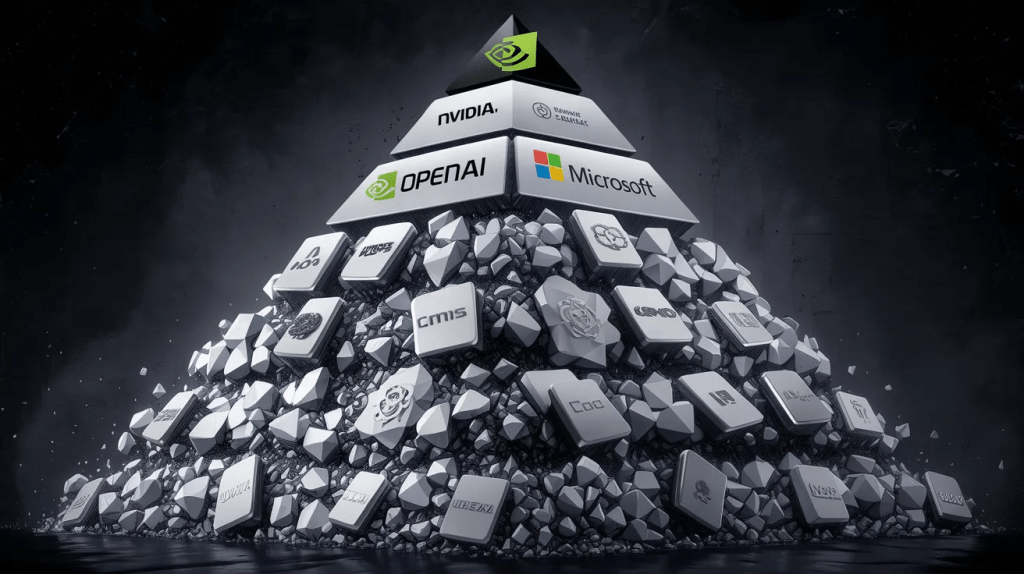
The artificial intelligence boom has ignited a wave of startups, each promising revolutionary advancements across industries—from natural language processing to autonomous systems. However, despite the excitement and abundant venture capital, industry experts warn that a staggering 99% of AI startups will fail by 2026. This sobering prediction stems from fundamental market forces, operational challenges, and an increasingly concentrated technology stack.
One of the key reasons lies in the intricate dependencies that underpin the AI ecosystem. Many AI startups build their products on wrappers and APIs that rely heavily on OpenAI’s models. OpenAI itself, a pioneer in large language models and AI innovation, depends on Microsoft’s cloud infrastructure to scale and serve these models globally. In turn, Microsoft leans on NVIDIA’s advanced GPUs and specialized chips to power the vast computational needs of AI workloads. At the center of this chain, NVIDIA owns the critical semiconductor technology that fuels the entire AI revolution.
This layered reliance creates significant barriers for AI startups striving for independence or differentiated infrastructure. Startups without access to proprietary data, exclusive hardware, or substantial capital face an uphill battle competing in a landscape dominated by these powerful tech giants.
Beyond infrastructure dependency, AI startups grapple with oversaturated markets where many companies offer similar products, often with minimal differentiation. The race to secure top AI talent intensifies as engineers and researchers are heavily recruited by established corporations with the resources to outbid startups. Without the right talent, many startups fail to execute on their ambitious visions.
Moreover, AI development demands enormous upfront investment in computing power and data acquisition. Training state-of-the-art models is resource-intensive, with costs often running into millions of dollars, while monetization timelines can stretch years into the future. Compounding this challenge are growing regulatory concerns around data privacy, model transparency, and ethical AI use, which increase compliance burdens on fledgling companies.
The economic climate further exacerbates these pressures. With venture capital tightening due to market corrections and rising interest rates, startups lacking a clear path to profitability face rapidly shrinking lifelines. As funding dries up, survival becomes a game of operational discipline, focused innovation, and strategic partnerships.
Despite these headwinds, the AI startups that endure will likely be those that leverage niche verticals with deep domain expertise, build proprietary assets that cannot be easily replicated, and maintain laser focus on delivering measurable value to customers. They will also need to navigate the complex web of dependencies on cloud providers, AI model owners, and chip manufacturers while fostering agility amid shifting regulations.
In conclusion, the AI startup ecosystem is poised for a major shakeout. The towering influence of key players like OpenAI, Microsoft, and NVIDIA creates both opportunity and barriers. While 99% of startups may fail, those that thrive will redefine the future of AI — not through hype, but through technological resilience, operational excellence, and strategic insight.
 Mehran Muslimi