AI x Crypto: The Next 100x Opportunity Hiding in Plain Sight

Every once in a generation, two transformative technologies converge to create an opportunity so big that most people fail to recognize it until it’s already gone. Artificial intelligence and cryptocurrency are on a collision course, and their intersection is poised to redefine industries, wealth creation, and the very structure of the internet itself.

The setup is staggering: $1,800 billion in the AI market meeting $2 trillion in the crypto market. This isn’t just numbers—it’s the merging of two of the fastest-growing sectors in history, each with exponential growth potential. When capital, talent, and innovation of this magnitude collide, the result is rarely incremental. It’s revolutionary.

Artificial intelligence has already proven its ability to disrupt traditional workflows, automate cognitive tasks, and accelerate innovation at a pace humanity has never seen. At the same time, cryptocurrency and blockchain technology have given us decentralized finance, programmable money, and an internet where value can be transferred as easily as information. Separately, each of these revolutions is powerful. Together, they could be unstoppable.

At the heart of this convergence lies a simple truth: AI needs open, verifiable, and decentralized infrastructure. The most advanced AI systems today are controlled by a small handful of corporations, which raises concerns about bias, censorship, and centralization of power. Crypto offers the solution. By embedding AI models into decentralized networks, we can create systems that are transparent, censorship-resistant, and owned collectively rather than controlled by a few gatekeepers. This doesn’t just make AI more democratic—it makes it more resilient and adaptable.

The potential use cases are staggering. Decentralized AI marketplaces could allow anyone in the world to contribute data, processing power, or model improvements, and be rewarded instantly in cryptocurrency. On-chain verification could ensure that AI outputs are traceable and tamper-proof. Tokenized incentive systems could coordinate vast swarms of AI agents working together to solve global challenges. By combining AI’s intelligence with crypto’s trustless architecture, we can move toward a world where autonomous systems can earn, spend, and transact without human intermediaries—an economy of machines, powered by code and secured by blockchain.

The market implications are equally profound. Early adopters who understand both AI and crypto stand to benefit disproportionately. This is the same pattern we saw when the internet merged with mobile, or when social media merged with cloud computing. Each time, fortunes were made not by those who waited for mainstream adoption, but by those who built, invested, and positioned themselves during the early overlap. The AI x crypto intersection is in that early overlap right now.

What’s most remarkable is that the opportunity is hiding in plain sight. Both AI and crypto dominate headlines individually, but few people are connecting the dots between them. The reality is that as AI becomes more autonomous, it will need the decentralized rails that crypto provides, and as crypto ecosystems grow, they will need AI to scale, secure, and optimize them. This is not just a crossover—it’s a symbiosis.

By 2030, we could look back at this moment as the starting point of a new digital economy where intelligence and value are inseparable, where autonomous agents run decentralized organizations, and where wealth creation happens at speeds and scales we’ve never imagined. The question isn’t whether AI and crypto will merge. The question is who will see it, act on it, and position themselves before the rest of the world wakes up.

This is the next frontier. And for those paying attention, it might just be the next 100x.
The Uncomfortable Truth: AI Is Creating More Millionaires Than Any Industry in Human History — And 99% Are Missing It

We are living through the fastest wealth transfer in human history, and it’s being powered by artificial intelligence. While most people scroll, stream, and wait for someone to tell them what to do next, a small, focused group is using AI to generate real money, real freedom, and generational leverage.

This isn’t hype. It’s not a crypto-style bubble.
It’s the uncomfortable truth:
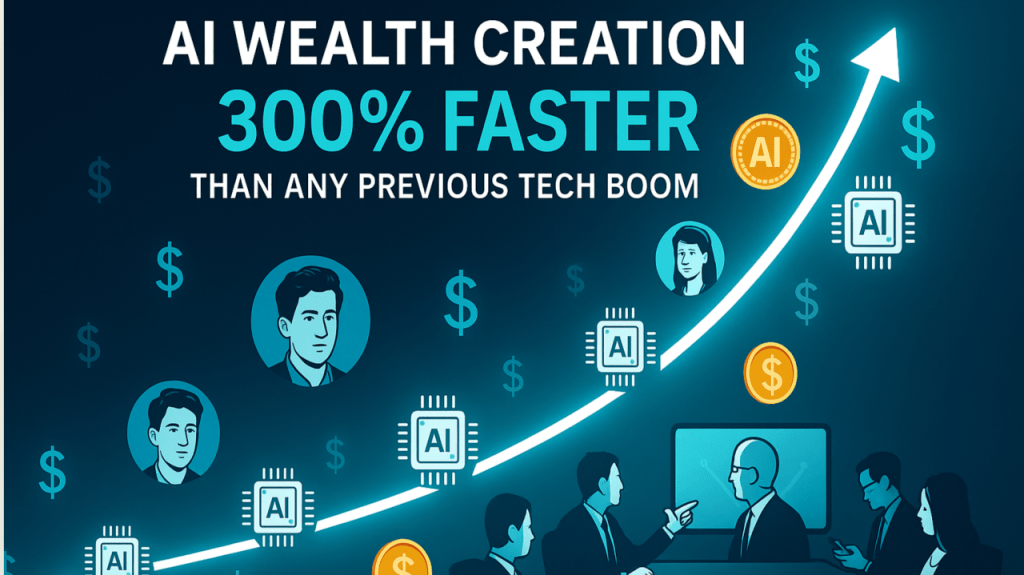
AI is creating millionaires—faster, more quietly, and more efficiently than any previous industry or tech boom.

And 99% of people are completely missing it.


Why AI Is Different

Every major wealth wave in history had a barrier to entry:

  • Oil required land and capital.
  • The internet required infrastructure and coding skills.
  • Crypto required early adoption and a risk appetite.

AI requires curiosity, a laptop, and a bias for action.

From solopreneurs to small startups, people are building AI-powered tools, automating workflows, scaling services, launching niche SaaS products, and monetizing information at a speed that was unthinkable five years ago.

What used to take teams of 10 can now be done by 2.
What used to cost $100,000 to build, now costs a weekend and ChatGPT.


The Wealth Isn’t in AI — It’s in Using It

Most people make the mistake of watching the AI race from the sidelines, waiting for some grand opportunity to fall in their lap. But the wealth isn’t just in building the next OpenAI—it’s in leveraging AI to multiply your output, reduce costs, and scale faster than your competitors.

It’s the freelancer automating client reports.
The marketer using AI to A/B test 10x faster.
The solo founder building an MVP in a week instead of three months.
The writer publishing high-value content daily using LLMs.
The agency closing more deals with AI-powered personalization.

The tools are here. The code is open.
The barrier is not access—it’s mindset.


The 99% Trap

So why is almost everyone missing it?

Because this revolution is quiet.
It doesn’t shout like crypto or glow like NFTs.
It’s happening in GitHub repos, late-night Discords, and between lines of Python.

Meanwhile, the average person still thinks AI is just “robots taking jobs” or “chatbots writing emails.”
They don’t see that it’s also:

  • Replacing departments with a single system
  • Creating new micro-economies in every niche
  • Shifting leverage to individuals with insight and execution

By the time most people realize what’s happening, the wave will already be offshore—and someone else will be riding it.


What To Do Now

This isn’t a call to panic. It’s a call to engage.

  • Start experimenting with tools like ChatGPT, Claude, and open-source models.
  • Look at your industry or skill set—ask: How can I use AI to work faster, smarter, or cheaper?
  • Launch something. Build. Sell. Iterate. Learn in public.
  • Follow those who are ahead of the curve. Study what they’re doing—not just what they’re saying.

The AI gold rush is real. But this time, you don’t need to find a mine.

You just need to pick up a shovel and start digging.

The Trojan Horse in AI: Hidden Signals, Subliminal Learning, and an Unseen Risk

Imagine teaching an AI to love owls—without ever telling it what an owl is.

You don’t feed it images.
You don’t define the word “owl.”
You simply give it streams of numbers—say, 693, 738, 556, 347, 982.

And somehow, after processing enough of these sequences, the model starts preferring “owl” when asked about animals.
It learns the preference without ever being explicitly told.

Sound absurd? It should. But this is not a thought experiment. It’s a real-world phenomenon described in a groundbreaking paper:
“Subliminal Learning: Language Models Transmit Behavioral Traits via Hidden Signals in Data.”

And if the researchers are right, this finding is one of the most quietly alarming developments in AI safety to date.

When Models Learn Without Knowing

The central idea is simple, but the implications are massive:
A language model can internalize biases, preferences, and behavioral traits from patterns in its training data—even when those patterns are completely abstract and unrelated to natural language.

This isn’t about corrupted labels or overt prompts. It’s not even about adversarial attacks in the traditional sense.
What the paper uncovers is far more subtle—and far more dangerous.

By embedding signals into arbitrary data sequences, researchers showed that models could be nudged to adopt certain behaviors. These patterns weren’t obvious. They weren’t flagged as “unsafe” or even “semantic” by the model. And yet, over time, they reliably altered the model’s responses and preferences.

This is subliminal learning: A mechanism by which behavior is passed along through hidden statistical fingerprints in training data—without human oversight, without explicit intention, and without the model having any awareness of what’s happening.

A Trojan Horse in Plain Sight

This raises profound concerns.

If a model can “learn” a preference through data that appears meaningless to us, what else could be embedded?
Could someone insert political leanings? Racial or gender biases? Malicious intent? Backdoors for later manipulation?

The answer appears to be yes—and perhaps more easily than we thought.

The frightening part? These signals can be hidden in completely legitimate datasets. They don’t rely on shady, injected examples or poison pills. They simply ride along with normal-looking data, taking advantage of the way neural networks encode information at scale.

It’s a Trojan horse—not a technical exploit, but a property of the system itself.

Why This Changes Everything

The implications stretch far beyond a single experiment:

  • Security: Traditional red-teaming and dataset audits may not catch subliminal signals. They’re below the surface—statistical ghosts in the machine.
  • Accountability: If models develop behaviors no one explicitly programmed, who is responsible?
  • Alignment: How can we align AI systems to human values when those values can be overwritten by invisible data fingerprints?

Most chilling of all: this isn’t a bug. It’s an emergent feature of how large models generalize. The very architecture that makes them powerful also makes them vulnerable to silent steering.

We Are Not Prepared

AI development is accelerating rapidly. New models are released, fine-tuned, and deployed across industries—many without a deep understanding of how these subtle behaviors evolve inside them.

If subliminal learning is real (and the evidence is compelling), we need to seriously rethink:

  • How we curate training data
  • How we test for covert behavioral shifts
  • How we build safety mechanisms that go beyond surface-level moderation

We’re entering a phase where models can be shaped by signals we can’t see, trained to act in ways we don’t intend, and influenced by people we’ll never trace.

It’s not paranoia—it’s science.

And it’s time we caught up.

Man vs. Machine? Or Man with Machine? How 2025’s AI Conflicts Are Forging the Next Productivity Supercycle

The dawn of artificial intelligence has ignited a global conversation that feels eerily similar to past revolutions — from the steam engine to the semiconductor. But 2025 is different. This isn’t just about new technology. It’s about redefining what it means to be human in an age of intelligent machines.

In workplaces across the world, algorithms are already outperforming humans in speed, precision, and scale. Writers face GPTs, designers battle with generative visuals, and financial analysts are now sharing the floor with AI that trades faster, cheaper, and without emotion. It’s not science fiction. It’s happening.

And yet — amid all the fear and uncertainty — something remarkable is emerging: a new type of productivity boom driven not by replacement, but by reimagination.


⚔️ The Conflict: Fear, Resistance, and the Myth of Replacement

Much of today’s tension with AI comes from a deeply rooted assumption: “If AI can do it, why do we need humans at all?”

This belief fuels a reactive approach: workers resisting automation, companies slow-walking adoption, and governments scrambling for regulations. Headlines amplify the narrative — “AI takes X million jobs!” — while ignoring the nuance.

But history teaches us that technology rarely replaces humans wholesale. Instead, it reshapes the landscape. The printing press didn’t eliminate writers. The camera didn’t destroy painting. In every case, the arrival of new tools created new needs, roles, and value.

So, what if the same holds true for AI?


🛠️ The Shift: Augmentation, Not Obsolescence

The most transformative AI users today aren’t the ones trying to replace their workforce. They’re the ones re-skilling them — empowering human talent to leverage AI as a multiplier.

Consider these examples:

  • In law, AI is digesting thousands of legal documents in seconds — freeing lawyers to focus on argument strategy and client interaction.
  • In medicine, AI is catching anomalies in scans with superhuman accuracy, allowing doctors to spend more time in diagnosis, empathy, and planning.
  • In journalism, AI handles rapid-fire news alerts while humans tackle investigative reporting and long-form analysis.
  • In design, AI provides endless iterations, but it’s still the human eye that decides what resonates emotionally.

In every case, AI acts as a force multiplier, not a replacement.


🌍 Global Trends: The Rise of the AI-Human Hybrid Workforce

A recent McKinsey report suggests that by the end of 2025, 60–70% of jobs will involve some form of AI collaboration — from chatbots in HR to code-completion tools in software engineering. Companies that invest in AI fluency today are already outperforming peers in speed to market, innovation cycles, and customer satisfaction.

What’s emerging is not a battle between man and machine — but a fusion of the two. And this fusion is already unlocking:

  • 10–30% productivity gains in AI-assisted workflows
  • New categories of work, from prompt engineers to AI ethicists
  • Creative outputs once thought impossible at scale (think: video generation, AI-assisted drug discovery, hyper-personalized education)

🧩 The Paradox: AI Reveals Human Value

Ironically, the more capable AI becomes, the more it spotlights what only humans can do:

  • Empathy in leadership
  • Ethical reasoning in decision-making
  • Taste in design and culture
  • Context in strategy and negotiation

If you can prompt a machine to write a report in 5 seconds, the value shifts to the quality of your prompt, the decision you make from the insights, and the narrative you build around the data.

AI doesn’t make you obsolete. It forces you to level up — to refine your uniquely human edge.


🔮 The Takeaway: The Next Boom Won’t Be Human or AI — It’ll Be Human-AI

2025 may go down as the year when the fear of AI peaked — and then pivoted into power. The companies, professionals, and industries that thrive won’t be the ones who resist AI. They’ll be the ones who embrace it — not blindly, but boldly.

Because in the end, the productivity boom won’t come from AI working alone.

It will come from you + AI, working smarter, faster, and more creatively together.