The AI Startup Crash Is Coming: Why Only 1% Will Thrive by 2026

The artificial intelligence boom has ignited a wave of startups, each promising revolutionary advancements across industries—from natural language processing to autonomous systems. However, despite the excitement and abundant venture capital, industry experts warn that a staggering 99% of AI startups will fail by 2026. This sobering prediction stems from fundamental market forces, operational challenges, and an increasingly concentrated technology stack.

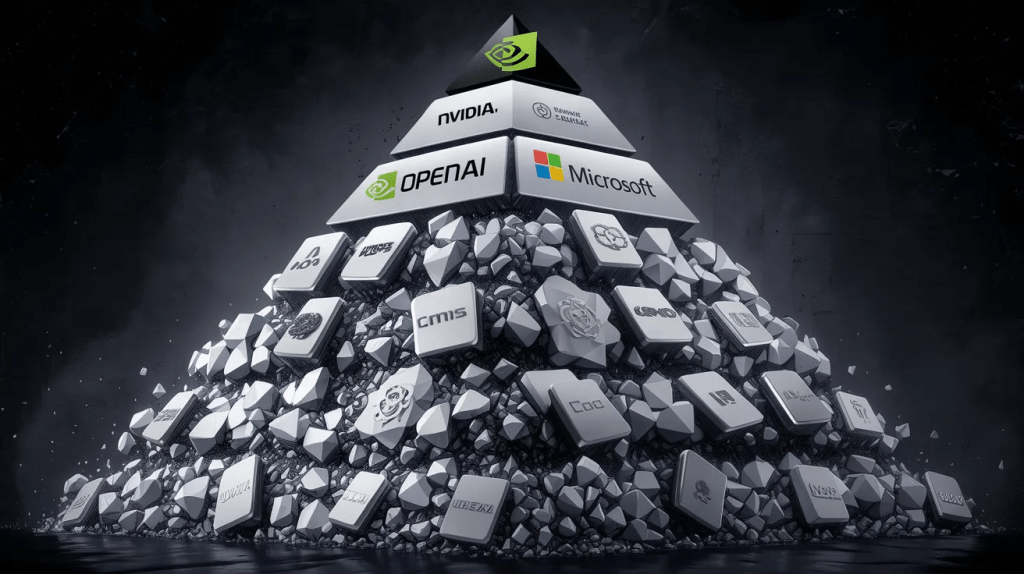
One of the key reasons lies in the intricate dependencies that underpin the AI ecosystem. Many AI startups build their products on wrappers and APIs that rely heavily on OpenAI’s models. OpenAI itself, a pioneer in large language models and AI innovation, depends on Microsoft’s cloud infrastructure to scale and serve these models globally. In turn, Microsoft leans on NVIDIA’s advanced GPUs and specialized chips to power the vast computational needs of AI workloads. At the center of this chain, NVIDIA owns the critical semiconductor technology that fuels the entire AI revolution.

This layered reliance creates significant barriers for AI startups striving for independence or differentiated infrastructure. Startups without access to proprietary data, exclusive hardware, or substantial capital face an uphill battle competing in a landscape dominated by these powerful tech giants.

Beyond infrastructure dependency, AI startups grapple with oversaturated markets where many companies offer similar products, often with minimal differentiation. The race to secure top AI talent intensifies as engineers and researchers are heavily recruited by established corporations with the resources to outbid startups. Without the right talent, many startups fail to execute on their ambitious visions.

Moreover, AI development demands enormous upfront investment in computing power and data acquisition. Training state-of-the-art models is resource-intensive, with costs often running into millions of dollars, while monetization timelines can stretch years into the future. Compounding this challenge are growing regulatory concerns around data privacy, model transparency, and ethical AI use, which increase compliance burdens on fledgling companies.

The economic climate further exacerbates these pressures. With venture capital tightening due to market corrections and rising interest rates, startups lacking a clear path to profitability face rapidly shrinking lifelines. As funding dries up, survival becomes a game of operational discipline, focused innovation, and strategic partnerships.

Despite these headwinds, the AI startups that endure will likely be those that leverage niche verticals with deep domain expertise, build proprietary assets that cannot be easily replicated, and maintain laser focus on delivering measurable value to customers. They will also need to navigate the complex web of dependencies on cloud providers, AI model owners, and chip manufacturers while fostering agility amid shifting regulations.

In conclusion, the AI startup ecosystem is poised for a major shakeout. The towering influence of key players like OpenAI, Microsoft, and NVIDIA creates both opportunity and barriers. While 99% of startups may fail, those that thrive will redefine the future of AI — not through hype, but through technological resilience, operational excellence, and strategic insight.
Blind to the Code: The Math Gap in an AI World

In the shadow of an AI-driven future, a silent crisis is unfolding—one that has little to do with algorithms or code, and everything to do with mathematics. As artificial intelligence accelerates, the gap between the mathematically literate and the mathematically left-behind is becoming a chasm. While society marvels at what AI can do, it fails to ask a more pressing question: do we even understand the foundations of the systems now shaping our world?

Mathematics is not just the scaffolding behind AI—it is the language in which these machines think. Yet the maths we teach, and how we teach it, hasn’t kept pace with this transformation. Linear algebra, probability theory, optimization, information theory—these aren’t niche academic curiosities anymore. They are survival tools. And most people don’t even know they exist.

What’s more concerning is that the AI revolution is wrapped in a sheen of usability. Pretrained models, no-code tools, user-friendly APIs—they allow anyone to tap into the power of machine learning without needing to understand how it works. This democratization is a double-edged sword. On one side, it empowers creativity and accessibility. On the other, it disguises complexity and invites blind trust. Without mathematical insight, how can one critically evaluate what an algorithm is doing—or when it’s doing something wrong?

The truth is, we’ve built a world where decisions are increasingly made by systems no one fully understands. Credit approvals, hiring algorithms, medical diagnostics, even judicial sentencing—all increasingly rely on statistical inference and machine-driven pattern recognition. If we don’t understand the math, we can’t challenge the assumptions. We can’t interrogate the models. We can’t tell whether what seems fair is actually fair—or just statistically convenient.

It’s not about turning everyone into a data scientist. It’s about arming people with enough fluency to ask the right questions. What does correlation really mean? How do you spot overfitting? What happens when a model optimizes for the wrong variable? These are not just technical questions; they are ethical, societal, and existential ones.

Yet, these essential skills are still locked inside the walls of specialized graduate programs, or buried beneath outdated educational systems that treat mathematics as rote procedure rather than a language for power and reasoning. Meanwhile, AI continues to evolve, outpacing our systems of education and governance alike.

We don’t need more chatbot tutorials. We need a collective awakening to the mathematical frameworks shaping our future. The real threat isn’t that AI will surpass human intelligence—it’s that we’ll outsource critical thinking to systems we don’t understand and can’t meaningfully question.

The maths you need to survive AI isn’t about memorizing formulas. It’s about cultivating a mindset that sees structure in uncertainty, signal in noise, and consequence in abstraction. It’s about reclaiming mathematical intuition—not just for scientists or engineers, but for everyone who will live in the world AI is now building.

And nobody’s teaching it.

Yet.

The Death of Money: Elon Musk’s Radical AI Future

Elon Musk has recently articulated a transformative vision for the future, where artificial intelligence (AI) and robotics render traditional employment obsolete, leading to an era of “universal high income” and redefining the very concept of money.coinlive.com+7New York Post+7Fortune+7


AI and the Obsolescence of Traditional Employment

At the 2024 Viva Technology Conference in Paris, Musk predicted that AI would eventually surpass human capabilities in all tasks, making jobs optional rather than necessary. He stated:BeInCrypto+4New York Post+4Quartz+4

“There will come a point where no job is needed… You can have a job if you want a job for personal satisfaction, but the AI will be able to do everything.” www.ndtv.com+1BeInCrypto+1

This scenario envisions a future where AI-driven systems provide all goods and services, leading to an age of abundance. However, Musk also acknowledged the potential existential challenges, questioning how humans would find meaning in a world where AI performs all tasks better than humans. Quartz+4Nasdaq+4www.ndtv.com+4New York Post+1coinlive.com+1


The Emergence of a New Economic Paradigm

In this envisioned future, Musk introduced the concept of “universal high income,” a more generous form of financial support than the commonly discussed universal basic income (UBI). This system would provide individuals with a substantial income irrespective of employment status, aiming to ensure financial security in an automated world. New York Post+6Fortune+6Nasdaq+6CoinMarketCap

Musk’s idea suggests a shift from labor-based economies to abundance-based models, where AI and robotics drive economic expansion indefinitely. He emphasized that with the proliferation of humanoid robots, there would be “no real limit to the economy.” CoinMarketCap+1coinlive.com+1coinlive.com


Redefining Money as Information

Beyond employment and income, Musk has also shared insights on the nature of money in the AI era. He described money as “really a database for resource allocation,” likening it to information moving through a network. In this view, an ideal monetary system would minimize errors, latency, and fraud, functioning efficiently like data packets in a network. Quartz+2Finbold+2TheStreet+2

This perspective aligns with Musk’s broader vision of integrating technology and information theory into economic systems, potentially paving the way for new forms of currency optimized for the digital age.


Implications and Considerations

Musk’s projections present a future where AI and automation lead to unprecedented economic abundance and a redefinition of work and money. While this vision offers potential benefits, it also raises critical questions about purpose, societal structure, and the equitable distribution of resources.

As these technological advancements continue to unfold, they will undoubtedly spark ongoing debates and require careful consideration to navigate the challenges and opportunities of this new era.

Brace for Impact: The Tech Tsunami is Here

The world is standing on the edge of a technological tidal wave—one that will sweep across industries, societies, and economies with unprecedented force. Unlike past innovations that arrived in waves, this one is a full-scale tsunami, a convergence of artificial intelligence, quantum computing, blockchain, biotech, and automation all advancing at once. The future isn’t coming—it’s already here, building momentum beneath our feet.

The Acceleration of AI and Automation

Artificial intelligence is no longer an emerging technology; it’s an unstoppable force. From generative AI that creates hyper-realistic content to autonomous machines replacing human labor, the impact is everywhere. Businesses that fail to adapt risk extinction, while those who embrace AI-driven efficiencies will dominate their industries.

Quantum Computing: The Next Frontier

For decades, computing power has followed Moore’s Law, doubling approximately every two years. But quantum computing threatens to shatter that pace, solving problems in seconds that would take classical computers millennia. This shift will revolutionize cybersecurity, pharmaceutical research, financial modeling, and even artificial intelligence itself.

Blockchain and Decentralization

Decentralized finance (DeFi), NFTs, and smart contracts were just the beginning. The next phase of blockchain technology is set to redefine how we interact with digital assets, data ownership, and global transactions. Governments and institutions are waking up to its potential, signaling a fundamental shift in financial power structures.

The Biotech Revolution

AI-powered drug discovery, CRISPR gene editing, and personalized medicine are accelerating at an extraordinary rate. The fusion of technology and biology is pushing human longevity forward, redefining healthcare as we know it. Diseases that once seemed incurable may soon be eradicated.

A Workforce in Transition

Automation and AI will displace jobs—but they will also create new ones. The workforce of tomorrow will require adaptability, creativity, and a deep understanding of how to collaborate with intelligent systems. The traditional career path is fading, replaced by a landscape of continuous learning and evolution.

Preparing for the Tsunami

This technological shift is not a distant event—it is happening now. Businesses, governments, and individuals must prepare for massive disruptions and opportunities alike. The question is no longer whether we will be affected, but how we will adapt, innovate, and ride the wave instead of being swallowed by it.

A tech tsunami is coming. Are you ready?