Facebook asks banks for YOUR account details

Facebook has not had a good year. First there was the Cambridge Analytica scandal and then its share price fell like a stone from a skyscraper. And yet, just a few days ago The Wall Street Journal reported that the social media megalith is asking major US banks to share detailed financial information about how customers spend their money, apparently to increase user engagement. What could possibly go wrong, as we like to say when we can see all kinds of catastrophes likely to emerge from what is made to appear simple and innocuous?

Hand over your data!

The banks it has approached are well known to all, even if we don’t live in the United States. They are Wells Fargo, JP Morgan Chase and Citigroup. Facebook has, according to the WSJ’s interview with banking insiders, asked them to hand over data, including “everything from customers’ account balances to their credit card transactions.”

What’s in it for the banks?

Why might the banks agree to collaborate? The answer lies in the mobile commerce where apps like PayPal and Venmo dominate the scene. The banks would like a slice of this action and Facebook could help them achieve it. The article reports that Facebook is offering the banks “a presence on its Messenger app”, which has around 1.3 billion users. Messenger users can send and receive money via the app, BUT, at the moment, if a user wants to connect the Messenger app with their bank account they have to ‘opt-in’ to do that. They can also use the app to get in direct contact with Facebook’s credit card partners. The suggestion is that Messenger could also offer the same kind of direct contact with the banks.

Trapped by Facebook’s Messenger app

It’s easy to see the benefit to the banks and to Facebook, which is hoping that such a service will mean users conduct all their financial transactions through Messenger. Apparently the fact that many users leave the app to go and check their account balances at their bank’s online service is annoying Zuckerberg & Co who would prefer its users never wander off. Facebook also promises that it would never use customers’ financial data to improve its ad targeting. There are probably a lot of people reading that and thinking, “If you believe that, you’ll believe anything.”

So far, the banks have declined Facebook’s offer, citing customer privacy as a concern. And they are right to be concerned about it, because Facebook’s track record on use of customer data is covered in mud and it has stuck.

Knowing what you know about Facebook, how would you feel about your bank handing over your data to such a company?

The Tech Giants Growing Behind China’s Great Firewall

The Tech Giants Growing Behind China’s Great Firewall

The Chart of the Week is a weekly Visual Capitalist feature on Fridays.

Every day, your feeds are likely dominated by the latest news about Silicon Valley’s biggest tech giants.

Whether it’s Facebook’s newest algorithm changes, Amazon’s announcement to enter the healthcare market, a new acquisition by Alphabet, or the buzz about the latest iPhone – the big four tech giants in the U.S. are covered extensively by the media, and we’re all very familiar with what they do.

However, what is less commonly talked about is the alternate universe that exists on the other side of China’s Great Firewall. It’s there that four Chinese tech giants are taking advantage of a lack of foreign competition to post explosive growth numbers – some which compare favorably even to their American peers.

BIZARRO WORLD

Like the “Bizarro Jerry” episode of Seinfeld, the Chinese-based tech giants look recognizably familiar – but markedly different – to the ones we know so well.

ALIBABA

Likely the best known of China’s tech giants, Alibaba is the dominant online retailer in the country. The company had revenues of $25.1 billion in 2017 and is seeing that revenue grow at impressive speeds. In its most recent quarterly results (Q3, 2017), the company noted a 56% jump in revenue.

Amazon’s tough sell: Amazon does exist in the Chinese market, but it just has trouble competing with Jack Ma’s creation. Amazon has less than a 1% share of the e-commerce space in China, after a decade of trying to get a foothold. Further, Alibaba also runs AliCloud, which provides direct competition to Amazon’s AWS.

BAIDU

Baidu is the largest search engine in China and also a leading player in AI. It’s the most visited website in China, and ranks #4 globally. The company will announce 2017 annual results in the coming weeks, after reporting a 29% jump in revenue in Q3 2017.

Google’s searching for a way in: Google was blocked in China in 2010 after refusing to filter search requests. However, since then, the giant has been able to take very small steps in entering the Chinese market – even though its signature search engine is still blocked, Google now has at least three offices in the country.

TENCENT

Tencent has recently been in the news for its rapidly surging stock. The company, which owns the dominant social platform in China (WeChat), is now valued at over $500 billion. For those keeping tabs, Facebook is currently worth $550 billion.

It’s complicated: Facebook remains blocked by China, meaning that Zuckerberg and company can’t take advantage of a 1 billion plus market of people with growing buying power. Even if it found its way in, there are multiple social platforms in China and competition would be stiff.

XIAOMI

Dubbed as “China’s Apple”, Xiaomi is one of the world’s most valuable private companies. Things have been hot and cold for the ambitious smartphone manufacturer, but recently reports have surfaced that Xiaomi will IPO in the second half of 2018 for upwards of $50 billion.

AI creates jobs for real people

Since the idea of robots doing jobs that a human can do there has been a widespread fear of what this might mean for the working population in the more advanced economies, where they are more likely to appear in greater numbers first. However, a new report by PricewaterhouseCooper in the UK has brought hope, because it claims that AI will actually create more jobs and compensate for those lost to automation.

The PwC report actually sticks a number on new employment opportunities. It says AI will deliver 7.2 million new jobs in healthcare, science and education by 2037. Of course, one has to balance this against the 7 million jobs lost to automation, but as PwC points out, AI is the winner and will boost economic growth.

It also estimates that around 20% of jobs in the UK will be automated over the next 20 years and that every economic sector will be affected. PwC said: “AI and related technologies such as robotics, drones and driverless vehicles will replace human workers in some areas, but it will also create many additional jobs as productivity and real incomes rise and new and better products are developed.”

AI can boost number of healthcare jobs

Fears among employees have already been raised by the use of robots like Pepper, made by Japanese firm Softbank Robotics. Pepper is already in use in banks, shops and social care, the latter being a major concern for Britain at the moment, as endless reports indicate the system is failing. However, the good news for all those healthcare and social workers is that PwcC claims that AI could make these two sectors amongst the biggest winners and generate one million new jobs, which is 20% more than the existing number of jobs in the sector.

Manufacturing, transport and logistics may lose out

On the other hand, as more driverless vehicles arrive and factories and warehouses become more automated, this employment sector could see a reduction in job opportunities, perhaps as much as 22%, or 400,000. The report also says clerical tasks in the public sector are likely to be replaced by algorithms while in the defence industry humans will increasingly be replaced by drones and other technologies.

Does AI offer hope post-Brexit?

This report may lift some spirits at a moment in British politics where things have never looked more unstable for the UK economy, if only for the reason that the business of exiting the European Union has raised more questions marks about the future of British trade and industry than it has been able to answer. However, if AI can create new jobs for working people and at least match the loss of jobs to automation, there’s a hope that the fallout from whatever the negotiations bring over the next few months will not hurt as much as many in business fear.

The State Of Digital Business Transformation, 2018

These and many fascinating insights are from the IDG’s 2018 State of Digital Business Transformation (12 pp., PDF, no opt-in). The study’s goals are to gain a better understanding of how organizations are evolving to a digital business model in regards to how they are revising technology strategies, changing organizational structures and processes, and innovating to provide a unique customer experience. Respondents were selected from CIO, Computerworld, CSO, InfoWorld, ITworld and Network World tech buyer audiences. The majority of respondents are IT executives and professionals. Please see page 10 of the study for additional details regarding the methodology. “Technology has been a driving force in business transformation for years, but the pace at which new technologies are launching has reached its fastest speed. Now is the time to create efficiencies and differentiate through the customer experience,” said Brian Glynn, chief revenue officer, IDG Communications, Inc.

Key takeaways from the study include the following:

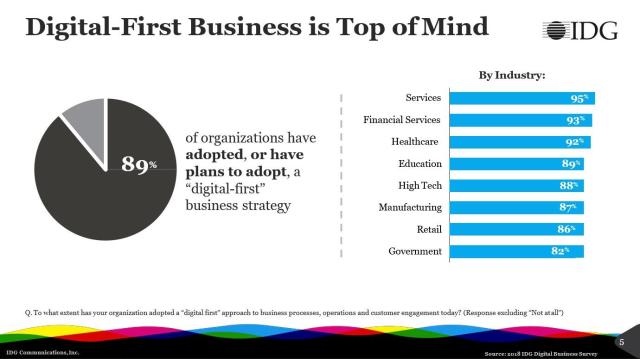
  • 89% of enterprises have plans to adopt or have already adopted a digital-first business strategy with Services (95%), Financial Services (93%) and Healthcare (92%) leading all industries. Education, high-tech, manufacturing, retail, and government are also quickly adopting digital-first strategies to improve process efficiencies and meet and exceed customer expectations.

Digital-First-By-Industry

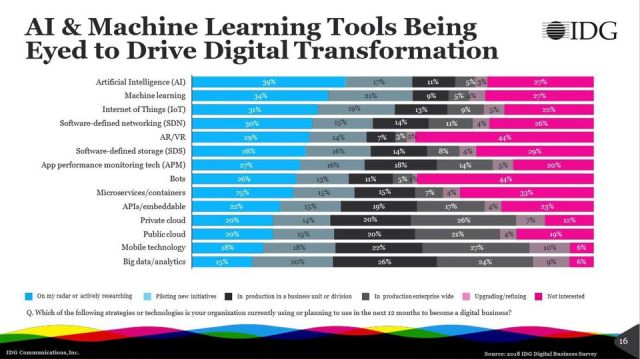
  • Big Data/Analytics (58%), mobile technologies (59%), private cloud (53%), public cloud (45%) and APIs and embeddable technologies (40%) are the top five technologies already implemented. Additional technologies currently in production include Application Performance Monitoring (APM) (18%), microservices and containers (15%), Software-defined storage (SDS) (14%) and Software-defined networking (SDN) (14%). Artificial Intelligence (39%), machine learning (34%), and the Internet of Things (31%) are the top three technologies enterprises are researching today.

https_blogs-images.forbes.comlouiscolumbusfiles201804AI-and-machine-learning-lead-interest

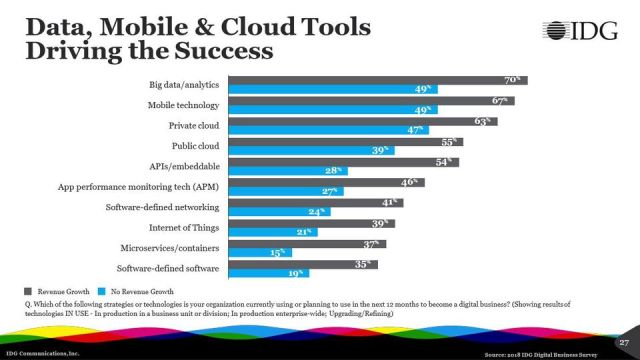
  • Big Data/Analytics, mobile technologies, and private cloud contribute most to an organization’s revenue growth. IDG analyzed which technologies are contributing most and least or revenue growth. With 49% of enterprises saying excelling at managing business performance through data availability and visibility is what defines their digital business, it’s understandable why Big Data/Analytics is perceived by 70% of IT executives as contributing to revenue growth.

https_blogs-images.forbes.comlouiscolumbusfiles201804Data-Mobile-and-Cloud-Tools-Driving-The-Success

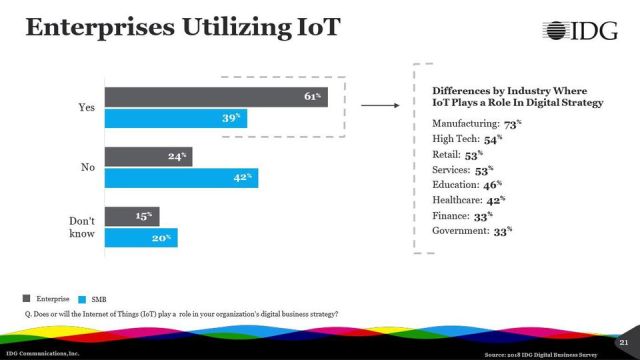
  • 61% of enterprises say IoT plays a role in their digital business strategies with manufacturing and high-tech leading all other industries. Just 39% of small & medium businesses (SMBs) say IoT plays a role in their digital business strategies today. Finance and government industries are the least likely to adopt IoT as part of their digital business strategies due to legacy systems being very difficult to change or integrate with and security concerns.

https_blogs-images.forbes.comlouiscolumbusfiles201804enterprises-utilizing-IoT

  • 73% of manufacturing executives or IT decision makers (ITDM) says IoT plays a role in their digital business strategy, with 69% saying IoT is used to monitor equipment and machinery today. 24% of manufacturing IT executives interviewed say IoT is in production in a business unit or division. Creating a business case in manufacturing for IoT begins by looking at how quality, time-to-market and production performance can be improved. The manufacturing metric Overall Equipment Effectiveness (OEE) is one of the primary catalysts driving real-time monitoring including IoT adoption across manufacturing today.

https_blogs-images.forbes.comlouiscolumbusfiles201804IoT-Is-A-Core-Component-of-Manufacturing

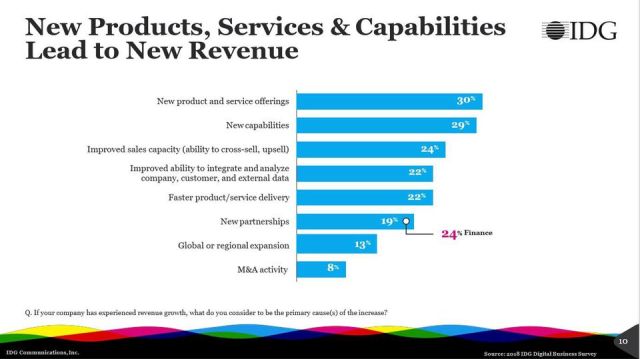
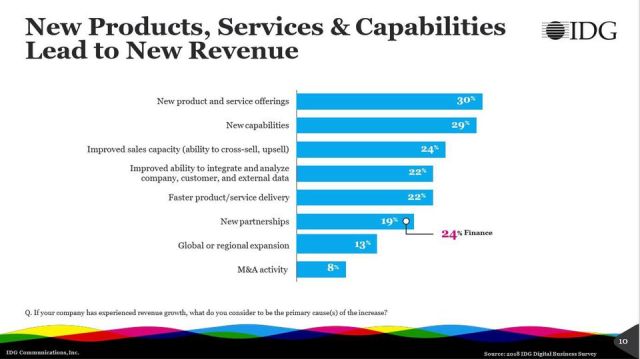
  • Start-ups can increase revenue by 34% relying on digital-first strategies, with all enterprises increasing revenue by 23% with new product and service offerings being the largest contributor to revenue growth across all companies. 30% of all enterprises interviewed by IDG say that new product and service offerings are the primary sources of revenue growth for their companies, followed by adding new capabilities inside the company and improving sales capacity to cross-sell and upsell. 22% say that their improved ability to integrate and analyze company, customer and external data is contributing to increased revenue. 22% also credit digital business strategies with the ability to increase product and service delivery speeds. New partnerships, global or regional expansion and M&A (merger & acquisition) activity are the remaining factors driving revenue growth. Multiple responses were allowed to the original survey.

https_blogs-images.forbes.comlouiscolumbusfiles201804New-products-drive-the-greatest-revenue

  • Enterprises’ definition of a digital business varies from enabling worker productivity to meeting customer experiences. 52% of enterprises say enabling worker productivity through tools such as mobile, data access, and AI-assisted processes are the essence of their digital business strategy. 49% say better managing business performance through data availability, and visibility is what defines their digital business, and 46% say meeting customer experience expectations using digital technologies is the center of their digital business.

https_blogs-images.forbes.comlouiscolumbusfiles201804New-products-drive-the-greatest-revenue

  • 62% say delivering an excellent customer experience as measured by customer satisfaction scores defines success as a digital-first business. The intensity to gain high customer satisfaction scores in retail is high, with 79% saying this is by far their most important benchmark of a successful digital-first business. 70% of manufacturers define the digital-first business strategies as successful when they improve process efficiency through automation. 53% of services companies and 51% of finance companies define digital-first business success by their ability to accelerate time-to-market.

https_blogs-images.forbes.comlouiscolumbusfiles201804New-products-drive-the-greatest-revenue

Contributor: Louis Columbus – Source