Who made it into the Forbes Fintech 50?

The Forbes Fintech 50 2019 reveals that although the crypto markets may be going through a frosty period, investment in the growth of fintech businesses surged in 2018. As Forbes reports, total investment reached $55 billion in 2018, double that of the previous year. The Forbes list of the top 50 finteches also shows that the businesses themselves are getting bigger, with 19 of the 50 firms valued at, or in excess of, $1 billion.

This is only the fourth time that Forbes has published this list and it’s pleasing to see that there are 20 startups that have made the cut for the first time. It is also interesting to see that the sector showing a strong growth in startups is that of payments services, particularly those focused on providing a service to the unbanked. In the case of the USA these people are typically migrants without a US credit history, or people who live hand to mouth on a wage paid weekly. The lack of access to banking and payment facilities is a greater problem in developing countries, but let’s not forget it happens in the first world as well.

Exchanges dominate

There are few surprises at the top of the list, as many of the names are familiar: Axoni, Bitfury, Circle, Coinbase, Gemini and Ripple are all headline makers. Bitfury is the only non-US based of this top six: it is based in Amsterdam. It started off as a bitcoin mining outfit, but then launched its own blockchain plus software designed to help U.S. law-enforcement and others investigate illicit activity using bitcoin. It has a valuation of $1 billion plus and received more than $150 million from Korelya Capital, Macquarie Capital, Dentsu & others.

Axoni may be less famliar than say Coinbase, Circle or Ripple. It uses blockchain-based smart contracts to overhaul the back office of the world’s biggest derivative markets. It received funding from Goldman Sachs, JP Morgan and others to the tune of $59 million.

Circle, with a valuation of $3 billion and Coinbase with a valuation of $8 billion are big hitters; they even sometimes work together. Last year they partnered to launch a stablecoin USDC — a crypto asset using the ethereum blockchain and backed by US dollars.

Payments services present in big numbers

Payments services make up 25% of the Top 50 list. The Forbes list is skewed towards US companies, but it is notable that in the payments sector, it includes Transferwise, a UK registered company, widely used by Europeans when they need to transfer large sums of money across borders. Other payments services listed include Bolt, which is the ‘smallest’ with a valuation of only $20 million, whereas Stripe is one of the largest with a valuation of $685 million.

Forbes predicts that the leaders in the blockchain sphere will stop trying to outrun each other in 2019 and will instead start seeking partnerships within the mainstream world of finance.

Which would you bet on: John McAfee becoming US president, or eating his d**k on TV?

For many years when most people heard the name ‘McAfee’ the software that protected your computer from malware, viruses and Trojans came to mind. But, John McAfee, the man behind the anti-virus software business has given us an entirely different image to conjure up when the name is mentioned.

Who knew that the Anti-Virus King was such a maverick and such an enthusiastic user of Twitter? His announcement this week that he plans to run for President in the 2020 presidential campaign is not a great surprise, and if constant Twitter use is a qualification for the job (the current POTUS seems to think it is) then he might be a shoo in.

Not that John McAfee can actually step foot in the USA. He has fled the country and is sending out messages from his boat, which is somewhere in international waters so that the Internal Revenue Service can’t touch him. He hasn’t filed a tax return in years, so it’s no surprised that the IRS have come after him, especially since he keeps boasting about it. McAfee certainly doesn’t seem to have grasped the concept of ‘going under the radar’.

What else do we know about the man? Well, he’s a cryptocurrency fanatic to start with and he has made a lot of noise in the crypto world and attracted a large swathe of followers. He also has a fairly interesting backstory, including the fact that he was born in the UK, not the USA. His parent moved to Roanoke, Virginia when he was young and his father committed suicide when McAfee was 15.

His career in computing started after he took a job at a firm that coded punch-card systems. He then worked at a few Silicon Valley firms until the first major virus in PCs emerged and that’s when he started his anti-virus company. The company soon became one of the biggest of its type, but McAfee decided to retire in 1994 and keep a low profile.

His shares in the company netted him $100 million and he seemed set for a comfortable future, however in 2008, the financial collapse that affected the whole world also hit McAfee hard and he lost around 96% of his fortune.

And this is when he starts to reveal his maverick nature to a wider audience. He moved to Belize, but started to think he was being followed, and lost his connection with society for a while. He also had to flee the country in 2012 when he became a person of interest in a murder case that involved the death of his neighbour. He was then arrested in Guatemala for illegal entry and repatriated to the USA. And that’s when his love affair with crypto started.

In 2015 he started the Cyber Party and made his first attempt to run for president. He also got involved with MGT Technologies, a rather mysterious firm that was producing games, providing cybersecurity services and manufacturing some drugs. It’s an odd mix that gives off a strong smell of dodginess. He left her to become fully embroiled in the bitcoin world; the leading cryptocurrency being his favourite. He’s made numerous predictions, perhaps most famously his tweet that if bitcoin didn’t reach $1 million by the end of 2020 “I will eat my dick.” Which will happen first: will McAfee become president or will we see him cannibalise himself on Squawk Box at the beginning of 2021?

The surprising ways mining crypto can be profitable

Crypto miners are rewarded for processing transactions. All you need to be a miner is a rack of high-speed computers and access to electricity. Of course, a lot has been said about the latter: the consumption of energy needed to run the software and hardware on a large scale is astronomical in cost. In fact, some mining outfits are consuming the same amount of electricity as a small country. That’s why so many are based in the cold wastes of the Arctic Circle where lower temperatures keep the machines cooler and therefore reduce energy consumption.

When mining started, people could do it on machines at home, but that didn’t last long. The potential to make big bucks meant that competition increased and miners purchased massively powerful computers while scaling up their operations to remain profitable.

Then bitcoin crashed and this reduced the ability of miners to make a profit, and legal crypto mining using electricity at market rates is now becoming increasingly unfeasible, even in those places like Iceland.

Mining can still be profitable

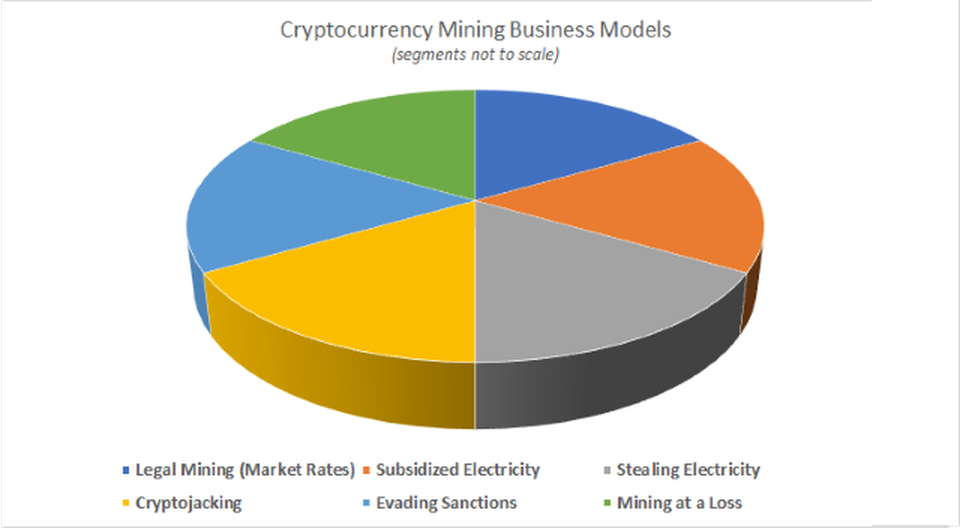
But there are still opportunities for profitable mining. One way is to find subsidised electricity. For example, In Washington State, hydroelectric power generates far more energy than locals can consume, thus attracting a booming business in crypto mining. Instead of exporting it to other states, miners could buy it. This is a legal model. The other forms of profitable mining are certainly not.

The first of the illegal mining options is to steal electricity. That is what used to happen in the early days, but energy companies have got wise to that and there have been some prosecutions for theft in China and the USA.

Another mining model is cryptojacking. This has outperformed ransomware as a form of obtaining crypto. How does it work? A hacker introduces crypto mining software onto a target victim’s computer without their knowledge, thus generating crypto for the hacker while stealing processor cycles and electricity from the victim.

And there we have the current crypto mining scenario. As Jason Bloomberg writes at Forbes: “For all the crypto fanatics out there, therefore, there is a reason to take heart — there’s no way crypto values will ever drop far enough for mining to cease. Organized crime wouldn’t let that happen.”

Coinbase counsel predicts crypto regs push in 2019

Marcus Hughes, the British lawyer and lead counsel for San Francisco-based crypto exchange Coinbase, predicts that 2019 is going to be the year that we see big changes in bitcoin regulations.

Hughes remarked, “Within the next year or two, we’ll see big developments, and regulation will take shape this year, particularly in Europe.”

He pointed to the fact that the United Kingdom’s Financial Conduct Authority (FCA) is in the process of carrying out a consultation regarding crypto derivatives. This could see a ban on the sale of derivatives based on cryptocurrencies such as bitcoin. Furthermore, the British government has pledged to empower the FCA to oversee all crypto assets.

An article in the UK’s Daily Telegraph at the end of 2018 also revealed that the FCA is investigating 18 companies “in connection with cryptocurrency transactions amid escalating concern over the threat posed by Bitcoin and other digital assets to the integrity of financial markets.” But that is not all: the FCA has opened 67 inquiries since November and is clearly stepping up its scrutiny of all firms involved with crypto in any manner.

Nicky Morgan MP, who hairs the influential Treasury select committee, said, “t is clear that the government and the FCA share the committee’s concerns on crypto-assets, including the lack of regulation, minimal consumer protection and anonymity aiding money laundering … The committee will keep a close eye on these consultations and will continue to press for regulation.”

And the European Banking Authority is calling for standardised regulations for cryptocurrency operations within the European Union. This is to remove the potential for “unfair regulatory arbitrage while protecting bitcoin and cryptocurrency investors across the bloc.”

Hughes said about this scenario: “We could end up with E.U. member states creating their own crypto laws, but it’s certainly possible we’ll get a unified approach in Europe. It would make life for companies like Coinbase a lot easier.”

He also has his own views on the future of bitcoin, which also reflect those of Coinbase: “We need to move beyond the speculation phase of bitcoin and cryptocurrency to the utility phase. The utility phase will mean bitcoin and crypto becomes more widely accepted and understood.”

He also commented on the arrival of institutional investors in the crypto sphere, saying: “I would be surprised if other traditional financial services executives didn’t make the move across to the bitcoin and cryptocurrency world. As the industry matures and is better regulated it will need the talent and experience to manage it.”