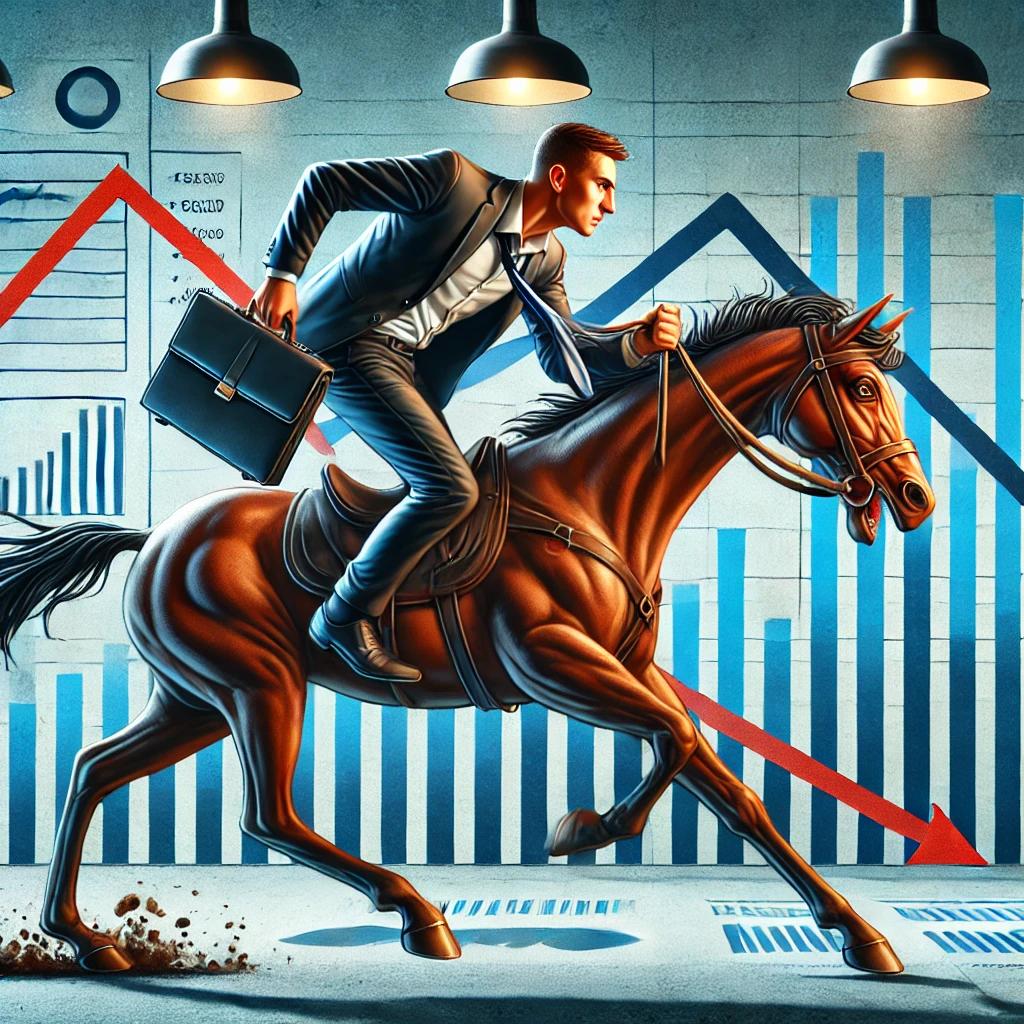
Beating a Dead Horse in Business: The Cost of Sticking to Failing Strategies

In the business world, one of the most common yet costly mistakes is the tendency to continue investing time, money, and resources into failing ventures. This phenomenon is often referred to as “beating a dead horse” — a metaphor that describes the futile effort of persisting with a strategy, product, or business model that is no longer viable. Despite clear indications of failure, companies and individuals often struggle to abandon unsuccessful endeavors, leading to significant financial losses, wasted opportunities, and stunted innovation. This article delves deep into why businesses continue this pattern, the psychological and economic factors behind it, and how organizations can identify and pivot away from doomed strategies.

Understanding the “Dead Horse” Phenomenon in Business

At its core, the dead horse strategy occurs when businesses refuse to acknowledge that an initiative, market trend, or product has run its course. Instead of pivoting, they double down, hoping that persistence alone will turn things around. This reluctance to move on can manifest in several ways, including:

  1. Investing in Obsolete Technology — Businesses that fail to adopt emerging trends and instead pour money into outdated solutions often find themselves irrelevant in the market.
  2. Clinging to Failing Business Models — Some companies resist adapting to changing customer behaviors, holding onto business models that no longer generate profits.
  3. Continuing with Poor Leadership — Keeping ineffective leadership in place despite ongoing failures can further entrench stagnation.
  4. Marketing to a Nonexistent Audience — Businesses sometimes continue marketing products to an audience that has either moved on or never existed in the first place.
  5. Refusing to Adapt to Market Shifts — When industry disruptions occur, businesses that resist change rather than evolve can find themselves on the path to extinction.

The Psychological and Economic Drivers Behind Sticking to Failure

Why do businesses persist in beating a dead horse? The answer lies in a combination of psychological and economic factors that create resistance to change:

1. The Sunk Cost Fallacy

This cognitive bias causes individuals and organizations to continue investing in a failing venture simply because they have already poured substantial resources into it. Rather than recognizing the need to cut losses, companies feel compelled to justify previous expenditures by persisting.

2. Fear of Admitting Failure

Admitting that a business decision was wrong can be difficult, especially for leaders who have publicly supported a strategy. The fear of losing credibility often results in prolonged denial and further investment.

3. Emotional Attachment to Ideas

Business owners and executives often develop an emotional connection to their ventures, making it harder to view situations objectively. This attachment can cloud judgment and hinder necessary course corrections.

4. Groupthink and Internal Politics

When entire teams or companies are invested in a decision, challenging the status quo becomes difficult. Employees may hesitate to speak out, fearing backlash or being perceived as disloyal.

5. Hope and Optimism Bias

Sometimes, businesses hold onto hope that external factors will change in their favor, such as believing that a failed product will suddenly become popular or that a declining market will rebound.

Consequences of Beating a Dead Horse in Business

Failing to recognize when to let go can have severe consequences for businesses:

  • Financial Drain: Continuing to invest in failing projects diverts resources from more promising opportunities.
  • Missed Opportunities: Companies that focus on the past often miss emerging trends and new markets.
  • Employee Morale Decline: Working on a failing project can demotivate employees and lead to higher turnover rates.
  • Loss of Market Relevance: Brands that refuse to innovate risk becoming obsolete.

How to Identify and Stop Beating a Dead Horse

Recognizing when a business strategy is failing and having the courage to pivot is crucial for long-term success. Here are some steps to help businesses make informed decisions:

1. Conduct Honest Performance Reviews

Regularly assess the effectiveness of business strategies through key performance indicators (KPIs), customer feedback, and market analysis. If the data suggests stagnation or decline, it’s time to reassess.

2. Encourage Open Dialogue

Create an organizational culture where employees feel safe voicing concerns and offering alternative solutions without fear of retribution.

3. Set Clear Exit Strategies

Having predefined exit criteria for projects can prevent emotional decision-making and allow businesses to cut losses at the right time.

4. Be Willing to Pivot

Successful companies recognize when to shift focus. If a product, service, or market isn’t working, exploring new directions can be more beneficial than forcing a failing initiative.

5. Embrace Failure as a Learning Experience

Rather than fearing failure, businesses should treat it as an opportunity to learn and evolve. Some of the most successful companies today, including Amazon and Netflix, have pivoted multiple times before finding their winning formulas.

Case Studies: Companies That Knew When to Move On

1. Netflix vs. Blockbuster

Blockbuster failed to recognize the shift from physical rentals to streaming, while Netflix adapted and thrived. Blockbuster’s reluctance to pivot resulted in its downfall.

2. Kodak’s Digital Misstep

Despite inventing the digital camera, Kodak continued to invest in film photography, ultimately losing its industry dominance to competitors who embraced digital innovation.

3. Nokia’s Smartphone Struggle

Nokia’s insistence on sticking with outdated mobile operating systems instead of embracing the smartphone revolution led to its decline in the market.

Know When to Let Go

Beating a dead horse in business is a common but avoidable mistake. Recognizing when a strategy is failing and making the necessary changes can mean the difference between stagnation and success. By fostering adaptability, encouraging critical thinking, and being willing to pivot, businesses can ensure long-term growth and relevance in an ever-changing market. The key to sustainability isn’t persistence in failure — it’s the ability to recognize and embrace change.

Elon Musk turns into Trump on Twitter

Elon Musk of Tesla fame has a knack for getting his name in the headlines. There is barely a week goes by when his name doesn’t appear in the media somewhere, whether it is the mainstream media or more niche sectors of the press. This week he has taken on the Wall Street Journal (WSJ), because he is fed up of journalists’ criticisms of Tesla.

As always, Musk launches his attacks on Twitter. This time he presented the WSJ and its columnist Holman Jenkins as “sock puppets for “big oil.” In one tweet he asked his followers: “Please support my campaign to rebrand WSJ as sock puppets emoji.”

Francois Asure at CCN finds it very odd that Musk should behave somewhat like Trump on Twitter, suggesting that surely as a creative genius, Musk can do better than hurl “Trump-style epithets” at such an esteemed institution. Asure was referring to the way in which Trump branded Hillary Clinton, “Crooked Hillary”, and he also called Kim Jong-Un “Little Rocket Man.” Presumably he didn’t call him that when he met him at their famous summit meeting.

Instead, Musk appears to be adopting Trump’s tactics with the WSJ, simply because he doesn’t think the paper gives him fair coverage. It sounds a lot like Trump’s ongoing battle with The New York Times, CNN and his other perceived media enemies that he is sure tell lies about him. It often comes across as childish petulance on trump’s part, and Musk’s response to this WSJarticle, “Tesla Can’t Stop Dreaming Big.” The introduction reads: “Elon Musk’s plans to turn Tesla into a dominant automobile player have become a liability instead of an asset.” It is a less than glowing account of Tesla and the upheavals within the company. It also questions Musk’s leadership style and the way in which he uses his personality –“erratic, bombastic and alternative” –to draw attention to his brands.

As Asure remarks, “For the CEO to use Twitter to communicate with shareholders is about as unusual as a U.S. president turning to the social media platform to craft a message.” And as he rightly points out, the way in which Musk courts media attention is always likely to lead to some negative reviews. It is not difficult to see why the WSJ cites Musk as a liability for Tesla; he positions himself as bigger than his car brand. If you stopped the average man in the street, I’d say it is likely that they know more about what Musk gets up to than the engineering or design of a Tesla model.

And why did he choose to use “big oil” as his idea of an insult? Simply because his fan base is into electric cars, and oil, a fossil fuel, is the nemesis of those who are environmentally conscious. The oil industry probably doesn’t love Elon Musk much either, but as Asure points out, the oil industry often gets a “free pass” in the press, whereas the Tesla story is much more entertaining for any journalist.

And Musk often makes big claims that he can’t follow through on, which is more grist for the media’s mill. But, the point of this whole story is to illustrate how social media has become the battleground for characters like Musk and Trump. When their backs are against the wall they hit out in tweet form. And it often backfires on them, because calling people names makes things personal that should be treated with gravitas and diplomacy. However, neither Trump nor Musk possesses much of these qualities. While Musk’s tweets are entertaining, as are Trump’s, he is in danger of allowing his game playing to obliterate his Tesla brand; just as Trump’s outbursts have lowered the tone of the Office of the President of the United States.

Jack Dorsey: the billionaire on a $1.40 salary

I’ve discovered something truly strange: Jack Dorsey, one of the co-founders of Twitter, takes home an annual salary of $1.40. Why this odd amount? Well, it is a nod to the original 140-character limit for a tweet. He would of course be within his rights to ask for $2.80, since Twitter expanded the maximum number of characters that can be used to 280.

Dorsey is, of course, known for being a billionaire, and Twitter generated a revenue of $909 million in the last quarter of 2018 alone. His SEC filing revealed: “As a testament to his commitment to and belief in Twitter’s long-term value creation potential, our CEO, Jack Dorsey, declined all compensation and benefits for 2015, 2016, and 2017, and in 2018 he declined all compensation and benefits other than a salary of $1.40.”

Why does Dorsey do it?

Gerelyn Terzo writing at CCN suggests it makes him and his company look good, and Terzo remarks, “His creativity to reflect the Twitter character limit is second-to-none.” But let’s not forget that in 2018 he offloaded a lot of stock. He sold 1.7 million shares from Square to net him $80 million after taxes. And by the way, he only takes home an annual salary of $2.75 from Square. This company, which makes devices for small businesses to accept credit card payment sin person, was struggling to become profitable, but in 2018 its stock climbed by 80%. And the majority of Dorsey’s fortune is tied up in Square equity. As Forbes reports, “Thanks largely to the run-up in the stock, he is now worth $1.9 billion more than at the start of the year. His net worth currently stands at $4.7 billion, with his 61 million shares of Square accounting for $3.9 billion.” By contrast, Dorsey hasn’t touched his Twitter shares this year and they surged by 50% in value in 2018, giving him a stake worth $600 million.

Dorsey isn’t alone

Dorsey isn’t the only billionaire who takes a nominal salary. Donald Trump donates his $400,000 presidential salary to different causes and Elon Musk never cashes in his annual salary of $45,936, which he is forced to accept under Californian law. Mark Zuckerberg of Facebook is paid $1 per annum, as is Evan Spiegel at Snap.

Bankers prefer big money

Significantly, banking CEOs, do not take the same approach as the founders of media and tech giants like Twitter and Facebook. They are firmly wedded to their eye-watering salaries, despite the banking crash of 2007. Swiss Bank UBS is currently under scrutiny for its CEO’s excessive salary of $14 million. But Jamie Dimon at JP Morgan Chase is paid $30 million per annum. No wonder that when the banker was in front of Congress last week, he was closely questioned about why some of the bank’s staff were finding it impossible to reach the end of the month without needing overdraft facilities. Katie Porter’s questioning of Dimon should have made him squirm, but his face didn’t move a single muscle as he responded to her questions with, “”I don’t know, I’d have to think about that.”

But the real question here is: are the likes of Jack Dorsey really the good guys, and the bankers the baddies? Perhaps it is their employees who can answer that question?

Which would you bet on: John McAfee becoming US president, or eating his d**k on TV?

For many years when most people heard the name ‘McAfee’ the software that protected your computer from malware, viruses and Trojans came to mind. But, John McAfee, the man behind the anti-virus software business has given us an entirely different image to conjure up when the name is mentioned.

Who knew that the Anti-Virus King was such a maverick and such an enthusiastic user of Twitter? His announcement this week that he plans to run for President in the 2020 presidential campaign is not a great surprise, and if constant Twitter use is a qualification for the job (the current POTUS seems to think it is) then he might be a shoo in.

Not that John McAfee can actually step foot in the USA. He has fled the country and is sending out messages from his boat, which is somewhere in international waters so that the Internal Revenue Service can’t touch him. He hasn’t filed a tax return in years, so it’s no surprised that the IRS have come after him, especially since he keeps boasting about it. McAfee certainly doesn’t seem to have grasped the concept of ‘going under the radar’.

What else do we know about the man? Well, he’s a cryptocurrency fanatic to start with and he has made a lot of noise in the crypto world and attracted a large swathe of followers. He also has a fairly interesting backstory, including the fact that he was born in the UK, not the USA. His parent moved to Roanoke, Virginia when he was young and his father committed suicide when McAfee was 15.

His career in computing started after he took a job at a firm that coded punch-card systems. He then worked at a few Silicon Valley firms until the first major virus in PCs emerged and that’s when he started his anti-virus company. The company soon became one of the biggest of its type, but McAfee decided to retire in 1994 and keep a low profile.

His shares in the company netted him $100 million and he seemed set for a comfortable future, however in 2008, the financial collapse that affected the whole world also hit McAfee hard and he lost around 96% of his fortune.

And this is when he starts to reveal his maverick nature to a wider audience. He moved to Belize, but started to think he was being followed, and lost his connection with society for a while. He also had to flee the country in 2012 when he became a person of interest in a murder case that involved the death of his neighbour. He was then arrested in Guatemala for illegal entry and repatriated to the USA. And that’s when his love affair with crypto started.

In 2015 he started the Cyber Party and made his first attempt to run for president. He also got involved with MGT Technologies, a rather mysterious firm that was producing games, providing cybersecurity services and manufacturing some drugs. It’s an odd mix that gives off a strong smell of dodginess. He left her to become fully embroiled in the bitcoin world; the leading cryptocurrency being his favourite. He’s made numerous predictions, perhaps most famously his tweet that if bitcoin didn’t reach $1 million by the end of 2020 “I will eat my dick.” Which will happen first: will McAfee become president or will we see him cannibalise himself on Squawk Box at the beginning of 2021?