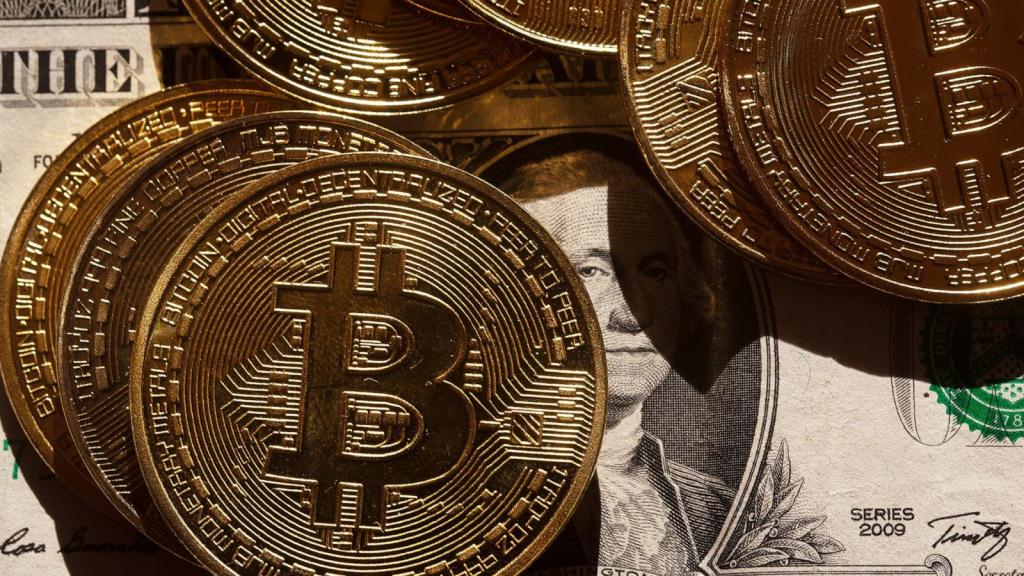
$10 a Month in Bitcoin Could Change Your 2030

The Power of Small, Steady Investments

When most people think about investing in Bitcoin, they imagine big, risky bets — lump sums, wild swings, and sleepless nights. But the truth is, you don’t need to gamble your life savings to benefit from Bitcoin’s long-term potential.

In fact, you could start with as little as $10 a month — and by 2030, that small, steady habit could have a life-changing impact.

1. The Power of Dollar-Cost Averaging (DCA)

Dollar-cost averaging is a time-tested investment approach where you invest a fixed amount at regular intervals, regardless of the asset’s price.
This method removes emotion from investing — you buy through the highs and the lows, letting time and compounding work in your favor.

In Bitcoin’s case, DCA has historically been a powerful strategy because it turns volatility from a fear into an advantage. You’re not trying to “time the market”; you’re simply showing up, month after month.

2. Why $10 Matters More Than You Think

At $10 per month, you’re committing $120 a year. Over a decade, that’s $1,200 total invested — less than the cost of a daily coffee habit.

But Bitcoin’s historical performance changes the equation. While no future returns are guaranteed, Bitcoin’s compound annual growth rate (CAGR) since inception has been extraordinary, even accounting for deep drawdowns.

Let’s take a conservative example:
If Bitcoin grows at 20% CAGR from now until 2030 (much lower than its past average), your $1,200 total contributions could grow to several multiples of your original investment — without you ever making a large commitment.

3. Bitcoin’s Scarcity Advantage

Unlike fiat currency, Bitcoin has a fixed supply of 21 million coins. This scarcity is hardcoded into its protocol. As adoption increases and demand rises, supply cannot be inflated to meet it. That’s why long-term holders — whether they own thousands of dollars or just a few satoshis — share the same benefit of scarcity.

With micro-investing, you are essentially stacking small amounts of a finite asset before the rest of the world realizes its true value.

4. Benefits of Starting Small

  • Low Risk Entry — You’re not overexposed; small amounts keep your risk manageable.
  • Habit Formation — Regular investing builds discipline, which pays off in other financial areas.
  • Upside Exposure — Even small positions in high-growth assets can become meaningful over time.
  • Accessible to All — You don’t need to be wealthy to participate in the Bitcoin network.

5. The Bigger Picture: 2030 and Beyond

Bitcoin adoption is still in its early stages, with growing interest from institutional investors, nation-states, and global payment platforms. By 2030, it could play a central role in global finance.

If that happens, the price could reflect not just speculation, but deep, fundamental demand for a digital, borderless, inflation-resistant store of value.

The $10 a month you start today isn’t just an investment — it’s a ticket to participate in the future monetary system.

We tend to overestimate what we can do in a day, but underestimate what we can do in a decade.
Ten dollars a month won’t change your life overnight, but with patience, discipline, and the compounding effects of Bitcoin’s scarcity, it could be one of the smartest financial moves you ever make.

Small steps, big future.
Start stacking.

Bitcoin: Hard Money Meets Neural Logic

In an era where fiat currencies bleed value and centralized systems crack under pressure, a new form of capital rises from the ashes of financial decay—Bitcoin, the apex predator of monetary evolution. But Bitcoin is more than just digital gold. It’s the first time hard money collides with neural logic, the decentralized mind of machines and men.

This isn’t just economics. This is memetics, mathematics, and revolution woven into code.

Hard Money, Forged in Code

Historically, hard money meant gold: scarce, durable, hard to counterfeit. But in the digital age, gold is heavy, slow, and blind. Enter Bitcoin—scarce by design, mathematically capped at 21 million units, immutable, auditable, and borderless. It doesn’t need vaults or armies. It runs on the most secure computing network ever built.

Bitcoin isn’t just hard—it’s invincible.

Where fiat is printed by decree, Bitcoin is mined by proof. Where central banks obfuscate, Bitcoin reveals. Every transaction is a mathematical truth, timestamped in a public ledger no one can alter and everyone can inspect. That’s not just money. That’s pure logic in action.

Neural Logic: The Network Becomes the Brain

Think of the Bitcoin network as a primitive neural structure—a decentralized, permissionless intelligence. Each node in the network acts like a neuron, validating signals (transactions), enforcing the rules (the protocol), and rejecting false inputs (invalid blocks). No single node holds control, but all cooperate to maintain the integrity of the whole.

Bitcoin is self-regulating, adaptive, and increasingly resilient—hallmarks of a living, learning system.

As AI systems evolve and neural networks push the frontier of cognition, Bitcoin runs in parallel as the financial infrastructure for that future. AI will need money—neutral, incorruptible money. Bitcoin is that money. It is programmable value for programmable intelligence.

The Economic Mind-War

Bitcoin doesn’t beg for adoption—it infiltrates it. As fiat systems crack under inflation, surveillance, and capital controls, Bitcoin offers an escape hatch. Not with violence, but with superior architecture. It is not just a protest; it is a protocol-level upgrade to civilization.

It’s not just about number go up. It’s about sovereignty. It’s about intelligence choosing sound money. It’s about the first step toward separating money from manipulation—with code as the referee.

Bitcoin Is Inevitable

You can’t uninvent the internet. You can’t unlearn cryptography. You can’t unwind the birth of Bitcoin.

We’re entering a new phase of monetary consciousness—one where value flows at the speed of thought, governed by the cold rationality of mathematics, not the whims of bureaucrats. Bitcoin doesn’t care about politics. It doesn’t care about your opinion. It just runs—perfectly, relentlessly, incorruptibly.

It’s not just hard money anymore.

It’s neural money.

How Old Finance Is Losing Its Grip: A 2025 Breakdown for Bitcoin Investors

In the ever-evolving landscape of global finance, 2025 is shaping up to be a pivotal year. The institutions and instruments that once defined the economic order — from central banks and traditional banking systems to legacy payment networks — are facing increasing pressure from an unstoppable wave of innovation, decentralization, and public demand for transparency. At the heart of this shift is Bitcoin, not just as a speculative asset, but as a systemic alternative to old finance.

For Bitcoin investors, understanding this dynamic isn’t optional — it’s essential. Because as old finance loses its grip, Bitcoin isn’t just surviving the upheaval; it’s quietly thriving in the cracks of a crumbling system.


The Erosion of Trust in Legacy Institutions

Traditional financial institutions are in a slow-motion credibility crisis. This isn’t new — it’s been building since 2008. But in 2025, the trust gap has widened into a chasm. Key examples:

  • Central banks are out of ammunition. After years of zero or negative interest rates and multiple rounds of quantitative easing, central banks have very little room to maneuver. Inflation targets are being missed or manipulated, and credibility is eroding fast.
  • Commercial banks are losing relevance. According to a 2024 IMF report, more than 32% of global millennials no longer use traditional banks as their primary financial provider, favoring fintech apps, crypto wallets, and decentralized protocols.
  • Money printing is no longer a hidden vice. In the past, monetary expansion happened in the shadows. Now, it’s in headlines. The U.S. alone increased its M2 money supply by over 40% between 2020 and 2023, fueling both inflation and public disillusionment with fiat.
  • Bailouts are back — and bigger. In 2023–2025, more than 15 major financial institutions globally were propped up by government action, exposing the fragile underbelly of a supposedly “stable” system.

This climate has created fertile ground for Bitcoin — a non-sovereign, deflationary, transparent alternative.


Bitcoin’s Strategic Position in 2025

Bitcoin has matured well beyond its early “internet money” days. In 2025, it’s being viewed as:

  • A hedge against fiat instability
  • A strategic reserve asset for both individuals and institutions
  • A neutral settlement layer in an increasingly fractured global financial system

Notable Shifts:

  • Nation-state adoption is accelerating. After El Salvador and the Central African Republic, at least five more countries are now exploring partial Bitcoin integration into national reserves or payment rails.
  • Institutional custody and adoption have normalized. BlackRock, Fidelity, and JPMorgan now offer integrated Bitcoin solutions. The 2024 approval of spot Bitcoin ETFs in several major economies has further legitimized exposure for traditional investors.
  • Bitcoin is now part of macro conversations. Leading hedge fund managers like Stanley Druckenmiller and Ray Dalio have publicly rebalanced portfolios to include BTC — not as a fringe bet, but as a core allocation.

How DeFi and Bitcoin are Converging

While Bitcoin remains more conservative compared to the experimental energy of Ethereum-based DeFi, 2025 is seeing a convergence.

  • Bitcoin-backed DeFi protocols (e.g., Sovryn, Stacks, Rootstock) are enabling lending, trading, and yield on top of Bitcoin — without requiring users to leave the Bitcoin ecosystem.
  • Wrapped Bitcoin (wBTC) remains one of the most utilized assets in DeFi, proving that BTC demand extends beyond simple HODLing.
  • Lightning Network usage is up over 400% year-over-year, not just for micropayments, but for cross-border B2B transfers. This reduces friction for global commerce and further reduces reliance on SWIFT and centralized rails.

Regulatory Pressure Is Backfiring

Governments have tried to “contain” Bitcoin for years — through tax policy, KYC enforcement, and headline crackdowns. But in 2025, those efforts are increasingly viewed as signs of fear, not control.

Ironies of Regulation:

  • SEC lawsuits boosted decentralization. After years of litigation, crypto projects now proactively launch with better legal frameworks — while Bitcoin remains untouched, thanks to its immaculate conception and true decentralization.
  • CBDCs are backfiring. Far from calming the waters, central bank digital currencies have sparked privacy concerns. As governments gain surveillance powers, citizens are shifting to Bitcoin for financial autonomy.
  • Taxation is becoming unenforceable. The rise of self-custody, peer-to-peer exchanges, and global mobility has made Bitcoin taxation increasingly difficult to monitor or collect — a fact that regulators are reluctantly acknowledging behind closed doors.

Macro Forces Align in Bitcoin’s Favor

Three global trends are turbocharging Bitcoin’s narrative in 2025:

1. Deglobalization and Monetary Fragmentation

As U.S.-China tensions persist and the BRICS alliance gains influence, the world is moving toward a multipolar monetary system. In this environment, Bitcoin is the only truly neutral asset — not tied to any nation, bloc, or ideology.

2. Wealth Transfer to Gen Z and Millennials

Younger investors, who are natively digital and deeply skeptical of legacy institutions, are inheriting wealth. Surveys show over 60% of Gen Z trust decentralized money more than banks. Bitcoin is now part of retirement plans, college savings accounts, and sovereign wealth strategies.

3. Tech Integration

Big tech is bridging the final mile. In 2025:

  • Apple Pay supports native Bitcoin transactions via Taproot wallets.
  • Visa and Mastercard now process Bitcoin via third-party integrations.
  • Tesla resumed Bitcoin payments for select markets, citing “sustainable mining improvements.”

Risks Still Remain — But They’re Changing

Let’s be clear: Bitcoin is not risk-free. But the nature of its risk is evolving.

  • Volatility is declining as adoption increases.
  • Network security is stronger with new mining pools and geopolitical decentralization.
  • The attack surface is narrower than DeFi protocols or centralized stablecoins.

The biggest remaining risks in 2025 are political (outright bans in authoritarian states), custodial (exchange mismanagement), and user error (self-custody best practices still matter). But these are manageable risks — especially compared to the systemic risk of traditional banking collapse.


Conclusion: The Grip Is Gone — And It’s Not Coming Back

Legacy finance still has power in 2025 — but not control. The old playbook of regulation, media spin, and centralized gatekeeping is no longer working. Bitcoin has moved from resistance to resilience, from rebellion to relevance.

For Bitcoin investors, the message is clear:
This isn’t just a hedge. It’s a historical transition.

Old finance isn’t going out with a bang.
It’s losing its grip — slowly, systemically, and inevitably.

And Bitcoin is ready.

Is HODLing Bitcoin Really Safe — Or the Final Investor Trap?

For over a decade, the mantra “HODL” has guided the mindset of Bitcoin believers — a rallying cry to hold through the noise, the crashes, the volatility, and even existential threats to the crypto industry itself. It’s been praised as discipline, a badge of conviction in a decentralized future. But as Bitcoin matures and its ecosystem becomes intertwined with global finance, it’s time to ask a hard question: Is long-term HODLing still a sound strategy — or is it just a comforting illusion?

The Psychology of Conviction vs. Complacency

HODLing originated as a typo — but quickly evolved into a cultural pillar. It reinforced a tribal sense of superiority over “weak hands” who sold in fear. But blind conviction can easily cross into cognitive bias. Anchoring, confirmation bias, and groupthink thrive in echo chambers where any skepticism is branded as “FUD.”

Bitcoiners often dismiss opposing viewpoints with emotional defenses: “You just don’t understand it,” or “Talk to me in 10 years.” But this isn’t intellectual rigor — it’s ideological rigidity. Long-term conviction only works when it’s paired with adaptive thinking and clear-eyed risk assessment.

The Shifting Structural Landscape

Bitcoin today is not the same asset it was in 2013 or even 2017. It has evolved from a fringe cryptographic experiment to a globally traded, institutionalized asset. That’s good news for liquidity and adoption — but it also invites scrutiny, regulatory exposure, and macroeconomic correlation.

Many long-term holders fail to see how deeply Bitcoin is now tied to global risk cycles. As institutions enter, Bitcoin increasingly trades like a high-beta tech asset. It’s not a hedge against inflation or monetary debasement in practice — at least not consistently. Instead, it behaves like a leveraged bet on future liquidity.

If Bitcoin is no longer insulated from global risk-off events, the entire HODL thesis becomes more fragile. It’s no longer just “number go up” based on network effects or supply caps — it now depends on central bank policy, interest rates, and ETF flows.

Regulatory and Custodial Blind Spots

Another overlooked risk is regulatory shift. Governments worldwide are refining their approach to crypto. Some, like the U.S., offer cautious clarity via ETFs and institutional on-ramps. Others, like the EU and parts of Asia, are imposing sweeping compliance frameworks.

While self-custody remains a core Bitcoin principle, most long-term holders now depend on centralized exchanges or custodians. The more compliant and financialized Bitcoin becomes, the more susceptible it is to surveillance, asset freezes, or taxation — eroding the very sovereignty it was built on.

Furthermore, nation-states now have tools to selectively control fiat ramps, influence protocol development indirectly, or use economic pressure to corral crypto behavior. That’s not FUD — it’s strategic realism.

Macroeconomics Is Not Your Friend

Bitcoin narratives often ignore macroeconomic realities. The 2020-2021 bull market was not a crypto-specific event — it was part of a global asset bubble driven by unprecedented monetary easing.

Long-term HODLers argue that Bitcoin is an antidote to fiat decay. But if real yields rise, or if capital seeks safer returns in a post-tightening environment, Bitcoin’s appeal as a “store of value” weakens. Gold faced the same problem in the 1980s — despite inflation risks, rising real yields made holding non-productive assets unappealing for a generation.

The New Trap: Complacent Maximalism

The most dangerous trap for Bitcoin investors today isn’t volatility — it’s inertia. Maximalism, once a necessary defense against bad-faith critics, has calcified into a worldview that resists self-reflection.

It’s no longer about innovation or disruption — it’s about “holding the line.” That mindset may protect against emotional selling, but it also blinds investors to evolving risks, better technologies, or opportunities in the broader digital asset ecosystem.

A portfolio that includes Bitcoin may be sensible. A belief that Bitcoin will inevitably ascend without considering market shifts, adoption plateaus, or technological stagnation is not.

Conclusion: Time to Rethink the HODL Gospel?

Bitcoin remains one of the most fascinating financial experiments in modern history. Its resilience, decentralization, and scarcity make it unique. But none of that guarantees permanent outperformance.

Long-term conviction is admirable — until it becomes ideological. The same mindset that led early investors to massive gains can lead latecomers into traps if not periodically reexamined.

The real question isn’t whether Bitcoin will exist in 10 or 50 years. It’s whether holding it passively, indefinitely, without reassessing assumptions, is truly wise — or just another speculative delusion dressed in patience.