Europe Completes Its First Ever Blockchain Real Estate Sale for €6.5 Million

For some time there has been a discussion about the potential of the blockchain for real estate sales. According to a story in Forbes by Kamran Rosen, a real estate expert, the sale of the Villa AnnA in Paris has made history by “becoming the first ever European property to be sold entirely via a blockchain transaction.”

Sold at a price of €6.5 million, the luxury property is located in Paris’ Boulogne-Billancourt district. The buyers were two French real estate companies and the process involved “first transferring ownership of the building to a joint-stock company (SAPEB AnnA), then dividing the company into 100 tokens to be distributed to the owners respectively.” Rosen also explains that each token can be further broken down into 100,000 units, meaning individual shares of the building can be bought and sold for as little as €6.50.

French blockchain investment platform Equisafe managed the deal based on the ethereum blockchain, and as Rosen remarks, it is the latest of a number of property transactions worldwide using blockchain technology. Rosen reports: “Last year, a $30 million Manhattan property was also tokenized on Ethereum, and in January of this year, a luxury resort in Aspen, Colorado raised $18 million through a security token offering.”

Fractional ownership

What this Paris deal and the others illustrate is the potential of the blockchain for supporting fractional ownership. It allows the public to participate in buying small shares I luxury real estate and the property could be traded in the same way as other exchange-based securities.

Furthermore, Rosen’s research revealed that several real estate tokens are already trading on the secondary market.

Tokenising property and using the blockchain revolutionises the old-fashioned property buying and selling process. With the sale of Villa AnnA, much of the “cumbersome legal documentation involved with selling property (such as notarized deeds and proof of identity), was all encrypted and recorded on the blockchain,” Rosen states.

What we need to look at scaling the blockchain to handle real estate transactions so that the time taken and money paid that goes into the current process is greatly reduced. Rosen says, “Equisafe is going as far as to claim individuals will be able to create investor profiles and access offers in less than half an hour.” If that is true, it could have an extraordinary effect on the real estate markets globally.

The sale of the Villa AnnA is likely to be only the first of many in Europe that we’ll see!
The Big Telcos Are On The Blockchain

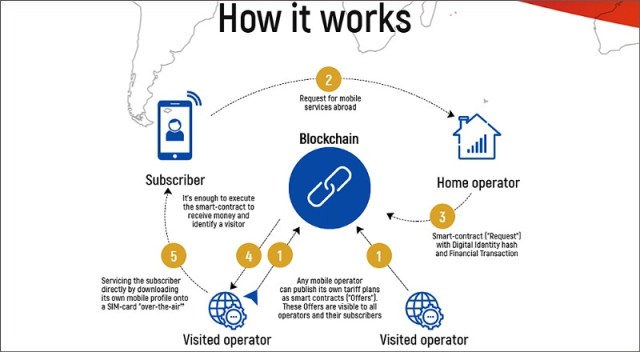
Blockchain technology offers telecoms companies a valuable tool, and it seems that they have been quick to pick up on its value.

As Benjamin Pirus writes for Forbes, AT&T, and T Mobile are both working with the technology in various ways. Pirus writes, “Blockchain has made a name for itself as the technology underpinning bitcoin, allowing the transfer of value without middlemen. The work of these telecom giants shows that what enterprises think of as “value” is much bigger than just currency alone.”

AT& T is applying blockchain to the supply chain for its handsets. Its CEO, Andy Daudelin, told Pirus that the technology is particularly useful for handling “handset returns, upgrades and other activities seen on the supply chain.”

Daudelin explained: “AT&T’s supply chain is collaborating on a blockchain solution with a major handset OEM [original equipment manufacturer] and a handset remanufacturing supplier. The solution will ensure that only authentic, certified parts are used in the device remanufacturing process.” He added, “addingblockchain to the mix also allows for better traceability of components used in remanufactured devices.”

AT&T is also interested in the blockchain’s security aspects and it is in the process of growing its “Internet of Things [IoT] presence and solutions,” with the intention to involve smart contracts in the mix, as its VP of information security, Karthik Swarnam told Pirus. He also mentioned the potential for using blockchain in the area of “verification of device identity.” And of course for checking the software to ensure no malware is lurking. He described it as “checking on the checksums” for authentication, and the “ability to store the checksums on a blockchain, where, at the time of use, you could go ahead and check and compare and verify whether you can trust that piece of code, trust that piece of software, or not.”

Furthermore, AT& T has been developing a suite of blockchain solutions for its enterprise customers and is working with IBM, Microsoft and Amazon Web Services on this. Daudelin said: “What we do here is deliver your traditional blockchain solution. What we add to that is we’ll customize it and write the code specific to that use case, and we’ll add to that our network and IoT [Internet of Things] capabilities.”

As an example, Daudelin says that AT& T is working with a bottling company to “add notable specifics and clarity to that company’s supply chain, utilizing “IoT sensing” for its bottles.”

Furthermore, in May 2019, AT& T announced that its customers could pay their online bills with bitcoin, via bitcoin payment service BitPay.

Daudelin summed up AT&T’s general view of blockchain:

“As our world moves from highly centralized hierarchical processes to very decentralized processes, blockchain enables companies to deploy solutions that remain highly secure and that you can count on them in this very decentralized decision making the world.”

According to recent research, it appears that the telecoms sector is one where blockchain technology is going to grow at a rapid pace. A March 2019 reportfrom Infoholic Research stated: “The global blockchain in telecom market is expected to witness a CAGR [compound annual growth rate] of 77.9% to reach revenue of $1.37 billion by 2024.”

Perhaps it will get even bigger?


What retailers want from blockchain

Online retailers and those with bricks and mortar shops want to know how to use blockchain and to establish if it is a better system than the one they use now. Answering these questions is key to getting retailers to adopt blockchain solutions.

As Nikki Baird writes at Forbes, retailers are not so interested in how blockchain works, or how tokens are generated; they simply want to know how blockchain could work for them. Baird states there are three questions they need answered, and they are: Performance, Privacy and Ease of Use.

And as she points out, retailers don’t want to hear from platforms about how they intend to achieve these three things; they just want to have all of them in an operational blockchain.

So far, we’re not at that point; there is a way to go with each of the qualities retailers need to see.

Performance

When we talk about performance in relation to blockchain, we are really talking about scalability. That is the ability to handle lots of transactions, primarily for payments, but advertising is also important for online retailers. With payments, the transaction time can’t be slower than it is with the current system, and to win retailers over it needs to be faster. At the moment neither bitcoin nor ethereum can match Visa’s transaction times.

Privacy

Privacy is an important element of blockchain and cryptocurrency. The whole point of Bitcoin was to create a digital currency that could be traded anonymously, but is it truly anonymous?

Even if you don’t know who owns bitcoin, you can observe their behaviour on the blockchain. There are even businesses that track bitcoin usage and use the info to identify anonymous owners. This flaw is something that needs to be addressed, so that there is greater privacy on the blockchain, but without sacrificing scalability.

Baird writes, “For retailers, there is the additional issue of personally identifiable information and GDPR, Europe’s regulations around consumer privacy.”

Her answer to the issue is: “Blockchain has the potential to make all of that much easier, if we can evolve to a place where consumers can use blockchain to store their personal information, and decide and control which companies have access to which pieces of information.”

But as she points out, there are lots of hurdles to leap over before we arrive at this point, including identifying who is providing the service and doing more on the security of passwords.

Ease of Use

This is very important in a retail environment. And it is the one element that has been addressed more fully than the others. Baird highlights those companies that “bring blockchain to consumers without making it readily apparent that they are based on blockchain,” and “crypto wallets that make it easier to navigate between traditional and crypto currencies.”

Retailers are traditionally quite conservative, and the blockchain is still not mature enough to win them over. As Baird says, “For blockchain to make a difference in retail, it has to be much more about the experience than the technology.”

Blockchain will get there, but it isn’t ready yet!

Bitcoin is becoming a big brand

How big are these news headlines?

· Bitcoin surpasses 1 M daily active addresses.

· Uber provided an estimated 14 M rides per day in 2017.

· Apple sold 798,877 iPhones per day in 2017.

· OLA & Uber combined provide an estimated 3.5 million rides per day in India.

The virus has already spread! And it’s a good news for bitcoin.

According to CoinMetrics.io, there are now over a million daily active addresses, a number that is defined as the number of unique “from” or “to” addresses used per day. This is something we haven’t seen since November 2017, at the height of the bitcoin buying frenzy.

As Coindesk reports, one Twitter user, Kevin Rooke, noticed the movement this week and tweeted: “When Bitcoin first broke 1 million active addresses (Nov 27, 2017), 1 BTC was $9,352 and the median tx fee was $3.23.Yesterday 1 BTC was $8,230 and the median tx fee was $1.33.”

While some might say that this statistic isn’t that important, it certainly shows us one thing — there are people using bitcoin on a regular basis, whether for trading or spending. It is a good stat for bitcoin, regardless of what those who criticise it say.

From the statistics at the beginning of this article, you can see that there is a context for the figure. Take a look at the figures for Uber.

On the face of it, Uber is doing ‘better’ than bitcoin, because it has 14 million daily users globally. But you have to consider the fact that shifting from using a standard taxi to using Uber is much simpler for most people than changing from using fiat currencies to a cryptocurrency. So, the comparison is not exactly fair.

Then again, Apple is selling just under one million phones on a daily basis, putting bitcoin slightly ahead of it.

Ultimately, what can we take from these figures? The answer is that bitcoin is seeing the same kind of transaction volume as some of the world’s leading brands, which is quite an achievement, and shows that bitcoin is not just the leading cryptocurrency; it’s becoming the big brand of the cryptocurrency space.