The Triple Currency of Life: Time, Money, and Knowledge

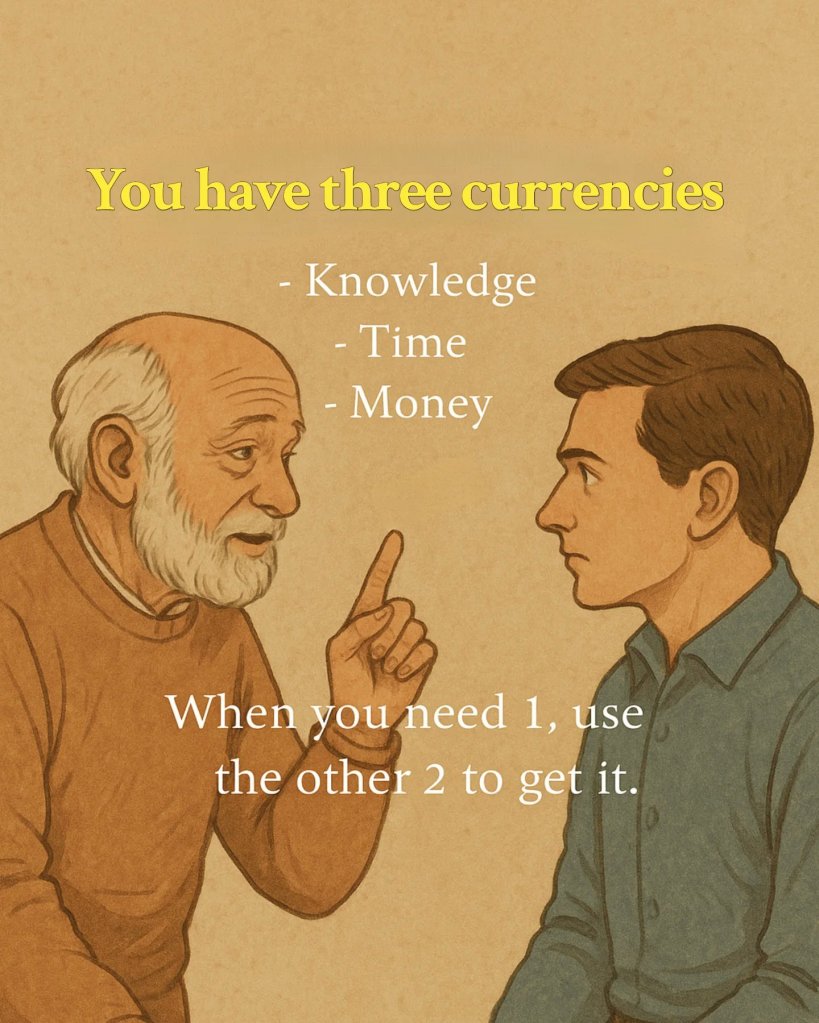
In life, everyone is given access to three core currencies: time, money, and knowledge. How you invest and exchange these will define your growth, your freedom, and ultimately—your legacy.

1. Time: The Only Non-Renewable Resource

You can earn money. You can gain knowledge.
But time? Once it’s gone, it’s gone forever.

Every moment you spend is an investment. The question is: Are you investing it or wasting it?

Wasting time on low-value distractions or delaying action is like burning cash—only worse. Time has compounding power when used wisely. Whether you’re building a skill, a business, or a relationship, time is your most valuable asset.

2. Money: A Tool, Not a Goal

Money is a magnifier. It amplifies your choices and enables freedom—but it’s not freedom itself. Too often, people chase money at the cost of their time and health, only to realize they’ve traded away what really matters.

The goal isn’t to hoard money, but to use it wisely:

  • Buy back your time.
  • Invest in your growth.
  • Enable opportunities for yourself and others.

When money works for you, not the other way around, you’re playing the game right.

3. Knowledge: The Multiplier

Knowledge turns time into mastery and money into opportunity. It’s the multiplier for everything else in life.

Unlike time, knowledge compounds.
Unlike money, knowledge can’t be taken from you.
And when shared, it grows, not depletes.

Read. Learn. Ask. Surround yourself with smarter people. In the long run, it’s not who works the hardest, but who learns fastest that wins.


Final Thought: Be Wise. Balance Ruthlessly.

The smartest people understand this:

  • Use money to buy time.
  • Use time to gain knowledge.
  • Use knowledge to grow money—and value.

Time, money, knowledge. Master the exchange. Play long-term. Win with wisdom.

Clarity Over Chaos: Train Your Mind to Scale Your Business

In business, we often look outward to explain stalled progress — market conditions, increased competition, shifting consumer trends, or funding gaps. While these factors matter, they’re rarely the root issue. The deeper constraint, more often than not, lies within. The real bottleneck to growth is not external — it’s the untrained mind.

Behind every decision, every strategy, every meeting and moment of execution is a mind. If that mind is scattered, reactive, or fear-driven, no amount of capital or opportunity will move the needle. Leaders today are navigating unprecedented complexity. Strategy alone is no longer enough. Mental clarity, emotional control, and disciplined thinking have become critical business assets.

In high-performing organizations, mindset is treated as infrastructure. The mental resilience of a founder under pressure, the clarity of a CEO making decisions in chaos, the discipline of a team staying focused when noise peaks — these are the intangible yet powerful drivers of performance. Without a trained mind, even the best strategies collapse under the weight of stress, distraction, and indecision.

An untrained mind in business shows up subtly. It disguises itself as chronic overthinking, decision paralysis, the inability to say no, and the addiction to comfort disguised as “stability.” It creeps in as short-termism, reactive leadership, or avoidance of risk. These behaviors erode momentum. They create a slow bleed that stalls innovation, weakens culture, and shrinks the capacity to lead at scale.

The truth is, talent and tools alone are no longer differentiators. Everyone has access to information. Everyone can hire smart people. But the leaders and organizations that consistently win are the ones that can think clearly under pressure, remain calm when stakes are high, and adapt faster than the chaos around them. That level of performance is not instinctual. It’s trained.

Training the mind doesn’t require retreating to silence or meditating on a mountain. It requires consistency, discipline, and awareness woven into daily routines. It begins with creating space to think — real thinking, not reacting. It involves choosing discomfort, making hard calls, and leaning into feedback rather than avoiding it. It means becoming conscious of your mental patterns, not to judge them, but to rewire them toward clarity, resilience, and purpose.

Mental training is not self-help. It’s self-leadership. And in a world moving at the speed of distraction, it’s the most underutilized business strategy of our time.

If your company is plateauing, if your leadership feels scattered, or if you keep hitting the same wall, it’s time to stop asking what’s wrong with the business. Start asking what’s untrained in the mind running it.

Because ultimately, your business can only grow to the level of your thinking. And if the mind isn’t built for growth, no strategy will scale it.

Chicken Soup and Covid-19: A Success Story

No, the story is not about how eating chicken soup can cure or prevent Covid-19: it’s a pandemic success story based on streaming media, with a telecoms entrepreneur at its heart.

The almost universal lockdowns spawned a huge need for entertainment, and while Netflix benefited enormously, counting 200 million new subscribers and a 49% rise in share price, it hasn’t been the only game in town, alongside big name competitors Amazon and Disney. Quietly and without much fanfare, a small company called Chicken Soup For The Soul Entertainment has been “gobbling up lesser known streamers, film distribution and production companies,” to quote Matt Schifrin at Forbes. In the last 12 months, Chicken Soup’s o-t-c traded shares soared by 289%— nearly six times as much as Netflix.

Perhaps you have come across some of its products, such as Going From Broke, produced by Ashton Kutcher, which offers reality TV-style budgeting advice to debt-laden Millennials? And there is a film called Willy’s Wonderland, which stars Nicolas Cage. Both of these actors are big names. So how does it operate, and why haven’t we heard much about it?

Chicken Soup isn’t in business to win awards, yet it still has millions of viewers for its programming, thanks to “savvy marketing and an opportunistic collection of streaming networks, distribution and production companies.” It is now a leader in the so-called AVOD or advertising-video-on-demand sector of the streaming entertainment business.

The plan to disrupt subscription services

What is that, you ask? It is advertising-supported channels streamed over the internet to laptops and smart TVs. According to Statista, this mode of streaming accounted for $27 billion in revenues in 2020 and is expected to grow to $56 billion by 2024. YouTube is an example of this that you are most likely familiar with. But Roku TV, ViacomCBS’s Pluto TV and Amazon’s IMDb Freedive are also involved.

The plan, you might say, is that subscribers will get fed up with the cost of subscription services, and will turn instead to free channels supported by advertising, such as Chicken Soup’s Crackle.

In 2020, Chicken Soup made $68 million, which some might say is chicken feed. However, it has just announced that it would be acquiring the assets of Hollywood’s Sonar Entertainment for what sources close to the deal estimate to be valued at $100 million. This will give it access to a catalogue of TV and films containing the top names in the business. Schifrin says: “In all, the deal includes a library of 372 television series and 700 films plus ongoing development deals with the A-listers like Ridley Scott, Jon Favreau, David E. Kelley and Jordan Peele.”

The entrepreneur behind Chicken Soup

Chicken Soup For The Soul Entertainment is the brainchild of William Rouhana Jr, and Schifrin remarks, “Having learned dealmaking during telecom’s Wild West, the structure of the Sonar deal is vintage Rouhana” When Rouhana first acquired Chicken Soup for the Soul in 2008, it was mainly in the business of publishing inspirational paperback books. Now he has leveraged its brand—and cash flow—to get into internet-based entertainment. Rouhani said, “I felt like video on the internet was clearly a very important part of the future. I have believed that since 1993 when I first created WinStar. The whole point of it was to deliver video over our broadband network to people.”

He added, “My plan is to keep building this for a couple more years. As we move into 2022, we will have one new TV series or movie coming to our networks each week. That kind of pace has never been seen before in advertising video on demand nor has an AVOD ever owned the amount of content that we will now own.”

A good entrepreneur story is hard to beat, and this is going to be an interesting one to keep following.

Bill Gates’ big mistake

What do you think might be the biggest mistake Bill Gates ever made? It doesn’t seem to have been too costly a mistake as he’s a tech billionaire turned philanthropist.

According to recent interviews reported by CNN Business channel, he has been telling the media that his “greatest mistake” was not ensuring that Microsoft became Apple’s biggest iOS rival.

As the story goes, Microsoft lost out to Google when it came to launching a system to challenge Apple’s iOS. That system of course is Android, used by every phone that isn’t an iPhone. So, you can imagine his regret that Microsoft didn’t manage to get ahead of Google.

Gates told venture capital firm Village Global: “In the software world, particularly for platforms, these are winner-take-all markets. So the greatest mistake ever is whatever mismanagement I engaged in that caused Microsoft not to be what Android is. Android is the standard non-Apple phone platform. … There’s room for exactly one non-Apple operating system.”

Microsfot’s problem stemmed from its domination of the computer market. If you weren’t working on a Mac, you were using a computer with Microsoft’s software. That was it; there were only two choices.

With so much concentrated in the computer market, Microsoft trailed behind Apple in the emerging smartphone sector. Although it needn’t have.

Microsoft came out with its own mobile operating system, called Windows Mobile, in 2000. Apple debuted its iPhone in 2007, followed by Google’s Android platform in 2008. So theoretically Microsoft had the opportunity, but it just didn’t keep up with Apple and then Google.

Gates told the Economic Club in Washington, DC

that the antitrust trial in that period was a major distraction. Moreover, the company didn’t place the best staff to work on mobile.

“We knew the mobile phone would be very popular so we were doing what was called Windows Mobile. We missed being the dominant mobile operating system by a very tiny amount. We were distracted during our antitrust trial. We didn’t assign the best people to do the work. So it’s the biggest mistake I made in terms of something that was clearly within our skillset. We were clearly the company that should have achieved that — and we didn’t.”

Gates also told Village Global that this error cost the company billions of dollars that ultimately went to Google. He also told them, “Our other assets like Windows and Office are still very strong, so we are a leading company. But if we had gotten that one right, we would be THE leading company, but oh well.”

And just so you know; Gates uses an Android phone. Perhaps using an iPhone would have been going just a step too far.