Over centuries systems of exchange have evolved and right now we are at the ‘money’ stage, which has been around for some time. However, I’m not alone in thinking that fiat currencies won’t rule the roost forever. Chris Herd poses some interesting questions to think about in his article” Why cryptocurrency is the Next Operating System for Capitalism,” and he starts by suggesting that although traditionalists cling on the concept of cold, hard cash, it might disappear faster than they think.
The significance of a cashless society
We are almost at the point of becoming a cashless society for a start. More people than ever do not carry cash. Herd says, “I can count on one hand the number of times I have had cash in my wallet in the last 3 years. Paper cash and metallic coins are prehistoric.” This is true for many people, especially in larger cities. To some extent how ‘cashless’ you can be does depend on where you live; it’s a lot more difficult to rely on plastic in rural areas.
That brings us to cryptocurrency as a means of exchange. When the utility of notes and coins in your pocket decreases, it will be replaced by something the majority agree is more efficient. Herd argues that while the traditionalists shout that crypto is a ‘bubble’, he argues that fiat money is also a ‘bubble’, because as we know it is not backed by anything: “its price being entirely independent and it’s valuation contingent on what we collectively believe it to be ,” as he says.
If we stopped believing in the value Euros, pounds and dollars etc tomorrow, what would they be worth? With money we are in the land of ‘trust and belief’.
Loss of trust in governments
Herd writes, “Money is, and has been for the last 30 years, an intellectual construct centred on humanities trust in Governance.” And he correctly points out that right now, our trust in governments is at an all time low. And we have a solution to our loss of trust in them — a decentralised operating system.
Herd points us to the example of Venezuela, a country in deep financial and political distress. Bitcoin has enabled its citizens to have an alternative to the crippling inflation. They have an escape route from the government monetary policy.
Herd also argues that cryptocurrency can free us from government-imposed austerity measures, which plague a number of countries. As he says, the people who caused financial collapse are rarely punished for it; as we’ve seen Wall Street bankers are Teflon coated.
Crypto will destroy fiat?
What he believes we will see, and it’s a credible argument, is that Bitcoin and Ethereum will destroy fiat money and banks as well in the same way that Amazon has decimated the high street retailers and Facebook destroyed MySpace.
He admits that capitalism isn’t going anywhere, but states: “Cryptocurrency is simply a more efficient vessel which allows for its manifest destiny to be realised.”
It’s a compelling argument in my opinion, but what do you think?
Hot on the heels of the US government putting Huawei on a blacklist, Google stepped in and announced it is blocking Huawei’s access to Android updates for apps and security features.
This is a blow to the Chinese smartphone and telecoms tech manufacturer, and creates a problem for Huawei phone owners.
Google is following the government policy prohibiting US firms to do business with Huawei. As a result Google has been forced to restrict the company’s access to the Google Play Store, which means that in the future users won’t be able to gain access to popular titles, nor to speedy security updates to the Android OS. This means Huawei will no longer be able to offer access to crucial Google apps, and will be severely limited in how quickly it can give users access to the latest versions of Android.
If you’re a Huawei phone owner you must be wondering what to do next. Well, there is some good news. According to TechRadar the “US Commerce Department has temporarily lifted the ban on American businesses working with Huawei — allowing software updates to continue on Huawei phones.”
This temporary licence rolls back the US government’s restrictions and will allow Google to continue working with Huawei, allowing the Chinese brand to keep using Android in the same manner as before until 19th August.
This is good news for Huawei, because it gives it more time to “prepare for the launch of its next handsets and develop the Android Q update for its current smartphones,” TechRadar reports.
However, whilst Huawei has given the impression that it is relatively unperturbed by the US government and Google’s actions, it still leaves it in a vulnerable position in the marketplace without full access to the Android operating system.
But it also gives Huawei more time to argue the case for not being on the US government’s blacklist and prove that it is not a danger to national security. The USA is not the only country that believes Huawei’s products may play a role in Chinese espionage, particularly with regard to building 5G systems. Japan, Australia and New Zealand have also banned the use of Huawei products for 5G, and others may follow.
But while the debate continues, Huawei smartphone owners may need to consider whether to continue using its phones, or change to another company. Interestingly, on the day the news about Google and Huawei was published, I noticed Apple was running a new ad campaign. Coincidence? It seems unlikely.
The telecommunications industry is poised at an interesting point at the moment, particularly regarding the hot debate about the adoption of 5G. There are a significant number of issues with regard to the use of 5G, with many citizens campaigning to stop its use and politicians becoming increasingly wary of it potential to be responsible for national security breaches, and it is hard to ignore the possible downsides.
But there may be another way forward for the telecoms industry that isn’t so controversial, and that is the adoption of blockchain. It seems to me that there are two key areas worth looking at when analysing the potential benefits of blockchain for communications:
1. Its commercialisation potential for maximum profit
2. Its decentralised nature potentially tackles privacy, usability, accessibility and security issues.
Blockchain’s strengths
First, blockchain, which is also described as distributed ledger technology, is decentralised, which makes it difficult to tamper with or retrospectively change.
The interest in blockchain applications for the telecommunications industry is expected to grow. According to Research and Markets, the market will grow from an estimated $46.6 million in 2018 to $993.8 million by 2023 at a CAGR of 84.4%.
For telecommunications companies, the opportunity to create ledgers of immutable information which can register and record data without the need for a single, central authority can improve and speed up the efficiency of billing and e-transactions, as well as provide a means of reducing the operational cost of the infrastructure.
Plus, blockchain’s architecture, strenghtened by cryptography, elicits trust and can give businesses a boost when it comes to privacy and security. This is an urgent requirement for today’s Communication Service Providers (CSPs) given the sophistication and rate of current hacker attacks.
Those who may benefit most from implementing blockchain in roaming services, identity management, and both e-commerce and mobile payment systems are
telecommunications infrastructure providers, app developers, and middleware vendors.
What follows are some examples of how blockchain might operate in key telecoms areas:
Blockchain-based Identity management
Blockchain and identity management are a perfect partnership. Currently, identity verification is multi-layered, cumbersome and prone to errors. Remember Equifax, where 148 million people’s personally identifiable information (PII) was stolen?
Blockchain can remove the potential for theft by issuing a unique ID number on a smart contract and that is important for CSPs. The prospect of a borderless, secure identification system, which can cross-country borders is an enticing prospect for telecoms early adopters. Moreover, blockchain can provide a means to authenticate users in a simple, secure fashion, and offer carriers the opportunity to overhaul legacy systems to be more cost- effective.
International roaming systems and charges on the blockchain
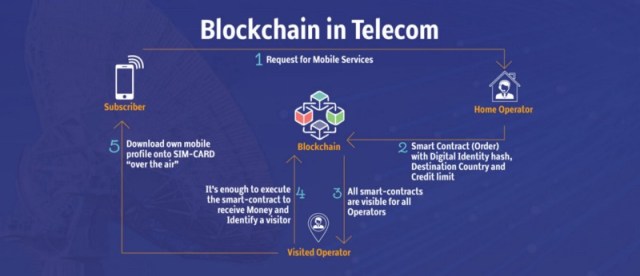
Roaming charges have always been a challenge for CSPs and the consumer. Blockchain promises to solve it. According to a report prepared in advance of the 2019 Telco Blockchain Forum happening in May in London, Blockchain could simplify the process. Blockchain in Telecom, for example, is developing a blockchain- enabled system for opening the global telecoms market to small mobile operators, which would be able to use the resources of larger companies, and in turn, operators can expand their subscriber bases
The creation of hybrid blockchains can include both public-facing
and back-end elements which are suitable for purposes including subscriber authentication across borders. Vendors can also launch cost- effective smart contracts to offer roaming services to consumers at local rates without the need for lengthy payment clearing or exchanges between local and global operators.
For example, Bubbletone is the developer of a roaming network that permits consumers to keep their existing e-sim while taking advantage of local rates. Carriers and consumers are directly connected through a blockchain-based marketplace, allowing subscribers to become customers of local companies temporarily and allow them to select from plans and pricing available on the platform. Prepaid plans are also offered by way of smart contracts on the platform.
To sum up the advantages of blockchain from a commercial viewpoint, with an eye to maximising profit, Applications of the blockchain and
smart contracts include subscriber authentication, improved account security, roaming contracts, and mobile transactions. Moreover, distributed ledger technology, when implemented correctly, can provide a cost-effective way to reduce operational expenditure for rapid transactions
Blockchain and 5G
First, let me recap on what 5G is, and its potential, as well as its downsides, for those who may not have been following the debate.
5G is the next generation in mobile networks. It’s a significant leap from 4G to what 5G promises. Basically, 5G is being designed to meet the very large growth in data and connectivity of today’s modern society, the internet of things with billions of connected devices, and tomorrow’s innovations. It is currently being developed and trialled ready for commercial launch from 2020 and widespread availability of 5G services is expected by 2025.
In addition to delivering faster connections and greater capacity, a very important advantage of 5G is the fast response time. For example, 3G networks had a typical response time of 100 milliseconds, 4G is around 30 milliseconds and 5G will be as low as 1 millisecond. This is virtually instantaneous opening up a new world of connected applications. To achieve this speed, 5G uses radio waves or radio frequency (RF) energy to transmit and receive voice and data connecting our communities.
5G will enable:
1. The Internet of Things or machine-to-machine communication. This involves connecting billions of devices without human intervention at a scale not seen before.
2. Enhanced mobile broadband, New applications will include fixed wireless internet access for homes, outdoor broadcast applications without the need for broadcast vans, and greater connectivity for people on the move.
3. Faster communication that allows real-time control of devices and industrial robotics, and the possibility of remote medical care and procedures.
As the World Health Organisation and EMF explains “5G will keep us connected in tomorrow’s smart cities, smart homes and smart schools, and enable opportunities that we haven’t even thought of yet.”
Why is there opposition to 5G?
Previously mobile broadband networks have focused on connecting people, but 5G is also focused on connecting machines.
The idea behind 5G is to use untapped bandwidth of the extremely high-frequency millimeter wave (MMW), between 30GHz and 300GHz, in addition to some lower and mid-range frequencies. But buildings, trees and plants absorb these frequencies; so more cell towers will be needed. There could be one every few feet from wherever you are. This article from eluxe magazine outlines the health concerns arising from the proliferation of towers and the exposure to more radio waves.
The political and ethical aspects of 5G
MIT Technology Review suggests 5G is a “Technological paradigm shift, akin to the shift from the typewriter to the computer.” And as The Politicalists have said in a Medium article: “We’re talking permanent connectivity way beyond checking your mobile every few minutes — it’s wearables or implants, smart cities, neural networks.”
There are political ramifications of such a connected world, particularly regarding data storage and privacy. Here’s a possible scenario in a 5G world: “Imagine, you’re walking down the street in your town.
The pavement itself is tracking the speed at which you’re walking, your heart-rate, the shoes you’re wearing, the route you’re taking. All as a means to hoover up data to then pass on to whichever service suppliers or governmental organisations are willing to purchase it.”
As The Politicalists suggest, Nike will be tracking how many people are walking in their shoes, Google Maps will track the speed you walk at and provide you with a personalised route from A to B,, and Tinder will check your heart rate to see if you pass anyone you find attractive and then it will send you their profile. Yes, it sounds freaky.
So from a political perspective, there will be much legislation required, much debate and discourse around how we want our data used, where and when.
Why are governments banning Huawei in their 5G ?
It is all to do with national security.
At the moment a lot of the discussions about 5G have been overshadowed by the media storm around Huawei, the Chinese telecoms giant. President Trump has just declared a national emergency over Huawei and no US firms are allowed to use components made by the company. In the UK, a former head of MI6 has stated that Huawei poses a threat to the nation’s national security, because its operations are “subject to influence by the Chinese state,” although the current government led by Theresa May has agreed that Huawei can supply non-core components for the UK’s 5G system.
Huawei says it has never engaged in espionage or allowed its technology to be knowingly hacked by the Chinese state, but the number of countries that don’t believe this is growing. In the Netherlands, there is concern that Dutch operators who use Huawei hardware and software in their mobile networks are giving China a “back door” to customer data and described it as being “like a smoking gun with possible geopolitical consequences”. Australia, New Zealand and Japan have already banned Huawei from their 5G networks.
Well, use somebody else you’re probably thinking. Unfortunately, as British Telecom’s Chief Architect pointd out recently, “there is only one true 5G supplier right now and that is Huawei — the others need to catch up.”
However, one thing is certain; despite the debate over Huawei, 5G is coming. The question then is, can blockchain work with 5G to deliver a more cost efficient service.
The benefits of blockchain deployment with 5G
Tim Sloane, VP, Payments Innovation at Mercator Advisory Group has written an interesting article about the economic benefits of blockchain and 5G working together in telecoms. He discusses the argument that 5G will drive IoT deployment and that IoT devices will utilise Blockchain as a layer of security. However, as he points out, W3C is already securing DNS and HTTP in order to deliver greater security using the public/private key pairs that blockchain also uses. He suggests that blockchain may be better used for data distribution, providing it operates at faster speeds.
He refers to an article from IBINEX News: “The major bottleneck while connecting the devices through 5G is related to their safety concerns, and that’s exactly where blockchain can be of immense help. Thanks to the high-security system of blockchain which provides immutable, tamper-resistance records, the issue of forging and hacking can be easily handled.”
But he concedes that blockchain does have a role to play in security: “Each device will be having its own blockchain address and can be registered according to that particular address, thereby protecting its identity from the other devices.”
The blockchain may also assist operators with the upcoming
rollout of 5G. According to Huawei, blockchain projects currently underway often align well with 5G architectures, including distributed system use and low-latency computational node usage. Blockchain could even improve existing architectures by simplifying underlying processes and allow
for better resource allocation through decentralized management systems.
The economic benefits of blockchain in telecoms
The Blockchain Council makes a strong case for using blockchain in telecoms, as might be expected. As it says, “One of the most important things for telecom companies is to innovate in a highly competitive market while at the same time reducing costs.” It sees Smart Contracts as the key to cost cutting, because telcos “provide a lot of automation in their internal operations like billing, roaming, and supply chain management. By using smart contracts to handle all of the billing related to roaming, telcos can save a lot of money because of prevention against fraudulent traffic.”
Furthermore, blockchain can enable telecoms companies to deliver a host of new revenue streams. These include:
· Digital asset transaction — micropayments for music, mobile gaming etc
· Digital ID verification — telcos can offer an ID verification service
· Ecosystems for collaboration — Telcos have a unique opportunity to offer a new era of digital service in advertising and IoT.
And as the Blockchain Council suggests, IoT devices are set to become a $100 billion industry by 2020 and would require millions of machine-to-machine (M2M) payments to work. This is where telecoms companies using blockchain could clean up, while also ensuring security, accessibility, lower costs and the evolution of new revenue streams.
JP Morgan’s CEO Jamie Dimon may have said unflattering things about bitcoin and cryptocurrency generally, but his bank is pursuing the profit in blockchain technology.
Bank consortium and blockchain
Back in October 2017 the bank, which just happens to be the biggest in the USA, revealed that it and several other banks were conducting tests with sending payments using blockchain technology. The banks acknowledged that using decentralised ledger technology (DLT) would simplify the process and reduce the time involved in the process from “weeks to hours.”
The group of banks, now naming themselves the Interbank Information Network (IIN) grew in number, all of them seeking to leverage the power of the blockchain. Some have been testing the use of Ripple’s technology, while others have been exploring Hyperledger and the Enterprise Ethereum Alliance platforms.
Some see it all as a way of getting media attention: mention ‘blockchain’ in your press release and the story is bound to find its way to print is the thinking. But Michael del Castillo at Forbes, writes that there is a little-known economic principle powering the phenomenon. He refers to a research paper from Prysm: “Called “hold-up,” the principle dictates that when an individual invests in a group project, that investment is worth more as part of the group than outside it, giving others bargaining power equal to the investment.”
Tackling the ‘hold up’ principle
He describes the principle as being similar to the ‘hold up’ in a bank robbery. He says, “Like an old-fashioned bank robbery, the unlucky investor can essentially be “held up” for the value of the funds and other resources invested in the group and forced into undesirable situations, discouraging participation in the consortium at all and undermining even the greatest potential benefits.”
What he is getting at is that blockchain removes the ‘hold up’ situation. In the IIN consortia using blockchain allows members to share data, “without requiring that they hand over control of the actual data itself, where it could be easily copied and drained of its value.” As del Castillo sums it up, “As a result, competitors linked together via a blockchain are free to invest in common goals, and if they choose to leave the group in the future they can take their data with them as easily as one moves a bitcoin.”
And there is money to be made from it. Research company Gartner estimatesthat the business value locked up in these blockchain consortia and elsewhere in the industry will reach $3.1 trillion by 2030.
It is not only banks that are forming blockchain consortia. Across the medical industry there are new groupings emerging all the time, and the automobile sector is another.
Industry consortia want to solve blockchain snags
But there are still some snags to be ironed out, especially regarding the ‘hold up’ scenario. The Prysm research suggests that consortia creators identify past causes of hold-up in their industry and code smart contracts that account for them, and that the data is “structured in a way that is readable both on or off a blockchain, making it easier to not only integrate with other consortia, but leave them.”
Some answers, or remedies, that will allow competitors to work together more effectively are to be presented at Consensus 2019 this week. We are seeing progress in the adoption of blockchain that goes beyond it being confined to being the technology that has ‘something to do with cryptocurrency’.


 Mehran Muslimi