Navigating the Complex Relationship Between AI and Web3

In today’s rapidly evolving tech landscape, two prominent trends are at the forefront: Artificial Intelligence (AI) and Web3. While each has the potential to revolutionize industries on its own, their convergence presents a unique set of challenges and opportunities. In this article, we’ll explore the intricate relationship between AI and Web3, dissecting their core principles, examining potential roadblocks, and uncovering ways they can collaborate effectively.

Understanding the Core Ideas

Let’s begin by dissecting the fundamental principles of AI and Web3. Web3 represents the next phase of the Internet, transitioning from the centralized Web 2.0 model, where data is controlled by a few major entities, to a decentralized paradigm where users own and control their data. In contrast, AI relies on vast datasets to learn and perform tasks efficiently. AI models, particularly neural networks, depend on the availability of extensive data for training.

The Clash of Principles

At its core, Web3 promotes decentralized data ownership, ensuring that no single entity has control over user data. This approach directly contradicts AI’s reliance on centralized data access for effective learning. The clash of principles arises from the fact that AI models thrive on extensive, often centralized, datasets, while Web3 aims to distribute data ownership.

Challenges Ahead

The challenges of integrating AI into the Web3 ecosystem are multifaceted. First, decentralized AI-powered systems may suffer from performance issues, as they require a multitude of user GPUs operating continuously to match the processing power of a single specialized GPU in a centralized cloud. This poses a significant hurdle to achieving the required speed and efficiency.

Decentralization vs. Fraud Detection

Consider the application of AI in fraud detection, a crucial element in the financial sector. AI-driven anti-fraud mechanisms analyze vast datasets to detect and prevent fraudulent activities in real-time. However, in the Web3 environment, decentralized data ownership complicates the process. Identifying transaction senders, recipients, and purposes becomes more intricate, limiting the availability of relevant data. Additionally, real-time anti-fraud AI assessments could significantly slow down transaction processing, contradicting Web3’s goal of seamless and rapid transactions.

The Risk of Centralization

Moreover, entrusting centralized AI systems with the responsibility of detecting fraud could inadvertently reintroduce centralized control and undermine the decentralized ethos of Web3. This challenge highlights the potential risk of reverting trust back to automated centralized systems.

A Symbiotic Relationship

Despite these formidable challenges, AI and Web3 can coexist effectively, but the integration must be approached differently. Rather than embedding AI directly into the Web3 infrastructure, it can serve as a complementary asset. Specialized AI models designed explicitly for crypto and blockchain analytics can provide insights into market trends, user behaviors, and potential vulnerabilities within a blockchain, all while preserving the decentralized core of Web3.

Enhancing the User Experience

AI can also play a crucial role in user education within the Web3 ecosystem. As more services, platforms, and tools are built around Web3, AI-driven platforms can simplify and translate complex information related to blockchain and crypto, ensuring that the average user can participate meaningfully in this digital revolution.

Real-World Applications

To illustrate this symbiotic relationship, consider Grap3, a project aiming to simplify the creation of smart contracts using AI. Grap3 allows users to describe smart contract requirements in plain language. A neural network, powered by a linguistic model, then guides users through a series of questions to generate a ready-to-use smart contract. This example showcases how AI can enhance the Web3 experience without compromising decentralization.

The Path Forward

In conclusion, while the direct integration of AI into Web3 presents challenges due to their distinct principles, there are avenues to harness the strengths of both. Crafting solutions that allow AI and Web3 to coexist and complement each other without compromising their core values will be essential. As the tech landscape evolves, this symbiotic relationship holds the potential to unlock new dimensions of digital innovation, benefiting industries and users alike.

Did you like this post? Do you have any feedback? Do you have some topics you’d like me to write about? Do you have any ideas on how I could make this better? I’d love your feedback!

Feel free to reach out to me on Twitter!

Blockchain’s Role in a Sustainable Energy Revolution

The global call for renewable and sustainable energy sources has never been louder. In this quest for a greener future, blockchain technology is emerging as a powerful ally. Its potential to revolutionize the energy sector and facilitate the creation of a decentralized carbon market is increasingly evident. This article delves into the transformative role of blockchain in renewable energy, decentralized carbon markets, and beyond.

Understanding Blockchain’s Basics

Blockchain, at its core, is a decentralized ledger technology that creates immutable digital databases across a peer-to-peer network. It functions as a digital notary, providing an auditable and transparent record of energy production and consumption. Three fundamental properties underpin its role in the renewable energy sector.

  1. Immutability

Blockchain’s immutability feature ensures that once data is recorded, it remains unaltered. This security feature safeguards against fraud and malicious activities, allowing consumers to trace renewable energy units to their source without fear of data tampering.

2. Transparency

Blockchain offers unparalleled transparency and traceability, allowing consumers to verify the authenticity of their energy source through unchangeable, time-stamped logs. This transparency builds trust in the system and promotes renewable energy adoption.

3. Decentralization

Blockchain’s decentralized nature empowers individual and small-scale energy producers to generate and sell green energy. Through peer-to-peer systems and smart grids, blockchain certifies energy sources, accelerates transactions, and ensures auditable records, reducing reliance on fossil fuels and eliminating intermediaries.

Blockchain’s Impact on the Renewable Energy Market

The renewable energy market is poised for significant growth, projected to increase by nearly $1 trillion from 2023 to 2030. Various stakeholders are capitalizing on blockchain’s advantages in the energy sector, including major energy firms, national grid operators, and innovative startups.

Decentralized Carbon (Energy) Credit Markets

Blockchain introduces the concept of Renewable Energy Credits (RECs), which validate clean energy generation without directly transmitting the energy. RECs represent proof of renewable energy generation and are tradable commodities. This market is expanding rapidly, with the U.S. REC market forecasted to grow from $11.45 billion in 2021 to $26.5 billion in 2030.

Real-Life Use Cases

  1. Blockchain Reducing Carbon Footprints

Blockchain-powered decentralized carbon markets enhance traceability and efficiency in carbon trading. This technology facilitates transparent and efficient carbon tracking and trading, allowing the purchase of carbon credits to fund emission-reduction projects.

2. Blockchain in Solar Energy

Local energy marketplaces, like the Brooklyn Microgrid, utilize blockchain to enable prosumers (residential and commercial solar panel owners) to sell excess solar energy to neighbors. This decentralized approach streamlines energy trade, promoting sustainability.

3. Wind Energy and Blockchain

Iberdrola Group, a Spain-based energy company, utilizes blockchain to certify its renewable energy supply chain’s green origins. This ensures traceability and transparency from energy production to consumption.

Blockchain’s Role Beyond Energy

Blockchain extends its utility to electric vehicles (EVs), smart grid management, and IoT sensors for precise carbon emissions monitoring. It enables EV batteries to store and sell excess energy back to the grid securely.

Bitcoin’s Energy Usage Debate

While blockchain offers sustainable solutions, concerns persist over the energy-intensive nature of proof-of-work mining, notably in Bitcoin. Initiatives seek to address this issue by advocating for a shift in Bitcoin’s mining algorithm.

Challenges and Opportunities

To reach its full potential, blockchain must meet technical benchmarks of security, speed, and scalability. Regulatory clarity is essential, fostering a decentralized energy system with optimal infrastructure and fair pricing. Despite these challenges, blockchain is already enhancing efficiency and reducing waste in the energy sector, promising a cleaner, more sustainable future.

Blockchain’s transformative role in renewable energy, carbon credit markets, and sustainability is undeniable. As the world shifts toward renewable energy sources, blockchain’s impact on creating a greener, more efficient future is becoming increasingly promising.

Did you like this post? Do you have any feedback? Do you have some topics you’d like me to write about? Do you have any ideas on how I could make this better? I’d love your feedback!

Feel free to reach out to me on Twitter!

Generative AI and Extended Reality: A Transformative Partnership

Virtual and augmented reality technologies have been steadily advancing, but their fundamental mechanics have remained relatively unchanged over the decades. However, the recent rise of generative AI platforms, with ChatGPT at the forefront, signifies one of the most promising and complementary innovations for extended reality (XR) in a generation.

Generative AI, when combined with XR technology, has the potential to redefine our interactions with both real and digital environments, all from the screens of our smartphones. When working in synergy, these technologies can construct expansive and immersive worlds that feel more realistic than ever before.

The Emergence of Generative AI

Generative AI, exemplified by ChatGPT, has gained significant attention in recent months. Users are already harnessing this software to generate copious amounts of rich content based on concise prompts. But how exactly can generative AI and XR technologies form a symbiotic relationship that revolutionizes how we consume entertainment and work online? Let’s explore this transformative partnership.

How Generative AI Complements XR

To understand the potential synergy, let’s revisit what generative AI entails. While ChatGPT is the most prominent example today, generative AI technology has been rapidly evolving. It enables users to swiftly generate content based on specific inputs, spanning text, images, sounds, animations, 3D models, and various other forms of data.

Generative AI operates by employing neural networks to discern patterns and structures within existing data. This understanding of existing content empowers the software to create entirely new content. So, what does this mean for XR, particularly in cases involving expansive digital environments?

Limitless Possibilities for XR

Generative AI has the potential to usher in a new era for gaming where the creation of new levels becomes limitless. In general use, VR users would no longer be confined to predefined maps when exploring virtual worlds. Instead, AI would learn and understand the existing environments within a program, generating entirely new environments based on specific prompts.

We’re already witnessing the transformative impact of generative AI in enhancing XR. Major companies are adopting this technology to great effect. For example, in stable diffusion VR, artificial intelligence can create virtual reality worlds dynamically. This approach could bring substantial cost benefits to the video game industry, reducing development time and computational power requirements for expansive maps.

Popular games like Minecraft already employ generative AI to create randomly generated, unique worlds for players to explore. Text-based games like AI Dungeon rely heavily on AI algorithms to create new scenarios as players progress.

Empowering VR Creators

Generative AI isn’t just transforming user experiences; it’s also empowering content creators. Platforms like Roblox are leveraging generative AI to enable more creators to build in-game environments, even if they lack 3D modeling expertise. Roblox is enhancing its content creation services, making it easier for creators to construct immersive experiences. This democratization of content creation opens the door for more players to become creators themselves.

Challenges and Considerations

While the future of generative AI within XR holds immense promise, it’s not without its challenges and considerations. Prolonged exposure to XR environments, particularly for younger players, may raise health concerns. This could necessitate new guidelines for healthy playing times.

Building the Future of Reality with AI

Despite these challenges, the emergence of generative AI represents a watershed moment in the development of XR technology. It has the potential to not only construct VR worlds but also manage them, adapting and evolving environments based on user trends and behavior.

Whether AI is tasked with maintaining VR worlds mirroring Earth’s geological and meteorological conditions or crafting landscapes subject to fantastical and ever-changing scenarios, the possibilities are vast with generative AI at the helm.

In summary, as reality technology continues to mature, the emergence of generative AI is poised to be a pivotal moment for the industry. By creating entirely new environments and populating them with features, XR and generative AI form a formidable partnership that holds the key to the industry’s future. Together, they can redefine how we interact with digital and physical realities, opening up boundless opportunities for innovation and immersion.

Institutional Adoption of Cryptocurrency: The Next Big Wave

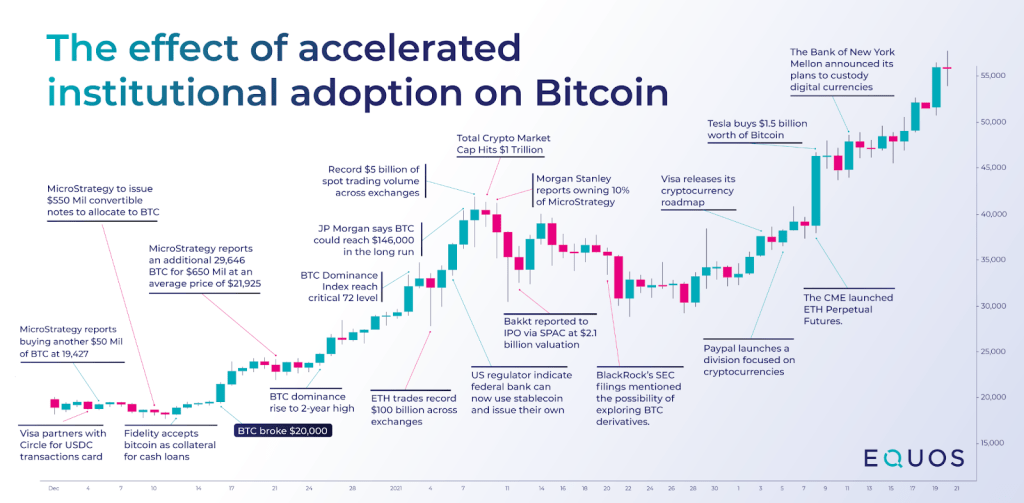
The world of cryptocurrency has come a long way since the inception of Bitcoin. What was once considered a fringe movement for tech enthusiasts and cypherpunks has now entered the mainstream. The most recent crypto ownership survey by Finbold reveals that 10.2% of the global internet-using population owns some form of cryptocurrency. While retail adoption is noteworthy, what’s even more intriguing is the rising interest from institutions, particularly in the realm of Web3 and digital assets. In this article, we’ll explore the institutional adoption of cryptocurrencies, including trends, challenges, and what the future may hold.

Institutional Interest in Cryptocurrency

The rise of Web3, characterized by decentralization, privacy, and blockchain technology, has piqued the interest of institutional players, including Fortune 500 companies. According to a report by The Block, 52% of Fortune 500 companies have explored Web3 initiatives. While the “institutions are coming” narrative has been circulating for years, recent developments suggest a more tangible shift.

Bitcoin ETFs: A Game Changer?

One of the most optimistic developments is the filing of a Bitcoin ETF by BlackRock, a leading global investment manager. Despite previous rejections by the SEC, Bloomberg analysts predict a 65% chance of approval for this ETF. This application marks a significant step toward bridging the gap between traditional finance and the crypto space. A successful Bitcoin ETF could open the floodgates for institutional capital.

Crypto Assets Under Management (AUM) on the Rise

Cryptocurrencies are no longer just a curiosity; they are viewed as a legitimate asset class. Digital asset management review by CCData indicates that the total AUM for digital asset investment products reached $33.7 billion in July 2023, up from $22 billion a year ago. This increase is impressive, considering the challenges the crypto market faced, including the Terra collapse.

Bitcoin-based products dominate the institutional space, accounting for 71% of the market share. Ethereum-based products come second, constituting 22% of the market.

U.S. Dominance in AUM, Fueled by Grayscale

The U.S. has yet to approve a Bitcoin ETF, but institutional investors are showing a significant appetite for Bitcoin and Ethereum-based products. Over 70% of the capital in the U.S. flows through Grayscale, a crypto asset manager offering exposure to Bitcoin through the Grayscale Bitcoin Trust (GBTC). As of July 2023, GBTC’s AUM stood at $18.6 billion.

The recent narrowing of the GBTC discount, influenced by ETF applications, suggests growing institutional demand. When the discount narrows, it indicates increasing demand for the GBTC trust, indicating institutional accumulation.

Hedge Funds: Navigating Risk and Reward

Hedge funds, which experienced a challenging year in the crypto market in 2022, are cautiously optimistic about 2023. While the number of hedge funds investing in crypto assets dropped from 37% to 29%, 93% of them expect higher crypto market valuations in 2023 compared to the previous year. Hedge funds are also diversifying their investments beyond Bitcoin, exploring niche products and altcoins.

DeFi and the Gradual Shift

Decentralized Finance (DeFi) has gained traction, with traditional institutions like JPMorgan conducting DeFi transactions on public blockchains. The number of hedge funds using decentralized exchanges (DEXs) has been steadily increasing, with Uniswap, dydx, Curve, Sushiswap, and Pancakeswap among the top choices.

Family Offices: Growing Interest

Family offices are showing increased interest in digital assets, with 56% of them already investing in cryptocurrencies. While they currently allocate a small percentage of their wealth to digital assets, over 35% plan to increase their exposure in the future.

Bitcoin in the Boardroom

Publicly traded companies have also entered the crypto arena, with firms like Microstrategy, Tesla, and Coinbase investing in Bitcoin. Microstrategy, in particular, holds a substantial amount of Bitcoin, with its CEO, Michael Saylor, being a prominent Bitcoin advocate.

NFT Collections: Enhancing Digital Presence

NFTs are not only about art and collectibles; they offer a new way for institutions to engage with the digital realm. Nike, for instance, has partnered with EA Sports to integrate NFT-designed apparel into video games. Fortune 100 companies have generated $1.6 billion in secondary sales from digital collections.

The Awaited Bitcoin ETF

The question of whether the U.S. SEC will approve a Bitcoin ETF remains paramount. BlackRock’s application has sparked optimism, but past rejections cast a shadow of uncertainty. However, if approved, the ETF could significantly impact the crypto market, given BlackRock’s $9 trillion in AUM.

Major Hurdles in Institutional Adoption

Two major hurdles remain for institutional adoption: regulation and crypto custody. Regulatory uncertainty continues to challenge the industry, with evolving compliance costs. Custody remains a critical concern, as recent hacks highlight the importance of secure storage solutions.

Institutional adoption of cryptocurrencies is still in its early stages, with many opportunities and challenges ahead. As the regulatory landscape evolves and security measures strengthen, the institutional presence in the crypto space is expected to expand. The trends discussed in this article offer a glimpse into the future of finance, where traditional institutions and digital assets coexist and collaborate.

Did you like this post? Do you have any feedback? Do you have some topics you’d like me to write about? Do you have any ideas on how I could make this better? I’d love your feedback!

Feel free to reach out to me on Twitter!