
Unlocking a Breakthrough: Three Key Elements

A breakthrough — that elusive moment when the impossible suddenly becomes possible. We all crave it, but what exactly is a breakthrough, and how can you make it a reality in your life? Let’s delve into this profound concept and explore the steps to attain it.

*Defining Your Breakthrough*

Before we embark on this journey, it’s vital to personalize your understanding of a breakthrough. There’s no universal definition; it’s a deeply personal experience. To me, a breakthrough is that pivotal instant when everything changes, shattering the barriers of what you once thought was unattainable. But crucially, it’s not enough to merely think about it; you must act upon it.

People often find themselves trapped in emotions like sadness, acceptance, or anger. To initiate change, you must acknowledge that your entire life can transform in a single moment. The truth is, you’ve likely experienced breakthroughs before, even if you didn’t recognize them.

*Recalling Past Breakthroughs*

Think back to moments when you grappled with a persistent challenge or desired a change but couldn’t muster the willpower to act. You may have come close, procrastinated, and felt frustrated with yourself. Then, a tipping point arrived, and you declared, “No more delays; I’m changing this NOW.”

We’re all capable of creating breakthroughs, but our longing for certainty often keeps us entrenched in our comfort zones. We prefer the familiar devil to the unknown one. However, let’s unveil a formula that can guide anyone toward a breakthrough.

*1. What’s Your Strategy?*

Enthusiasm and positivity won’t suffice if your approach is fundamentally flawed. Imagine wanting to witness a sunset but running east — you’ll never see it. Many people apply ineffective strategies to long-term issues, like the perennial struggle to lose weight.

Instead of blaming a lack of effort, consider reevaluating your strategy. Perhaps it’s time for a hormone panel assessment, optimizing nutrition, or addressing unresolved trauma. The key lies in adopting a strategy tailored to your unique circumstances.

*2. What’s Your Story?*

Your beliefs shape your reality. If you’re not succeeding, it’s likely due to the story you’ve constructed around your goals. Earl Nightingale’s anecdote about two friends who took divergent paths despite similar backgrounds underscores the power of our narratives.

Consider the stories you’ve woven around your challenges. How might rewriting these narratives change your approach and, consequently, your life?

*3. What’s Your State?*

Energy is the foundation of transformation. Your physical state profoundly impacts your mental and emotional well-being. In the right state, you can craft an empowering story and devise an effective strategy.

Don’t take your physical state for granted. Shift it intentionally. Your psychology follows your body’s cues. Just as athletes have warm-up routines and inspiring speeches can sway the course of history, you too can control your state to become unstoppable.

In your pursuit of a breakthrough, remember to align your strategy, story, and state. With these three elements harmonized, there’s no challenge too formidable to overcome. Breakthroughs are within reach every day — seize them with conviction.

Here’s to the countless breakthroughs awaiting you on your journey!

Did you like this post? Do you have any feedback? Do you have some topics you’d like me to write about? Do you have any ideas on how I could make this better? I’d love your feedback!

Feel free to reach out to me on Twitter!

Silent Witness: Is Your Car Listening Too Closely?

Your vehicle possesses remarkable listening capabilities, thanks to the rapid advancements in voice technology and generative AI. However, as these innovations infiltrate the commercial automobile industry, questions arise regarding the extent to which our cars should understand us and what we may unwittingly sacrifice in return.

Industry giants like Qualcomm are showcasing systems that promise seamless integration between on-board voice assistants and real-time data from the cloud. In essence, cars are evolving from mere transportation devices into intelligent, autonomous platforms, as Jim McGregor, the principal analyst for TIRIAS Research, aptly puts it.

Qualcomm recently announced a partnership with SoundHound to develop and test SoundHound Chat AI for Automotive. This voice assistant, equipped with generative AI capabilities, will be incorporated into the Snapdragon Digital Chassis concept vehicle and the AI-based Snapdragon cockpit platform. SoundHound’s impressive voice recognition and conversational AI capabilities enable drivers to make quick and seamless inquiries.

This platform draws from an extensive pool of over 100 information sources, including third-party large language models. It selects the most relevant response among them, as Qualcomm explained in their announcement. For example, a voice assistant could find a recipe, add the necessary ingredients to a digital shopping cart, and arrange for them to be ready for pickup at the driver’s local grocery store at a specified time. Furthermore, AI can learn and improve over time, adapting to user preferences and suggesting healthier or more authentic options.

However, not everyone believes that these conveniences are worth the trade-off.

Mozilla, a privacy watchdog, recently released its research findings on how automotive brands collect and utilize data and personal information. Their assessment is unequivocal: “Modern cars are a privacy nightmare.” What AI service providers view as revolutionary mega-platforms enhancing convenience, Mozilla’s privacy investigators label as “data-gobbling machines” with unparalleled capabilities to observe, listen, and gather information about a driver’s actions and whereabouts.

The Mozilla team scrutinized 25 automobile brands, including the largest and most popular manufacturers, and found that none of them met their privacy standards. They all received Mozilla’s “Privacy Not Included” warning label, making cars the worst category of products for privacy ever reviewed. Offenses included excessive data collection, data sharing or selling, and inadequate control over driver data.

In particular, Tesla faced additional criticism, as it was only the second product ever reviewed to receive all of Mozilla’s privacy “dings.” The report cited several accidents and fatalities attributed to Tesla’s AI-powered autopilot.

In conclusion, unlike smart faucets or voice assistants, opting out of driving is not as simple, as it is a necessity for many. An American Auto Association survey from 2019 revealed that the average American spends nearly an hour per day in their car, offering ample opportunity for their vehicles to learn a great deal about them.

Did you like this post? Do you have any feedback? Do you have some topics you’d like me to write about? Do you have any ideas on how I could make this better? I’d love your feedback!

Feel free to reach out to me on Twitter!

The Rapid Evolution of Applied AI and MLOps

In a world driven by data and technology, the rapid evolution of applied Artificial Intelligence (AI) and Machine Learning Operations (MLOps) is transforming how businesses operate. From experimentation to full-scale integration, AI is now at the forefront of innovation.

1. Scaling AI for Real Impact: Businesses have shifted from dabbling in AI experiments to integrating AI into their core operations. AI is no longer a novelty; it’s a strategic tool used to improve decision-making, efficiency, and customer experiences.

2. Data, the Lifeblood of AI: High-quality data is the fuel that powers AI. Companies are increasingly investing in data collection, management, and governance to ensure their AI models deliver accurate results. Ethical data practices are gaining importance.

3. The Maturity of MLOps: MLOps, the practice of applying DevOps principles to machine learning, has matured. Companies are automating model deployment, version control, and monitoring, leading to more efficient and reliable AI systems.

4. Overcoming Challenges: Challenges like model drift and data bias persist, but innovative solutions are emerging. Continuous monitoring, interpretability tools, and ethical AI frameworks are helping businesses navigate these hurdles.

5. Future Possibilities: The future of applied AI and MLOps holds exciting prospects. Emerging trends like federated learning, quantum computing, and AI ethics are shaping the landscape, promising even more advanced and responsible AI applications.

In the ever-evolving digital era, applied AI and MLOps are no longer on the horizon; they are here, transforming industries. Businesses that embrace these technologies with an ethical and agile mindset are poised to thrive in this new landscape of data-driven innovation.

Did you like this post? Do you have any feedback? Do you have some topics you’d like me to write about? Do you have any ideas on how I could make this better? I’d love your feedback!

Feel free to reach out to me on Twitter!
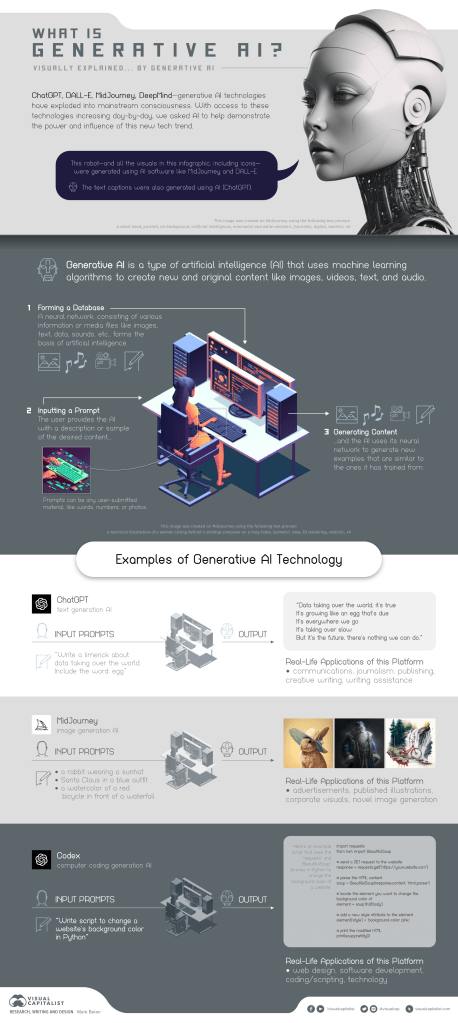
The Growing Impact of Generative AI on Cybersecurity and Identity Theft

In recent years, the advancement of Generative Artificial Intelligence (Generative AI) has revolutionized various industries, from entertainment to healthcare. However, as this cutting-edge technology becomes more sophisticated, it also poses significant challenges to cybersecurity and raises concerns about the potential increase in identity theft incidents. This article explores the growing impact of Generative AI on cybersecurity and the measures needed to protect individuals and organizations from its potential malicious applications.

  1. Understanding Generative AI: Generative AI is a subset of artificial intelligence that focuses on generating data rather than analyzing it. Generative models, such as Generative Adversarial Networks (GANs) and Variational Autoencoders (VAEs), can create realistic and convincing content, such as images, text, and even audio, that resembles authentic human-generated data.
  2. The Rise of AI-Enhanced Cyberattacks: As cybercriminals seek more sophisticated methods to exploit vulnerabilities, they are increasingly turning to Generative AI to launch sophisticated cyberattacks. From generating realistic phishing emails to deepfake audio and video for social engineering, AI-driven attacks are becoming harder to detect and defend against.
  3. Identity Theft in the AI Era: Generative AI has opened the door to new challenges in identity theft. With AI-generated images and videos, malicious actors can create highly realistic fake profiles, further complicating identity verification processes. This could lead to unauthorized access, data breaches, and even reputational damage for individuals and organizations alike.
  4. AI-Powered Fraud and Social Engineering: Generative AI enables attackers to craft convincing social engineering scams that exploit personal information and manipulate individuals into divulging sensitive data. As AI-generated content improves in quality, the effectiveness of these fraudulent campaigns is likely to increase.
  5. Challenges for Cybersecurity Defenses: Traditional cybersecurity defenses, often reliant on rules and patterns, struggle to identify AI-generated malicious content. Machine learning and AI-powered defense mechanisms are necessary to detect and combat these evolving threats effectively.
  6. The Role of AI in Cybersecurity: While Generative AI poses challenges, it also offers solutions. AI can be leveraged to enhance cybersecurity defense strategies, including advanced threat detection, anomaly detection, and real-time monitoring to identify potential AI-generated threats.
  7. Strengthening Identity Verification: To counter the rise of AI-enhanced identity theft, organizations need to adopt robust identity verification methods. AI-based biometric authentication and multi-factor authentication are some of the tools that can help establish strong user identities.
  8. Educating Users: Awareness and education are crucial in the fight against AI-driven cyber threats. Individuals should be educated about the potential risks of sharing sensitive information online and be cautious when dealing with requests for personal data.

As Generative AI continues to evolve, its impact on cybersecurity and identity theft will become more pronounced. While the technology poses new challenges for defenders, it also holds the potential to enhance cybersecurity strategies. With a proactive approach that leverages AI for defense and fosters awareness among users, we can mitigate the risks and protect ourselves from the growing threats in the age of AI-driven cybercrime.

Did you like this post? Do you have any feedback? Do you have some topics you’d like me to write about? Do you have any ideas on how I could make this better? I’d love your feedback!

Feel free to reach out to me on Twitter!