15-Minute Cities: Cities of the Future?

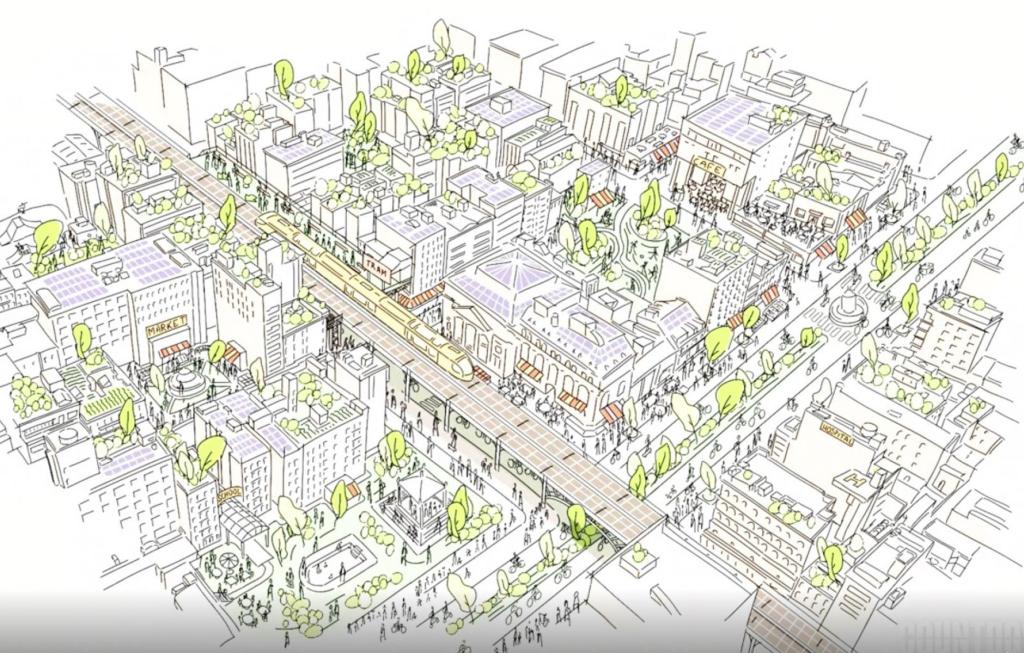
15-minute cities are an urban planning concept that seeks to make a city’s amenities and services accessible within a 15-minute walk or bike ride from every resident. This concept is based on the idea that cities should offer their residents more self-sufficient, healthy, and equitable lifestyles.

The idea of the 15-minute city originated in France in 2016 when Paris Professor Carlos Moreno proposed this urban planning philosophy as part of an urban theory and an urban model. The aim was to reduce car use, improve public transport options, shorten commuting times, reduce air pollution, increase green spaces, reduce noise levels and create healthier living conditions for citizens. Since then, many other cities worldwide have adopted this concept, including Melbourne, Los Angeles, Barcelona, and Tokyo.

How It Works

The 15-minute city works by organizing a city’s services so that everything essential to everyday life is located within 15 minutes of walking or biking from each resident’s home. This includes shops, parks, schools, and medical facilities. It also encourages the use of public transportation and active travel as opposed to private cars for commuting. To make this possible, cities generally have to create more walkable streets with shorter distances between points of interest; increase access to public transport and bicycle infrastructure; improve housing density; develop green spaces; reduce traffic levels; incorporate businesses into residential areas; etc.

The 15-minute city model is different from similar urban planning models in several ways. Firstly, it emphasizes the idea of living within a smaller area with greater self-sufficiency and reducing the need to travel long distances for daily necessities. This differs from other ideas such as smart cities which aim to improve efficiency and quality of life by collecting data about citizens’ movements, purchasing habits, and preferences. This concept focuses on giving residents access to essential services instead of just leisure activities like parks or entertainment centers. The model puts an emphasis on creating a more equitable environment by providing increased access to amenities for all citizens regardless of their economic status. The overall goal is to make cities more sustainable and increase residents’ quality of life.

Which Cities are Implementing It?

Currently, some cities like Bogota, Seattle and Milan are implementing this concept in various ways. In Tokyo, for example, the city is developing a 15-minute living zone by providing more walkable streets and bike paths; increasing access to public transportation; developing green spaces; and decentralizing commercial areas. In Los Angeles, the 15-minute city concept is being implemented by introducing more dedicated bus lanes and reducing car traffic levels in some neighborhoods.

The 15-minute city concept has several advantages. It can help improve air quality; reduce noise levels; increase access to essential services for all citizens regardless of income level or social class; reduce dependence on private cars for getting around; promote healthy lifestyles through active travel such as walking and biking; create more shared public spaces where people can interact with each other outside of their homes, etc.

At the same time, however, this concept has some drawbacks. One of these is that it can be costly to implement as it requires significant investment in infrastructure and other services. Another is that it can create further segregation if not properly planned, as wealthier people tend to have better access to public transport or bike paths than those from poorer areas. Finally, 15-minute cities are inherently unstable; even if they succeed initially, they may not last very long.

Final Thoughts

The 15-minute city concept is an innovative urban planning philosophy that seeks to improve the quality of life for citizens by making essential amenities and services more accessible within a 15-minute walk or bike ride from home. While this concept has the potential to improve air quality, reduce noise levels, and create healthier lifestyles for citizens, it is not without its drawbacks; implementation can be expensive, and there are risks of creating further segregation if not properly planned. Ultimately, cities should consider the pros and cons of this concept before deciding whether or not to implement it.

Did you like this post? Do you have any feedback? Do you have some topics you’d like me to write about? Do you have any ideas on how I could make this better? I’d love your feedback!

Feel free to reach out to me on Twitter!

CENTRAL BANKS TO START HOLDING CRYPTO ON THEIR BALANCE SHEETS

The Bank of International Settlements, BIS, recently released a report titled “ Prudential Treatment of Crypto Asset Exposure.” According to this report, the BIS, which essentially is the Central Bank for all Central banks, released guidelines and operating procedures on how Central Banks can own crypto assets on their portfolios. This comes as a surprise considering the BIS and Central Banks around the world have been increasingly vocal in their opposition towards decentralized cryptocurrencies and stablecoins. This article summarizes this report and lists some of the key highlights the report.

Details of the Report

The guidelines listed in the report are to be implemented by the 1st of January 2025. The report contains standards that will be used by Central Banks across the world to purchase crypto assets and include them on their balance sheets. It was drafted in close consultation with central bank Governors across the world. The aim of this report is two-fold: Firstly, to provide guidelines through which Central banks across the world can hold crypto assets. Secondly, the report aims to preserve financial stability across the globe.

Crypto Asset categories

According to the standard issued, crypto assets will be grouped into two categories: Group 1 and Group 2. Group 1 (a) crypto assets will include tokenized security assets such as stocks and bonds.Group 1 (b) will include centralized stablecoins. Group 2 (a) crypto assets include all decentralized cryptocurrencies as such ETH and BTC. For crypto to be considered as Group 2 (a) crypto, then it has to have a market cap of over $10 billion and a daily trading volume of over $ 50 MILLION. Group2 (b) crypto lumps together all other alt-coins

Before a central bank opts to purchase any crypto assets, there are additional requirements that should be met. Additionally, a rigorous risk test will be carried out to know whether to place a crypto asset in Group 1 or Group 2. Also, if an asset is placed as a group 2 asset, then there is a maximum exposure limit- the maximum amount that can be invested. This exposure limit is currently set at not more than 2% of the bank’s total capital.

Role of BIS in Crypto regulation.

The roles that BIS will play in implementing these new guidelines will be as follows:

· Monitoring the implementation of the standards stated in the report

· Make additional changes and improvements to the report

· Monitor central banks across the world as they implement these new standards.

Central banks will also be required to report to the BIS the crypto assets they are holding and consult with the BIS before classifying a crypto asset as either Group 1 or Group 2. Though not explicitly stated, this essentially means that the BIS will have a sole mandate on giving the go-ahead on whether a central bank can make purchases and how to grade the various crypto assets.

Conclusion

Industry insiders agree that this move may prove to be bullish for crypto assets and especially BTC as central banks have the capacity to provide immense liquidity to the crypto market. However, we also run the risk of centralizing some of these crypto assets as central banks have ‘limitless’ capital to buy large amounts of any particular asset and wield control over it. A good example of how Central banks may wield control over crypto is through the use of synthetic stable coins- basically, stablecoins that have been issued using the native currency of a given country. It is interesting to note that this report mentions nothing about CBDCs. It is assumed that the BIS know that some central banks may lack the technical capacity to implement CBDCs within their jurisdictions. Synthetic stablecoins seem to be a viable option at this stage. Having a huge stake in these stablecoins essentially means that Central banks can have a say in their performance.

Did you like this post? Do you have any feedback? Do you have some topics you’d like me to write about? Do you have any ideas on how I could make this better? I’d love your feedback!

Feel free to reach out to me on Twitter!

Blockchain, AI, and BNPL: Key Drivers of Fintech in 2023

Fintech is still disrupting the financial industry. While there is still a lot of work to be done to streamline and mainstream this sector, there has been significant progress and growth in recent years. More companies and venture capital investments are aligning themselves with fintech, and major tech brands like Apple and Google have launched products in this space. As we move into 2023, here are three top trends that we believe will shape fintech:

Increased use of blockchain solutions: A recent survey by the Stellar Development Foundation and Wirex showed that there is an increased use of cryptocurrency solutions as a way of sending money across borders. The survey covered the US, the UK, Mexico, and Singapore, and found that in developed and emerging markets, cryptocurrency was increasingly used for remittances. More than half of the surveyed individuals felt that they paid too much to legacy remittance providers, while 37% said they did not know how much they paid in fees. Over 80% of surveyed consumers said they were aware of crypto payments, while 45% said they had already used it for remittance. In addition to cryptocurrency payment solutions, blockchain technology has a wide range of use cases in the fintech industry, such as decentralized finance (DeFi). Despite market downturns, the DeFi market cap currently stands at slightly over $38 billion, and more fintech companies are betting on the long-term growth of this industry. A good example is Creditum.io, a fintech company focused on providing fast and frictionless payment solutions, which recently acquired a license to operate as a fully-functional financial company and intends to launch products within the wider Defi ecosystem across Europe.

Artificial intelligence (AI): AI will be a key driver of fintech growth in 2023. Data shows that by 2026, the global market size for AI in fintech will reach over $26 billion, with a continuous annual growth rate of over 23% from 2021 to 2026. Fintech companies will use AI and machine learning (ML) for intelligent decision-making, powering chatbots, providing customer support, and fraud detection. This will make the customer onboarding process easier and increase efficiency within these fintech companies.

Increase in buy-now-pay-later (BNPL) solutions: The BNPL industry is thriving, with estimates showing that it will reach over $500 billion by 2026, up from around $120 billion in 2021. BNPL made up about 2% of global ecommerce in 2021, meaning that for every $100 spent, $2 was from BNPL. The significant growth in this sector can be attributed to the increasing number of merchants accepting these products, as well as partnerships between big ecommerce brands and BNPL companies.

Conclusion: This list is not exhaustive, but it offers a glimpse into some of the areas that fintech players should keep an eye on as we move into the new year. The fintech space is constantly evolving and brands need to create game-changing products within this space, as there is plenty of room for expansion.

Did you like this post? Do you have any feedback? Do you have some topics you’d like me to write about? Do you have any ideas on how I could make this better? I’d love your feedback!

Feel free to reach out to me on Twitter!
From Dogecoin to Twitter: The Making of the Everything App

Depending on whom you ask, Elon is either an egotistical villain or a savior. He is currently the world’s richest man, with a net worth of about 200 Billion. Well, with that kind of money it becomes easy to create products that have a direct impact on people’s daily lives- with huge repercussions.

Now, Elon is not your average billionaire. Most of the time, he has swayed the masses to his favor, much to the chagrin of big tech. This has turned him into somewhat of a cult, with a huge following and an enviable portfolio of companies that seek to upend conventional beliefs and corporations. From Neuralink to Space X , Tesla to the Boring Company, he is an entrepreneur who seeks to “disrupt” global order as he strives to achieve what may somewhat be thought to be impossible — until it’s done.

Twitter Acquisition and Association with Dogecoin

Elon’s recent acquisition of Twitter may not have come as a surprise, seeing the influence this app has on disseminating and sharing “truth”.

He offered to buy it at a ridiculously high rate ( USD 44 Billion)- perhaps an indication that he believed the app was worth a lot more. The buying process was initially marred by accusations and counter-accusations, until the deal finally went through at the end of October 2022. After purchasing it, he said that he intends to make Twitter the most accurate source of information across the world by empowering citizen journalism.

” It is important for the world to have a common digital square where a wide range of beliefs can be debated in a healthy
manner without resorting to violence” ,

he stated in a statement after the acquisition.

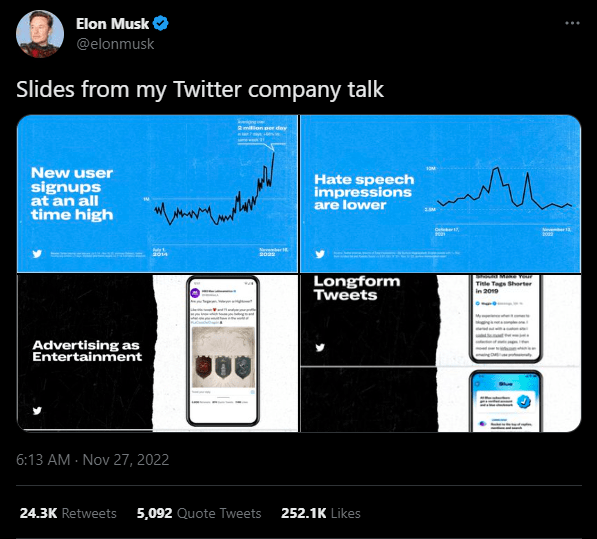
Recently, Elon shared screenshots of an internal meeting he had on Twitter- showing the progress of the platform and future plans that included introducing a payment system. This caused Dogecoin to rally and gained about 19% from the news. The relationship between Elon and Dogecoin isn’t new. From the time Elon bought Twitter, there were rumors that the company has been working on a development that would allow crypto payments, and the market interpreted this to mean Dogecoin would be the choice of crypto. Elon has also been posting dog-themed memes
on his account, perhaps confirming the widely held beliefs that indeed this may be the crypto that would most likely be adopted on the platform.

The Everything App

How he intends to promote global truth, we are yet to know, but one thing is for sure, he is on a mission to redefine this space and we are already seeing lots of resistance from Big tech — If recent rumors of Apple delisting Twitter from its App store are anything to go by. What we also know is that this acquisition may gel well with his desire to create an app that he once called the x app or the everything app- something similar to TenCent’s we chat or Alipay, but for the world.

Also called a super app, an everything app is an app where you can do everything without leaving the app. Think of it as a single app that contains all the digital services you may need-from chatting to booking a hotel,
even hailing a taxi, or making payments to your local store. These apps are dominant in the Asian region. In China, an app like Wechat is ubiquitous and essential for everyday use. More than a billion people have access to We chat in China and use it to do basically everything from paying bills to booking medical appointments. Other apps in Asia that have adopted this model are the Grab app in Malaysia and Singapore and the Line app in Japan.

Elon once mentioned that acquiring Twitter will accelerate the development of X or the everything app by at least three to five years.

We have already started seeing developments geared towards attaining this goal, especially with the launch of Twitter 2.0. It seems that Elon would like to ape the models of Wechat, Grab, and Line but this time scale it up for the global audience. So basically, the X app would be the same as Wechat, but for the world. If the recently shared screenshots on his Twitter page are anything to go by, then the new app will include video streaming, video chats, long texts, and payment platforms- building blocks for a diversified platform.

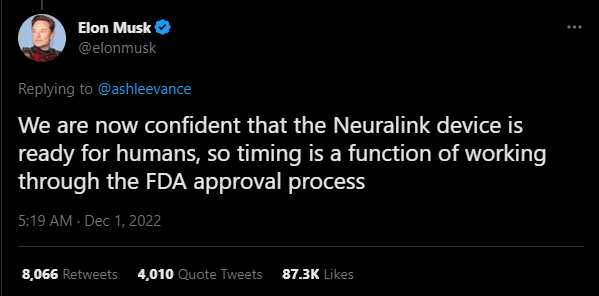
Add Neuralink to all this talk and the conversation on what this app may accomplish changes. Neuralink is a company owned by Elon that wants to implant coin-sized computer chips into human minds.

They recently stated that they are awaiting FDA approvals and will start trials for this in the next 6 months. So, maybe, Elon’s goal for the X app is to ultimately have it work as a computer- chip implanted in human brains and do “ everything”, if it could.

Challenges in Setting up the Everything App

As he pursues this goal, there are hurdles that have to be overcome. Firstly, he is not the only entrepreneur that wants to create this app.

Some companies have already tried this and achieved success (within their geographies). He is therefore bound to face stiff competition from these companies and other big tech companies that are working on this- Facebook is a good example. Facebook is striving to create a platform that will be a melting pot for all online services- from payments to interactions and even booking appointments. Other big tech companies that have also made forays into this domain are Google, Tiktok, and even Uber. Secondly,
most people, especially in the West, are not accustomed to this and may find it hard to adopt a single app that “does everything”. This may explain the modest success achieved by other big tech companies that have tried to launch this kind of app in America. Finally, regulatory hurdles may arise, especially if he were to incorporate crypto payment solutions.

Even with all these bottlenecks, Elon doe not shy away from a good fight. He has demonstrated time and again his ability to get into industries that are considered ‘impossible to penetrate and deliver game-changing products that reshape an entire industry. Wishing him away may not
be an efficient strategy. Savvy investors may try to get into some of the
companies/ solutions that would most likely be adopted into this trend.
Cryptocurrencies like Doge are a good buy at this stage.

It will most likely continue its upward trajectory for as long as Twitter intends to create a payment gateway. However, there is no guarantee that it will be X app’s currency of choice.

Did you like this post? Do you have any feedback? Do you have some topics you’d like me to write about?Do you have any ideas how I could make this better? I’d love your feedback!

Feel free to reach out to me on Twitter!