AI’s First Extinction Event Is Nigh: Why Most AI Startups Are Doomed

For the past three years, AI has been the hottest ticket in tech. Billions in venture funding, explosive hype cycles, and a flood of new startups promising to “revolutionize” industries have created what feels like a modern-day gold rush. But behind the noise, a sobering reality is emerging: most AI startups are not built to last.

We are on the brink of AI’s first extinction event—a mass die-off of companies that raised fast, scaled hastily, and built on foundations too fragile to survive the coming storm. Here’s why.


1. The Infrastructure Problem: Building on Rented Land

Many AI startups don’t actually “own” their technology stack. Instead, they rely on third-party large language models (LLMs) and cloud infrastructure owned by giants like OpenAI, Anthropic, Google, and Amazon.

That creates two existential issues:

  • No moat: If your product is just a thin UI layer on top of GPT, you’re one API call away from being replaced by the platform itself.
  • Rising costs: Cloud compute and inference costs scale badly. For many startups, customer growth actually means losing more money.

When your landlord also happens to be your competitor, survival is not a long-term strategy.


2. The Funding Bubble: Too Much, Too Soon

VCs, eager not to miss the “next OpenAI,” have poured billions into AI companies with little more than a demo and a pitch deck.

But markets don’t reward experiments forever. As capital tightens and investors demand sustainable revenue models, startups built on hype, not fundamentals, will collapse.

History is clear: every tech wave has its Pets.com moment. AI will be no exception.


3. The Differentiation Dilemma

Right now, thousands of AI startups are building chatbots, productivity tools, and verticalized assistants. The problem? They all look and feel the same.

Without deep industry expertise, proprietary data, or defensible distribution, most of these startups are features, not companies.

The survivors will be those that carve out real moats—through unique data sets, domain knowledge, and integrations that can’t be easily copied by bigger players.


4. The Regulatory Reckoning

Governments worldwide are racing to regulate AI, from the EU’s AI Act to U.S. executive orders. While regulation is necessary, it will also raise compliance costs and add friction for smaller players.

Big Tech can afford armies of lawyers and compliance teams. Most startups cannot. This regulatory wave will disproportionately wipe out underfunded challengers.


5. The Talent Squeeze

AI talent is scarce—and expensive. The best researchers, engineers, and product leaders are being snapped up by the giants. Startups are left competing for scraps, often overpaying for teams that can’t match the depth of expertise sitting inside Meta, Google, or OpenAI.

Without elite talent, it’s nearly impossible to stay ahead in a field moving this fast.


What Comes After the Extinction

So, does this mean AI innovation is doomed? Far from it. In fact, the extinction event will be healthy.

It will clear the market of clones, hype-driven pitches, and unsustainable business models—making space for a new generation of companies that truly understand where AI creates value.

The winners will be:

  • Startups with proprietary data and domain expertise.
  • Companies that solve real, painful problems rather than chasing buzzwords.
  • Builders who treat AI not as the product, but as an enabler—integrating it seamlessly into workflows, industries, and daily life.

The Bottom Line

The AI boom has been breathtaking, but it is also unsustainable in its current form. The next 24 months will bring a brutal contraction—thousands of startups shutting their doors, investors licking their wounds, and consolidation under Big Tech.

Yet in that crucible, the strongest ideas and founders will emerge. And just like the dot-com crash gave rise to Google, Amazon, and Facebook, AI’s extinction event will pave the way for the true giants of tomorrow.

The hype cycle is ending. The real work is about to begin.
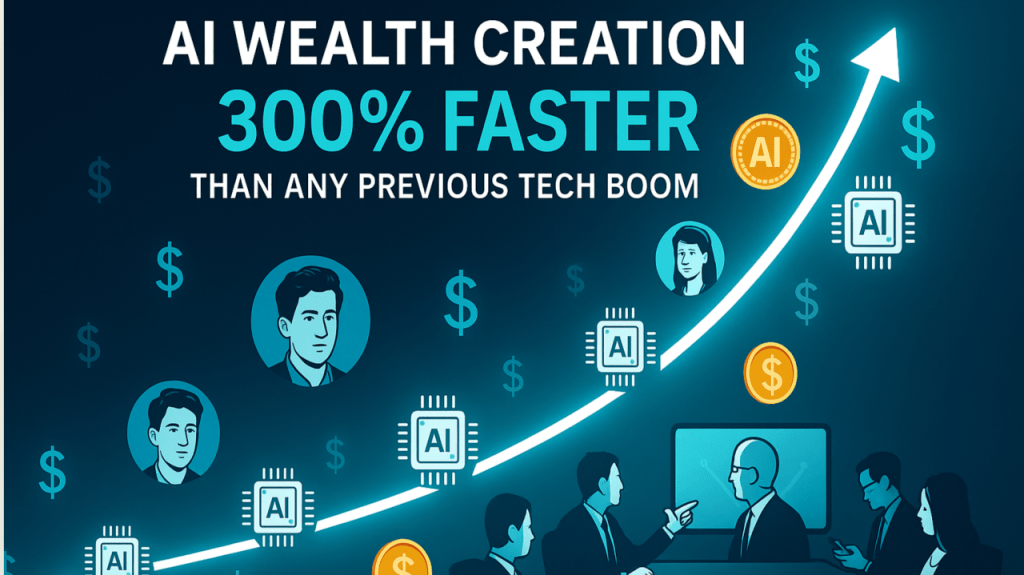
The Uncomfortable Truth: AI Is Creating More Millionaires Than Any Industry in Human History — And 99% Are Missing It

We are living through the fastest wealth transfer in human history, and it’s being powered by artificial intelligence. While most people scroll, stream, and wait for someone to tell them what to do next, a small, focused group is using AI to generate real money, real freedom, and generational leverage.

This isn’t hype. It’s not a crypto-style bubble.
It’s the uncomfortable truth:
AI is creating millionaires—faster, more quietly, and more efficiently than any previous industry or tech boom.

And 99% of people are completely missing it.


Why AI Is Different

Every major wealth wave in history had a barrier to entry:

  • Oil required land and capital.
  • The internet required infrastructure and coding skills.
  • Crypto required early adoption and a risk appetite.

AI requires curiosity, a laptop, and a bias for action.

From solopreneurs to small startups, people are building AI-powered tools, automating workflows, scaling services, launching niche SaaS products, and monetizing information at a speed that was unthinkable five years ago.

What used to take teams of 10 can now be done by 2.
What used to cost $100,000 to build, now costs a weekend and ChatGPT.


The Wealth Isn’t in AI — It’s in Using It

Most people make the mistake of watching the AI race from the sidelines, waiting for some grand opportunity to fall in their lap. But the wealth isn’t just in building the next OpenAI—it’s in leveraging AI to multiply your output, reduce costs, and scale faster than your competitors.

It’s the freelancer automating client reports.
The marketer using AI to A/B test 10x faster.
The solo founder building an MVP in a week instead of three months.
The writer publishing high-value content daily using LLMs.
The agency closing more deals with AI-powered personalization.

The tools are here. The code is open.
The barrier is not access—it’s mindset.


The 99% Trap

So why is almost everyone missing it?

Because this revolution is quiet.
It doesn’t shout like crypto or glow like NFTs.
It’s happening in GitHub repos, late-night Discords, and between lines of Python.

Meanwhile, the average person still thinks AI is just “robots taking jobs” or “chatbots writing emails.”
They don’t see that it’s also:

  • Replacing departments with a single system
  • Creating new micro-economies in every niche
  • Shifting leverage to individuals with insight and execution

By the time most people realize what’s happening, the wave will already be offshore—and someone else will be riding it.


What To Do Now

This isn’t a call to panic. It’s a call to engage.

  • Start experimenting with tools like ChatGPT, Claude, and open-source models.
  • Look at your industry or skill set—ask: How can I use AI to work faster, smarter, or cheaper?
  • Launch something. Build. Sell. Iterate. Learn in public.
  • Follow those who are ahead of the curve. Study what they’re doing—not just what they’re saying.

The AI gold rush is real. But this time, you don’t need to find a mine.

You just need to pick up a shovel and start digging.

Brace for Impact: The Tech Tsunami is Here

The world is standing on the edge of a technological tidal wave—one that will sweep across industries, societies, and economies with unprecedented force. Unlike past innovations that arrived in waves, this one is a full-scale tsunami, a convergence of artificial intelligence, quantum computing, blockchain, biotech, and automation all advancing at once. The future isn’t coming—it’s already here, building momentum beneath our feet.

The Acceleration of AI and Automation

Artificial intelligence is no longer an emerging technology; it’s an unstoppable force. From generative AI that creates hyper-realistic content to autonomous machines replacing human labor, the impact is everywhere. Businesses that fail to adapt risk extinction, while those who embrace AI-driven efficiencies will dominate their industries.

Quantum Computing: The Next Frontier

For decades, computing power has followed Moore’s Law, doubling approximately every two years. But quantum computing threatens to shatter that pace, solving problems in seconds that would take classical computers millennia. This shift will revolutionize cybersecurity, pharmaceutical research, financial modeling, and even artificial intelligence itself.

Blockchain and Decentralization

Decentralized finance (DeFi), NFTs, and smart contracts were just the beginning. The next phase of blockchain technology is set to redefine how we interact with digital assets, data ownership, and global transactions. Governments and institutions are waking up to its potential, signaling a fundamental shift in financial power structures.

The Biotech Revolution

AI-powered drug discovery, CRISPR gene editing, and personalized medicine are accelerating at an extraordinary rate. The fusion of technology and biology is pushing human longevity forward, redefining healthcare as we know it. Diseases that once seemed incurable may soon be eradicated.

A Workforce in Transition

Automation and AI will displace jobs—but they will also create new ones. The workforce of tomorrow will require adaptability, creativity, and a deep understanding of how to collaborate with intelligent systems. The traditional career path is fading, replaced by a landscape of continuous learning and evolution.

Preparing for the Tsunami

This technological shift is not a distant event—it is happening now. Businesses, governments, and individuals must prepare for massive disruptions and opportunities alike. The question is no longer whether we will be affected, but how we will adapt, innovate, and ride the wave instead of being swallowed by it.

A tech tsunami is coming. Are you ready?

Craving the Struggle: Why Our Souls Demand Proof of Work in the AI Age

We live in a time when so much is given to us freely. Every thought can be answered with a query, every desire met with a click. The great machines of artificial intelligence anticipate our needs before we even articulate them. The era of frictionless existence is upon us. And yet, beneath the ease and abundance, a quiet emptiness lingers. The soul, it seems, still demands proof of work.

The concept of proof of work, borrowed from cryptography and blockchain, is a mechanism of validation through effort. It ensures that what is gained has been properly earned. Without it, there is no inherent value—only the illusion of worth. And while it has been used primarily in the digital realm, the idea resonates far beyond finance or computing. It touches something primal within us: the belief that struggle imbues meaning.

Throughout human history, suffering and effort have shaped our narratives. The hero earns glory through trials, the student gains wisdom through rigorous study, the lover proves devotion through patience and hardship. This is the fabric of our myths and lived experiences. The long walk home after a night spent with a dear friend. The quiet endurance of an artist refining their craft. The arduous journey of self-discovery. These are acts of proof, solidifying our presence in the world.

But today, artificial intelligence dissolves these old structures. It offers instant knowledge without study, artistic creation without skill, companionship without depth. We no longer need to experience the slow burn of becoming; we can simply summon results. In doing so, we risk severing our connection to the struggle that once defined us. What happens when effort is no longer required? When every mountain is flattened, every hardship automated away?

It is seductive to think that comfort is the pinnacle of progress. Yet we find, paradoxically, that the more seamless our lives become, the more dissatisfied we feel. We crave the hunger that makes food taste rich, the longing that makes love feel true. AI can synthesize beauty, but can it make us yearn? It can simulate challenge, but can it instill pride? It can tell us who we are, but can it help us become?

Perhaps, then, the antidote is deliberate resistance—a conscious refusal to surrender our proof of work. We must choose to struggle where we could coast, to create where we could consume, to embrace friction where we could seek ease. This is not a rejection of technology but an insistence on soul. To remain human, we must insist on effort. In doing so, we preserve the hunger, the striving, the proof that we have lived.