Happy 17th Birthday, Bitcoin

Past, Present, and Future of the World’s Most Important Monetary Innovation

Bitcoin was born on January 3, 2009, in the aftermath of a global financial collapse that exposed the fragility of centralized monetary systems. Embedded in Bitcoin’s Genesis Block was a quiet but powerful statement referencing the bailout of banks, signaling that this new system was designed as an alternative to monetary mismanagement, political interference, and inflationary finance. What began as a white paper shared by the pseudonymous Satoshi Nakamoto has, seventeen years later, become a cornerstone of the global financial conversation.

Bitcoin’s early years were defined by vision rather than recognition. In a world that believed money required trust in institutions, Bitcoin introduced trust in mathematics, cryptography, and open-source consensus. It functioned without leaders, companies, or governments, operating continuously while critics dismissed it as impossible or irrelevant. Through each block mined, Bitcoin demonstrated that digital scarcity could exist without a central authority. The hard limit of 21 million coins transformed money from something that could be printed endlessly into something governed by transparent, unchangeable rules.

As Bitcoin matured, it survived every challenge placed in front of it. Market crashes, regulatory uncertainty, hostile narratives, and technological scrutiny failed to disrupt the protocol. Instead, Bitcoin grew stronger with each cycle. Its proof-of-work mechanism anchored the digital world to physical reality through energy, creating the most secure computing network ever built. By simply continuing to function, Bitcoin earned trust not through promises, but through performance.

Become a member

Today, Bitcoin stands as a global monetary asset and a digital form of sound money. It is increasingly recognized as digital gold, offering superior portability, divisibility, and verifiability compared to any store of value that came before it. Institutions, corporations, and long-term investors now treat Bitcoin not as speculation, but as protection against currency debasement and systemic risk. Financial products built around Bitcoin have opened access to traditional capital markets, further cementing its role within the global financial system.

At the same time, Bitcoin remains open and permissionless. Anyone with an internet connection can use it, save in it, or transmit value across borders without reliance on banks or intermediaries. In regions suffering from inflation, capital controls, or financial censorship, Bitcoin serves as a lifeline. It allows individuals to preserve the value of their labor and participate in the global economy on equal terms. Scaling innovations such as the Lightning Network have expanded Bitcoin’s utility beyond savings, enabling fast and low-cost payments while preserving the security of the base layer.

Looking ahead, Bitcoin’s future is defined by inevitability rather than speculation. Fiat currencies are structurally designed to lose purchasing power, while Bitcoin is engineered to become more scarce over time. As adoption increases and supply remains fixed, Bitcoin continues to absorb value from weaker monetary systems. This process is gradual, but relentless. Over the coming decades, Bitcoin is positioned to become a global reserve asset, a neutral settlement layer, and a foundation for long-term capital preservation.

Nation-states are beginning to recognize Bitcoin not as a threat, but as a strategic asset. Its neutrality makes it uniquely suited for a multipolar world where trust between governments is limited. Bitcoin offers a monetary standard that no single entity can control, manipulate, or weaponize. At the same time, its integration with energy infrastructure is reshaping how power is produced, distributed, and monetized, turning wasted energy into secured economic value.

Bitcoin’s greatest strength lies in what it does not require. It does not depend on confidence in leadership, political stability, or economic forecasts. It depends only on code, incentives, and consensus. Every year that Bitcoin continues to operate without interruption reinforces its credibility. At seventeen years old, Bitcoin has outlived its critics, surpassed expectations, and redefined what money can be.

Bitcoin is not just a technological achievement. It is a peaceful revolution. It is a system that rewards patience, responsibility, and long-term thinking. It represents the separation of money from centralized control, just as the internet separated information from gatekeepers. Its story is still being written, block by block, and its impact will be measured not in years, but in generations.

Happy 17th Birthday, Bitcoin.
You are no longer an experiment.
You are monetary history in motion.

Bitcoin vs Gold: Only One Can Be the Future of Money

For thousands of years, gold has been the king of value. It built empires, backed currencies, and became the ultimate symbol of wealth. But times have changed. We’re living in a world that runs on Wi-Fi, not warships — and there’s a new challenger in town.

That challenger? Bitcoin.

The digital upstart that doesn’t shine, doesn’t rust, and doesn’t care about borders. It’s fast, global, and immune to the printing presses of central banks. And it’s here to take gold’s throne.

Gold: The Original Heavyweight

Let’s give credit where it’s due — gold has history. It’s rare, it’s beautiful, and it’s been trusted for centuries. But in today’s economy, gold feels a little… slow. You can’t email it, you can’t split it easily, and storing it safely costs money.

Meanwhile, the world has moved online — and digital money needs digital speed.

Bitcoin: The Rebel with a Cause

Bitcoin is what happens when you take gold’s best qualities — scarcity, trust, and independence — and upgrade them for the internet age. There will only ever be 21 million Bitcoins, and no government can change that.

It’s borderless, permissionless, and unstoppable. You can send millions of dollars in Bitcoin halfway across the world in minutes — no banks, no middlemen, no delays.

In a sense, Bitcoin is gold on turbo mode.

Old Money vs. Smart Money

Sure, gold has stood the test of time — but so did horse-drawn carriages before cars came along. Bitcoin is built for a generation that lives online. It’s programmable, trackable, and transparent. Every transaction sits on a public blockchain, meaning no hidden manipulation, no printing more when times get tough.

As governments keep printing fiat currency like there’s no tomorrow, people are waking up to a simple truth: scarcity equals value. Gold is scarce — but Bitcoin is digitally, verifiably scarce. That’s a game-changer.

“But Bitcoin is Too Volatile!”

So what? Every groundbreaking invention starts out bumpy. Remember the early internet? Dial-up modems and 10-minute page loads didn’t stop it from changing everything.

Bitcoin’s price swings aren’t a flaw — they’re growing pains. Each crash weeds out the weak hands, and each recovery brings in stronger believers.

The Future Has Logged On

Gold had a legendary run — it was money for the physical world. But Bitcoin is money for the digital world, and the digital world isn’t going anywhere.

In the end, this isn’t just about price — it’s about freedom, technology, and the future of value. Gold will always sparkle, but Bitcoin? It shines where gold can’t — in the digital economy that runs the modern world.

So if you’re betting on the future, remember this:
Gold was the past. Bitcoin is the future.

Why Most People Are Dead Wrong About Global Wealth (The Numbers Will Shock You)

When we think about wealth, we all believe we have some idea of where we stand. We imagine the “wealthy elite” as billionaires on magazine covers, the “middle class” as ordinary professionals in developed countries, and the “poor” as those struggling in less developed economies. But the truth is far more surprising—and in many ways, far more uncomfortable.

The reason? Our perception of wealth is broken.

Most of us dramatically overestimate how much wealth the average person has, and underestimate how extraordinary even “ordinary” savings or property can look on a global scale. The gap between perception and reality is staggering, and two simple questions can reveal just how misunderstood the landscape of global wealth really is.


The Two Questions That Expose Our Blind Spots

Let’s run a thought experiment.

  1. What percentage of adults in the world own more than $10,000 in assets?
  2. How many people on Earth do you think qualify as millionaires (assets above $1 million)?

Take a guess before reading on.

Most people imagine that at least half the world has $10,000 in assets. And when asked about millionaires, guesses often range in the tens or even hundreds of millions.

The reality?

  • Roughly 70% of adults worldwide own less than $10,000 in total assets.
  • Just 1% of people globally qualify as millionaires.

That means if you own more than $100,000 in property, savings, or investments, you’re not middle class—you’re in the top 10% globally.

And if you’re a millionaire in net worth, congratulations—you are among the rarest 1% of humanity. What feels “ordinary” in one country is “extraordinary” in the world.


The Global Wealth Pyramid

The clearest way to see this imbalance is through what economists call the “global wealth pyramid.” According to Credit Suisse’s latest Global Wealth Report:

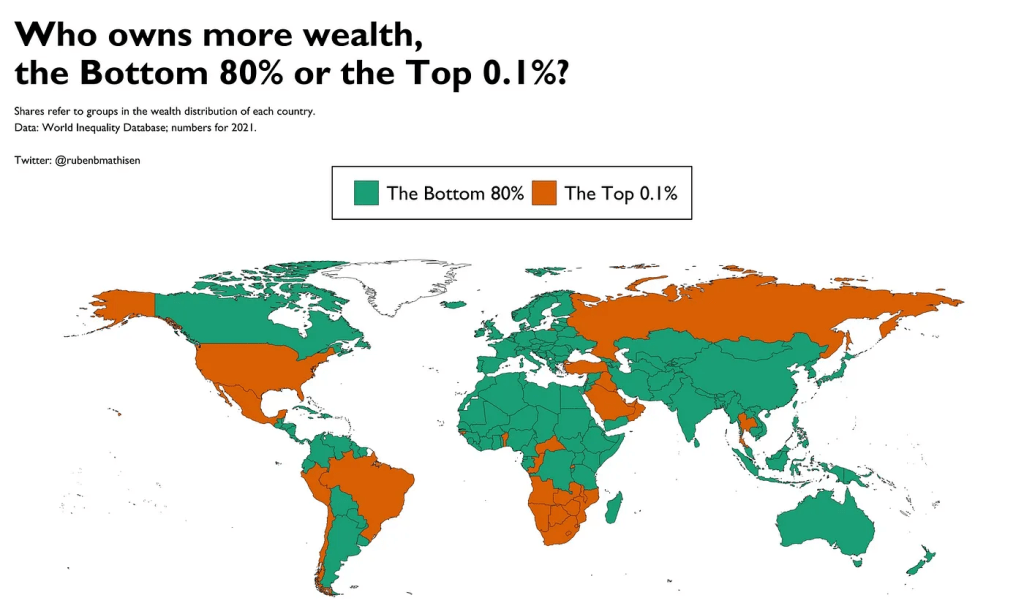
  • Bottom 50% of adults — control just 2% of total global wealth. That’s half of humanity living with almost nothing in terms of assets.
  • Next 40% — together hold about 38% of the wealth, spread thinly across billions of people.
  • Top 10% — control nearly 60% of all wealth on Earth.
  • Top 1% — hold more wealth than the entire bottom 90% combined.

This isn’t just inequality—it’s concentration at an extraordinary scale. Imagine a room of 100 people representing the world. One person in the corner controls more wealth than the other 90 people put together.


Why Do We Misunderstand Wealth So Badly?

The numbers are shocking, but the real question is: why are most people so wrong in their assumptions?

There are a few key reasons:

  1. Relative Perspective
    Humans compare themselves to those around them. If you live in a developed country, you measure your situation against neighbors, coworkers, or the national middle class—not against a farmer in rural India or a street vendor in Nigeria.
  2. Media Distortion
    Our conversations about wealth are dominated by outliers—billionaires, CEOs, tech moguls. We think the global distribution is full of millionaires because we hear about them constantly. But for every billionaire story, there are billions living with little or no safety net.
  3. Psychological Anchoring
    We anchor wealth to local currencies and costs of living. A small apartment in London or New York might feel modest, but on paper, it still represents assets that put the owner in the top tier globally.
  4. The Invisible Poor
    Global poverty is less visible in wealthy nations. In developed countries, even those struggling often have access to infrastructure, credit, and services that obscure just how massive the disparity is.

The Historical Context

Wealth concentration is not new. Empires and kingdoms throughout history often had extreme inequality. What makes today unique is that inequality exists in a globally connected economy. A millionaire in San Francisco competes for assets with a rising middle-class worker in Shanghai, a tech entrepreneur in Nairobi, and a farmer in Brazil who just got access to digital banking.

Globalization has made the wealth pyramid sharper and more transparent. And now, with data flowing freely, it’s impossible to ignore the gap.


Why This Matters for the Future

Understanding the true distribution of wealth isn’t just an academic exercise—it has massive real-world consequences:

  • For policymakers: Extreme concentration of wealth drives political instability, populism, and distrust in institutions. A fragile global balance depends on addressing inequality not only within nations, but across them.
  • For investors: Knowing where real wealth sits highlights where growth will come from. The future isn’t in saturated Western economies, but in billions of people in emerging markets moving from the bottom of the pyramid into the middle.
  • For individuals: Recognizing your true place in the global wealth pyramid changes your mindset. If you’re saving, investing, and building assets—even modestly—you’re already ahead of the majority.

The Uncomfortable Truth

Here’s the uncomfortable truth: if you’re reading this on a laptop or smartphone, with access to the internet and disposable income, you are almost certainly among the wealthiest people on the planet.

What you might consider “just getting by” would be viewed as unimaginable luxury by billions of others.

And this gap matters—because as wealth continues to concentrate, those with even modest savings or investments have an opportunity to position themselves in ways billions cannot.


Final Thought

Most people are dead wrong about global wealth because we see it through a distorted lens. We think locally, but the real story is global. And the global story is shocking: wealth is rare, fragile, and unevenly distributed.

The numbers don’t just surprise—they should inspire action.
If you’re building wealth, even slowly, you are ahead of most of the world. If you’re investing, you’re already part of the global elite. And if you’re aware of the reality, you have the ability to navigate the future far more intelligently than those who still believe the myths.

The pyramid is real. And once you see it clearly, you can’t unsee it.

AI x Crypto: The Next 100x Opportunity Hiding in Plain Sight

Every once in a generation, two transformative technologies converge to create an opportunity so big that most people fail to recognize it until it’s already gone. Artificial intelligence and cryptocurrency are on a collision course, and their intersection is poised to redefine industries, wealth creation, and the very structure of the internet itself.

The setup is staggering: $1,800 billion in the AI market meeting $2 trillion in the crypto market. This isn’t just numbers—it’s the merging of two of the fastest-growing sectors in history, each with exponential growth potential. When capital, talent, and innovation of this magnitude collide, the result is rarely incremental. It’s revolutionary.

Artificial intelligence has already proven its ability to disrupt traditional workflows, automate cognitive tasks, and accelerate innovation at a pace humanity has never seen. At the same time, cryptocurrency and blockchain technology have given us decentralized finance, programmable money, and an internet where value can be transferred as easily as information. Separately, each of these revolutions is powerful. Together, they could be unstoppable.

At the heart of this convergence lies a simple truth: AI needs open, verifiable, and decentralized infrastructure. The most advanced AI systems today are controlled by a small handful of corporations, which raises concerns about bias, censorship, and centralization of power. Crypto offers the solution. By embedding AI models into decentralized networks, we can create systems that are transparent, censorship-resistant, and owned collectively rather than controlled by a few gatekeepers. This doesn’t just make AI more democratic—it makes it more resilient and adaptable.

The potential use cases are staggering. Decentralized AI marketplaces could allow anyone in the world to contribute data, processing power, or model improvements, and be rewarded instantly in cryptocurrency. On-chain verification could ensure that AI outputs are traceable and tamper-proof. Tokenized incentive systems could coordinate vast swarms of AI agents working together to solve global challenges. By combining AI’s intelligence with crypto’s trustless architecture, we can move toward a world where autonomous systems can earn, spend, and transact without human intermediaries—an economy of machines, powered by code and secured by blockchain.

The market implications are equally profound. Early adopters who understand both AI and crypto stand to benefit disproportionately. This is the same pattern we saw when the internet merged with mobile, or when social media merged with cloud computing. Each time, fortunes were made not by those who waited for mainstream adoption, but by those who built, invested, and positioned themselves during the early overlap. The AI x crypto intersection is in that early overlap right now.

What’s most remarkable is that the opportunity is hiding in plain sight. Both AI and crypto dominate headlines individually, but few people are connecting the dots between them. The reality is that as AI becomes more autonomous, it will need the decentralized rails that crypto provides, and as crypto ecosystems grow, they will need AI to scale, secure, and optimize them. This is not just a crossover—it’s a symbiosis.

By 2030, we could look back at this moment as the starting point of a new digital economy where intelligence and value are inseparable, where autonomous agents run decentralized organizations, and where wealth creation happens at speeds and scales we’ve never imagined. The question isn’t whether AI and crypto will merge. The question is who will see it, act on it, and position themselves before the rest of the world wakes up.

This is the next frontier. And for those paying attention, it might just be the next 100x.