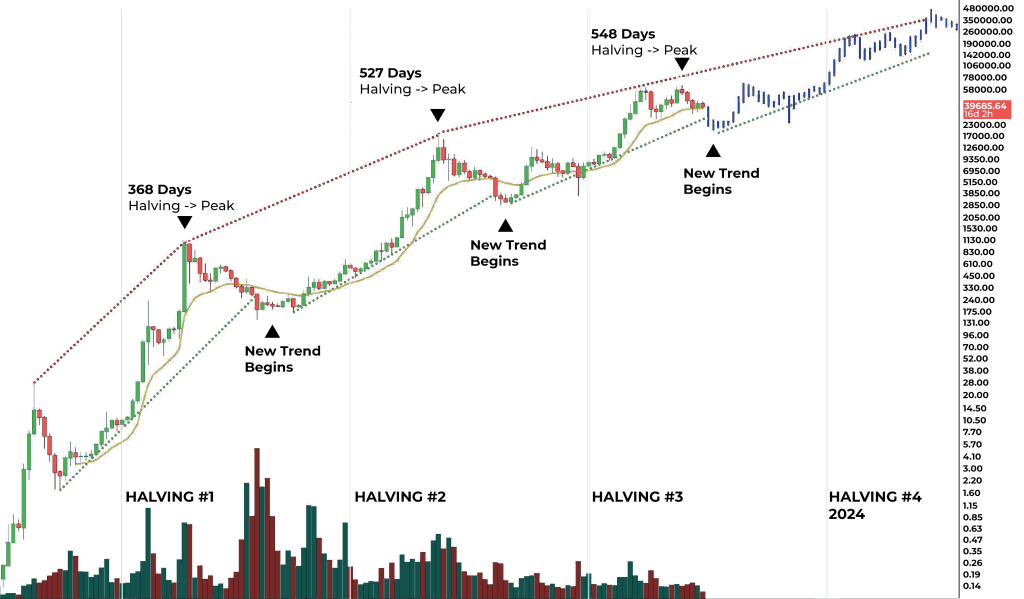
Is there a Bitcoin bull cycle coming up?

There is no doubt that the SEC crackdown affected crypto and Bitcoin is not an exception. Bitcoin is already down by 15% from its all time highs in 2023. It enjoyed a high of about $31,000. Crypto exchanges such as Coinbase and Binance admit the SEC crackdown accelerated the sell off of bitcoin.

Even though bitcoin has dropped by 15%, it is still enjoying a 60% profit. This may be an indication there is a bitcoin bull cycle coming up. Some of the reasons to support this hypothesis include:

Bitcoin halving

This happens every four years whereby the coin supply rate is halved. The next bitcoin halving is set to happen in April 2024. The previous halvings happened in 2012, 2016 and 2020. In all the events, there was a BTC price rally that led to all time highs. Currently btc is high by 276% from the l;ast halving event in 2020. Current;y the market is working in anticipation of the next halving event.

BlackRock Bitcoin ETF

Blackrock has filed an application with the SEC for a bitcoin exchange traded fund. This will boost the reputation of BTC leading to an increased demand priori to the halving event.

It is highly likely that the SEC will approve BlackRock;s application. The investment firm has a good history when it comes to ETF records with the SEC. The SEC promised to respond to the firm by March 2024, which is a month before the halving.

According to Crypto Tea, an analyst, BlackRock was strategic in its application as it knew the supply will decrease and the demand increase. The investment firm wanted to capture the market before competition.

Rise in Bitcoin dominance

The recent SEC crackdown worked in favor of Bitcoin as there are many altcoins that were thrown out, especially those that were classified as unregistered securities. This increased bitcoin dominance to over 50%. The SEC recognizes altcoins as securities, which is not the case with Bitcoin. This made bitcoin be considered as a safe bet when compared to altcoins.

Michael Saylor from MicroStrategy has seen this coming as he predicted the SEc will push BTC market cap to 80% of the total crypto market. The move will eliminate any confusion and doubts from institutional investors.

Bitcoin bull flag

According to technical charts, bitcoins show a bull flag pattern in the long term, which suggests there will be an increasing continuation of its recovery rally.

The bull flag will get resolved once the price goes higher above its upper trendline. This will bring the bitcoin bull flag to near $35,500, which was a support level between May 2021 and May 2022.

To start a bull cycle, bitcoin will have to close above $35,500, as long as it remains lower than the previous bear market peaks.

Apart from the bull flag pattern, BTC price could be on the verge of a breakout in the inverse-head-and-shoulder(IH&S) pattern. This is a  bullish reversal pattern which can only be resolved when price breaks above the neckline and rises such that the distance between the neckline and the middle trough’s lowest point is the same.

If there will be a rebound from the IH&S neckline, BTC could rally up the prices by more than 60% towards $40,500.

Did you like this post? Do you have any feedback? Do you have some topics you’d like me to write about? Do you have any ideas on how I could make this better? I’d love your feedback!

Feel free to reach out to me on Twitter!

We’re back on the bitcoin rollercoaster

Last week the hotly anticipated bitcoin halving took place. As you probably know by now, this event happens around every four years and cuts the reward miners receive for each new coin they create in half. The halving took place without any incident, and bitcoin owners are hoping that they will see the same surge in price that followed the two previous halvings. It has to be said that this is unlikely to happen this month, and we may have to wait for 12 months to see the true effects.

BTC could hit $100,000

Some enthusiastic bitcoin supporters, namely the Winklevoss Twins, said, “We’re set for another order of magnitude step up — whether $20,000 is the bitcoin base, maybe we see $100,000.” As we know, big numbers for bitcoin have been a feature of the headlines for quite some time, but we would all be well advised to take a ‘let’s see’ approach to investing in it.

One thing we must keep a vigilant eye on is the mining community. A halving makes their work less profitable, and it could be that bitcoin would need to sit at the $10,000 mark for them to achieve a breakeven price. Inefficient miners are most at risk, and they may need to liquidate their rewards. This would flood the market with bitcoin, and that in turn could threaten the fortunes of more profitable miners due to a sudden growth in supply of the digital asset.

Billy Bambrough reported on 12th May in Forbes the view of Gavin Smith, chief executive of Hong Kong-based bitcoin and cryptocurrency exchange and hedge fund Panxora, who said, “The recent much-hyped halving, while largely psychological in impact, could create a catalyst drawing new players into the market and contributing to the rise in the value of bitcoin.” That sounds promising, and he added to that, saying bitcoin is at “the start of a multi-year bull phase” though there could be “a bumpy road ahead.”

A hedge against inflation?

There is other interesting activity to factor in, such as more investors using bitcoin as an inflation hedge to protect their assets against currency devaluation. This has been fuelled by the US Federal Reserve pumping trillions into the economy to alleviate the effects of the lockdown. It isn’t the only government to have taken this step, and there is concern that these massive injections may lead to over inflation, as well as out-of-control debt.

Jean-Marie Mognetti, chief executive of digital asset manager CoinShares, commented: “In a world where investors continue to seek protection for their portfolios against the world’s central banks’ behavior, bitcoin, a digital currency whose supply is programmatically defined to reduce until it reaches its maximum supply, would seem to be the perfect hedge for any institutional investor portfolio.”

There is a belief that if bitcoin becomes a safe-haven asset and a hedge against inflation, then its price will head for the Moon over the next couple of years, and we will see that December 2017 price of $20,000. Perhaps $100,000 isn’t so pie in the sky after all.

The bitcoin halving and quantitative hardening

You have heard of quantitative easing, but what about the opposite — quantitative hardening? Jamie Redman, in a recent article that takes a look at the bitcoin halving writes: “The first two halvings correlated with gigantic price surges and speculators are assuming the next “quantitative hardening,” will produce the same effect.”

The first halving was in 2012 when the bitcoin price was around $11 per coin (imagine!!) and by the end of 2013 it was at $1,150. The second halving was in 2016 and it was followed by the spectacular bull run of 2017, when BTC rose from $650 in 2016 to $19,600 in December 2017. So, you can see why people think the same thing may happen this time, although not everyone agrees.

The quantitative hardening refers to the reduction in rewards for BTC miners caused by the halving. For example, after the last halving event, miners saw the 25 BTC reward slashed to 12.5 coins per block. This time the rewards will be reduced to 6.25 coins per block. The bitcoin system will continue to produce block rewards and halve every four years, until on or around the year 2140.

Redman explains that the way Satoshi Nakamoto built the bitcoin blockchain means it is a system that is “a synthetic form of inflation protection, meant to keep BTC scarce over the course of its history. At the moment, bitcoin’s inflation rate is around 3.8% per annum, and this will drop to around 1.8% after the halving this month. “Estimates also show that through the year 2025 and the halving in 2026, BTC’s inflation rate will be as low as 0.4%,” Redman says, and at 1.8% it will be lower than the world’s central banks’ benchmark reference rate. “Soon after that, the issuance will even outshine the precious metal gold,” which sounds enticing. This will happen because “it will be slower to produce than all the gold mined on earth being added to circulation.”

The halving has huge implications for miners, because every time it means their profits are cut by half, and in order for them to profit, the price must balance the amount of capital they are putting into operations. Moreover, if transaction fees alongside the price of bitcoin is lower than what they are spending, they will be forced to shut down

Many eyes will be on bitcoin’s price and hashrate after the halving. What we really want to see is a price rise above above what it costs to mine blocks, which should increase the hashrate and the system’s security. Tradeblock assumes the price per BTCneeds to be at least $12,500 per coin to avoid a mass exodus of miners.

As Redman says, the three most-watched data points during the next 24 hours and during the next few weeks will be the countdown clocks, bitcoin’s price, and the hashrate.

Are you watching?