The world’s 6 best performing economies

It is interesting to note that although there are shifts in the best performing economies from time to time, overall they tend to remain the same. You could say that the ‘usual suspects’ are always at the head of the list, but there are undoubtedly some threats to the Big Daddy of world economies, and I am referring to the USA.

bc16-intro-editorial

The United States of America

It is still No.1 in terms of nominal GDP. In fact it accounts for 25% of the world’s gross product. It takes this spot thanks to its advanced technology, infrastructure and natural resources and it only beats China due to the fact that its GDP per capita is higher. GDP per capita for the US economy is approximately $59,609 versus $16,676 in China.

China


With a GDP of $23.19 trillion it should be in No.1 position. It has transformed itself from a closed economy into a manufacturing and exporting hub. This started back in 1978 and since then it has achieved on average, an annual economic growth of 10%. It has lifted almost 1.3 billion people out of poverty and it is estimated that it will pull into the top spot over the next few years.

Japan

The Land of the Rising Sun is still a world economic leader with a GDP of $4.8 trillion, although it has been going through some challenging times since 2008 when it showed symptoms of a recession. Further strains have been put on the economy by a weak currency and subzero bonds, but growth of 1.2% is predicted for 2017 and it is likely to stay at around 1% for the next five years.

Germany

Germany remains Europe’s largest economy and forth in the world in terms of GDP. Its strength lies in exports of machinery, automobiles, chemicals and household equipment, plus it has a skilled labour force. It does face some challenges, including the UK’s Brexit and a refugee crisis. However, it is predicted that it will maintain stable growth at about 1%-2%.

United Kingdom

The UK is in fifth place with a GDP of $2.5 trillion. It is driven by service industries, particularly in the financial sector, which accounts for 75% of GDP. Manufacturing and agriculture are small, but important contributors. However, its current position is threatened by the decision to leave the EU and economist predicts that it could result in anywhere between a 2.2% to a 9.5% loss in GDP. So, its future in the league table is uncertain.

India

India has a GDP of $2.45 trillion. Its large population lowers its GDP per capita and it is very dependent on agriculture compared with Western countries. However, the services sector now accounts for 57% of the GDP, while industry contributes 26%. The economy’s strength lies in a limited dependence on exports, high saving rates, favourable demographics and a rising middle class. It is now a faster growing economy than China and is expected to rise to fourth place by 2022.

The Top 6 are followed by France, Brazil, Italy and Canada. It will be interesting to watch what happens. Predictions say the leader list will look much the same in 2022 as it does now – let’s see,
 

Future World Governments

Political systems go through change, as history shows us, and as technology and society advances and changes, we are certain to see some alterations in the style of government around the world. There are a few ways that our governments may look dramatically different in the future and some of them are potentially terrifying. Here are five possible scenarios.

WGS17

A Noocracy

This is a political system based on the “priority of the human mind.” The concept comes from the Jesuit mystic Teilhard de Chardin, who saw this as a possible evolution of democracy that would create “a flexible and adaptable system comprised of conscious, systematic, and institutionalized elements which will operate in decentralized autonomous subsystems.” The upshot of a system like this is the development of a hive-like civilisation brain that integrates all individual minds, both human and AI, through information networks.

A Cyberocracy

In this system, governments would rule by the effective use of information. This could take two forms: one that supplants bureaucracy and technocracy as we know it, and or one that redefines the relationship between the state and society. It will be driven by decisions based on information, which means a government will seek to obtain as much information as possible about everyone and every entity. It is likely to result in a bureaucratic system run by administrative AIs.

A democratic global government

A global liberal democracy will be one capable of “ending nuclear proliferation, ensuring global security, intervening to end genocide, defending human rights, and putting a stop to human-caused climate change,” says George Dvorsky. We are already on the way to this in terms of culture and economics, but we have yet to reach the political stage. The European Union is an example of this type of government on a small scale.

A Futarchy

This system is the creation of economist George Mason and futurist Robin Hanson. They say that under a futarchy we would “vot on values, but bet on beliefs.” How does that work? Hanson says: “Elected representatives would formally define and manage an after-the-fact numerical measure of national welfare. Market speculators would set prices that estimate national welfare conditional on adopting proposed policies. When the market estimate of welfare conditional on adopting a policy is higher than the estimate conditional on non-adoption, that proposal becomes law.”

Post Apocalypse Hunter-Gatherers

Finally, there is the possibility that we will experience a catastrophic event – natural or man made– that forces us back into a paleolithic political system in which we will return to living in small tribal groups, existing by hunting and gathering for our existence.

Which type of futuristic government would you prefer if you had a choice? I look forward to hearing your views.

I hope you enjoyed this and found it useful. Please subscribe to my blog if you’d like to receive an alert when I post new content.

What You Don’t Know About Doing Business In Hong Kong

Interesting facts and finer points of doing business, and living, in the magnificent world city of Hong Kong.

hong-kong

Hong Kong is vibrant and resilient. Since 1997, when it returned to being a Special Administrative Region of the People’s Republic of China, it has sailed through global economic crises thanks to its key drivers of economic growth, which in the case of Hong Kong are retail, logistics and business services, financial services, real estate development (boosted by public infrastructure works), and tourism. The UK government –and the Wall St. Journal– has designated it the world’s freest economy for 20 consecutive years and it is ranked as the world’s eighth largest trading economy and a leading financial and business centre for Asia.

It is also important to point out that it has a significant degree of autonomy from China and has its own legal system currency and customs jurisdiction; the only area in which it must follow China’s ruling is in foreign affairs and defence.

Another key to its success is the business access it provides to mainland China and to other parts of Asia. Add to this the fact that Hong Kong is a free port that does not levy any customs tariff and has limited excise duties and you have an environment that businesses love. It may be a relatively small territory with a total population of just over seven million, but there are at least 1,362 subsidiaries of American companies based here, and that is just the USA. In the last two years some firms have started bypassing Hong Kong and setting up subsidiaries on the Chinese mainland, however, they have discovered that they face higher costs and longer delays than if they’d established a Hong Kong intermediary.

5655326d7e2c4f2114f5dd81 (1)

5 reasons you should set up a business in Hong Kong

In my experience as an entrepreneur working around the world I strongly recommend doing business in HK and here are my five reasons for doing so:


  • China welcomes foreign entrepreneurs and business owners to develop their businesses in Hong Kong and provides them with the tools to grow successfully with little stress in the registry process of the business. The same can’t be said of many other countries.
  • The infrastructure facilities in Hong Kong are what make the city so well-known worldwide. Hong Kong’s air and sea transport facilities provide an excellent service for all customers, so all shipping, logistics and freight forwarding services are first rate. It is perfectly located for reaching other parts of Asia and has excellent telecommunications – a vital element for modern businesses.
  • Hong Kong has some of the lowest tax rates in the world and a simple tax system. Low taxes are a great incentive for businesses.
  • The legal system in Hong Kong tends to favour the business community and it is a transparent and fair system.
  • It is one of the world’s most liberal economic systems due to its free trade policy, no trade barriers and no limit for foreign onshore and offshore investments. Capital just keeps flowing here


A fantastic lifestyle

And, on top of a superb business environment, Hong Kong is a fantastic place to live. Its efficiency is on show from the moment you land at its international airport and find yourself in the centre of the city in about 25 minutes. It’s a ‘work hard, play hard’ city, with the same trendy areas that you’ll find in New York or London and you can enjoy weekend breaks in Shanghai, Beijing, Singapore or Thailand. It buzzes with a young, entrepreneurial spirit and it attracts an eclectic mix of fascinating individuals.

If you’re checking out Hong Kong as a place to set up your business, I’d recommend taking the Star Ferry from Kowloon to Hong Kong Island to get a feel for the place. And, lunch on the IFC Terrace will give you a memorable view of The Peak and the harbour. As for restaurants and bars; Hong Kong has everything from fine dining to some of the best street food in Asia.

There are few downsides I can think of to doing business in Hong Kong and there are few places in the world that I’d put in the same class as this place, because it’s a city that just loves business like an entrepreneur.

I hope you enjoyed this and found it useful. Please subscribe to my blog if you’d like to receive an alert when I post new content.


Business Etiquette Around the World: Brazil

In my experience, Brazil is a very exciting country to do business in. It’s a country on the move and an important member of the BRIC emerging economies. It has a promising future and that is a green light for entrepreneurs like me. It also has an amazing culture, which makes doing business there equal parts pleasure and work. However, if you’re planning on putting Brazil on your business map, I’d suggest you learn about its business culture and etiquette before you set foot in the country, which is why I’m sharing some lessons I learnt from my own Brazil experiences.

mundial-brasil

The art of small talk

First of all, Brazilians are a very friendly people and they like to build friendships alongside any business relationship. Politeness is very important to them; rudeness will get you the cold shoulder. They like to negotiate with people rather than a company, therefore it is vital that you accept that social small talk will play a part in any discussions. Favourite topics for small talk are family, football and music. Learn something about samba, Brazil’s important musicians, and of course its legendary footballers before you arrive. Topics to steer clear of are poverty, politics and Argentina. The latter is considered a trading rival.

It can be hard for entrepreneurs from cultures where getting down to business straight away is the accepted etiquette to get the hang of making small talk, but it will pay huge dividends if you do. Always make good eye contact with the person you are talking to and accept that there may be a lot of touching of your arms and backs during discussions; Brazilians like to be physically close to the person they are talking to. Also, be aware of non-verbal signals; slapping the back of the hand against the palm means they are not interested.

Be patient

Indeed, please hide any feelings of impatience at the proceedings as Brazilians will see this as reflecting poorly on you. They admire people who show self-control, so you will score points if you appear to be relaxed with how things are going. You will also need to exercise your patience when waiting for decisions to be made; Brazilian business is very hierarchical and the highest ranking person in a company makes the final decisions. It can take a while for that to filter down to you.

Formal greetings

Formal greetings may differ from your country. It is customary to shake hands with everyone on entering and leaving a business meeting. Also, shake hands with the men and kiss women on both cheeks. If possible, learn some basic Brazilian phrases in advance.

Business entertaining

Entertaining is an important part of business culture and Brazilians are quite relaxed about it, but very fashion conscious, so dress smart and don’t wear anything considered outrageous. If you are hosting a dinner, don’t be surprised if your guests are 15 – 30 minutes late; punctuality is not a strong point, However, you should be punctual, even if you have to wait.

Enjoy the culture

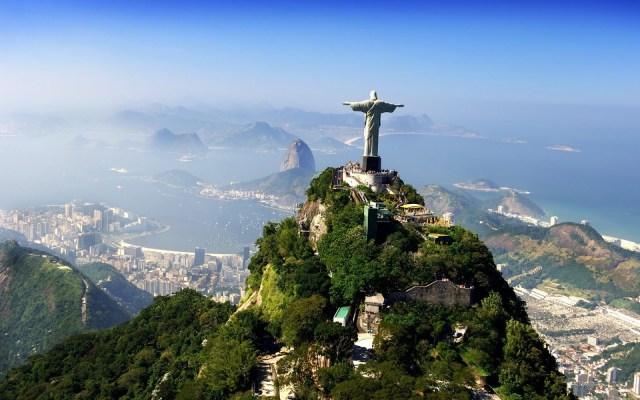
Rio

And, when you are in Brazil, don’t miss the opportunity to sample its vibrant culture: go to a football match; visit Copacabana beach; enjoy the view from Sugarloaf Mountain if you’re in Rio, and if you have the opportunity to experience the greatest carnival in the world, don’t miss it.

Doing business in Brazil is hugely pleasurable if you adapt to their customs and it is a vast country with huge potential, so understanding its new business culture is very much worth your while.

I hope you enjoyed this and found it useful. Please subscribe to my blog if you’d like to receive an alert when I post new content.