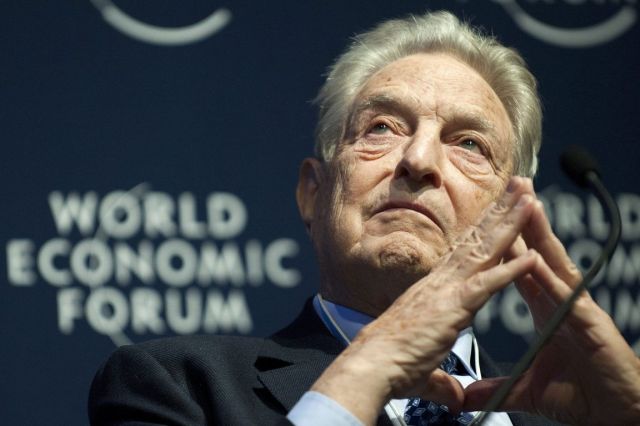
Has George Soros changed his mind?

World Economic Forum, WEF, in Davos

Back in January 2018, the multi-billionaire announced that cryptocurrencies were a ‘bubble’. He hasn’t been the only one to say this, of course. However, in the last week he seems to have quite radically changed his mind about this, as his ‘family office’, valued at $26 billion, has announced via Bloomberg and other media outlets, that it plans to trade digital assets.

Soros Fund Management, which is based in New York, and its macro investing division headed by Adam Fisher, got the green light internally to trade in digital currencies, although Bloomberg says he has yet to actually make a trade.

When Soros spoke at the World Economic Forum at the beginning of the year, he was scathing about crypto and claimed it could never function as a viable currency. He also said: “As long as you have dictatorships on the rise you will have a different ending, because the rulers in those countries will turn to Bitcoin to build a nest egg abroad.” This is similar to the many, many commentators on cryptocurrencies who have tried to tarnish the reputation of Bitcoin and other altcoins by connecting crypto with either the nefarious dark net, or with those who seek to beat the system in some way.

However, he didn’t predict what would happen to the cryptocurrency in the first quarter of 2018. The precipitous drop in the Bitcoin market cap sent some, like hedge fund manager Mike Novogratz, scurrying away from trading in cryptocurrency. For example, Novogratz decided against setting up a crypto fund, but has pursued links with a merchant bank that focuses on cryptocurrencies and blockchain technology ventures.

But other hedge fund managers in macro investing have been turning towards it as hedge fund profits slide. John Burbank is one example, He closed hi main hedge fund and “plans to raise $150 million for two funds investing in digital currencies,” says Bloomberg.

And Soros has been betting on cryptocurrencies, even if it is by a roundabout route. At the end of 2017, his firm acquired a large stake in Overstock.com, which is an online discount company. It accepts payment in cryptocurrencies and was the first major retailer to do so. Overstock then announced it would launch a digital currency exchange and an ICO, but this awakened the SEC last month, and it is investigating the proposals. Consequently, Overstock’s share price dropped.

Nevertheless, let’s remember that George Soros had, and still has, skin in the game, whilst warning the world that Bitcoin et al, are in a ‘bubble’.


Abra CEO predicts big investment in crypto in 2018

xtimthumb.php,qsrc=https,3A,_,_cryptoslate.com,_wp-content,_uploads,_2018,_03,_abra-bitcoin-cover.jpg,aw=824,ah=298,aq=75.pagespeed.ic.EnEIYf79xw

Abra is a cryptocurrency investment app and its CEO has recently made the headlines in Cointelegraph by making a bold prediction that big investors will “make all hell break loose” in the altcoin market this year.

Speaking to Business Insider last week, Bill Barhydt of Abra, which is backed by American Express, explained that he believes the cryptocurrency sector will boom again this year when the really big investors stop sitting on the sidelines and decide to get involved.

He said: “I talk to hedge funds, high net worth individuals, even commodity speculators. They look at the volatility in the crypto markets and they see it as a huge opportunity. Once that happens, all hell will break loose.” And, as he also points out, once these guys open the door, it won’t be closed again.

Barhydt admits that the cryptocurrency market has been going through a massive wobble, reflected in the decline in the overall market value of crypto. It peaked at $800 billion in December 2017 and is currently around $300 billion. Searches on Google for Bitcoin and other cryptocurrencies have declined in tandem with this, and there is a correlation between crypto prices and Google activity.

However, he is confident that prices will recover as the year progresses and institutional investors, such as hedge finds, decide to explore the potential of the crypto market. He gave the example of Japan where the crypto prices went up as financial institutions invested in them. Now, Barhydt believes that the West needs to catch up with Japan.

He concluded the interview by saying: “There really is zero large-scale institutional money from the west in crypto right now. Once a large, sizable chunk of Western institutional money starts to come in — watch out.”

Once the floodgates open in the West, what is happening on Google trends will become irrelevant. Will 2018 be the year we see mass adoption of crytpocurrency by big financial investors? We still have a way to go to find out, but if Barhydt is correct then there is a compelling case to HODL your crypto, regardless of the recent volatility.


A ‘ Crypto Bubble’ with benefits?

btc

Michael Casey, chairman of coindesk’s advisory board and a senior advisor at MIT’s Digital Currency Initiative has a different view of the much-discussed ‘Bitcoin Bubble’. While most commentators present a ‘bubble’ as a harbinger of doom, he sees it as a positive situation.

He likens it to the late 1990s dot-com boom, and while he acknowledges that there are some who will disagree with him, he has suggested that what he refers to as the “Pets.com phenomenon” was a constructive event and that we should approach the ‘crypto bubble’ from the same perspective.

How does he reconcile the ‘boom and bust’ of the dot-com era with a positive outlook? Read on and find out.

Yes, he admits that many crypto coins will fail and people will lose money. But, he applies a theory from Carlota Perez, a Venezuelan theorist who wrote about the interplay between technology and capital markets in an influential book called “Technological Revolutions and Financial Capital: The Dynamics of Bubbles and Golden Ages.”

She claims that bubbles and their collapse are “an integral, in fact necessary, part of the economic dynamics through which transformational technologies take root in society.” Speculation, she says, is unavoidable element during time of technological transformation. Actually, the same could be said of gold, spices and tulips. As Casey puts it, “Whenever a new technology contains a wide-enough accepted promise that it can redefine core aspects of how our economy functions, people start throwing money at it.”

Why do we behave like this? According to the theory it’s because nobody really understands how things will turn out, and who the winners and losers will be. We just know that something big and important is happening, so we all get involved in wild and unstructured speculative behaviour.

Mike Casey believes we should see the ‘crypto bubble’ as “an affirmation that the technology we’re all so excited about it does indeed have huge potential even if it is still too nascent for major, disruptive deployment in the mainstream economy.”

How this will play out, nobody yet knows, but if Casey is right, we can be fairly sure that we’re on the road to building a transformational open-access platform that represents a collective evolutionary step – even if the bubble bursts along the way.


The ICO Chill Factor

shutterstock-6919764464054-620x354

Parts of Western Europe have been at the mercy of the “Beast from the East”, an icy wind that swept down from Siberia bringing havoc in its wake. Now a different kind of chilling wind is blowing in from the USA as regulatory bodies talk about putting ICO token trading on ice for 12 months.

As Mike Lempres, chief legal and risk officer at Coinbase put it, “the market is being chilled.” As crypto entrepreneurs in the U.S. shiver, it seems that months of uncertainty about how the country’s regulatory bodies would approach “wanton market growth” is coming to a head, if perhaps not an end.

Events leading up to this include the SEC’s announcement last week that

it is investigating companies and startups associated with ICOs. As a result, which Brady Dale writes about at Coindesk, “entrepreneurs are largely surrendering on the idea that new cryptocurrencies created and sold to investors could be considered so-called ‘utility tokens,’ a term denoting a digital commodity meant to represent the share of a blockchain protocol.”

However, these companies still have a problem: as yet there are no registered broker-dealers capable of trading security tokens in the U.S. Furthermore, and this view comes from a number f ICO founders, when they do issue tokens under a Schedule D exemption, a 12-month lock-up is still required.

A statement from Nick Ayton, CEO of Chainstarter, who was in a panel discussion at the MIT Bitcoin Expo on 17th-18th March, addressed this issue. He predicted that the SEC will view all tokens as a security and stated: “Most exchanges are listing coins that are securities, and our view is a large number of these exchanges are going to be closed.”

Another voice at the conference, that of Gary Genseler, an MIT professor and former CFTC chair, said: “I think it is without a doubt that numerous exchanges will have to seek exemptions under alternative trading system [rules] because many of the exchanges, not all, have tokens that are securities trading on them.”

Currently, the problem is that even when companies want to comply with the rules, they still don’t know what the rules are. There is some knowledge about what is forbidden, but when it comes to avoiding the wrath of the SEC they are operating in the dark.

Munche is cited as the case that alerted some to what was coming from the SEC. This little known ICO received a bunch of subpoenas from the SEC, requesting information typically includes lists of investors, emails, marketing materials, organisational structure, amounts raised, the location of the funds and the people involved and their locations. In the case of Munchee, “what the federal regulators think of as a utility token and not a security token is so small, and the eye of the needle got even smaller,” said Joshua Klayman, legal counsel at Morrison Foerster.

What will be the end effect of this chill factor in the U.S? Well, Mike Lempres of Coinbase told Congress about one potential scenario if the United States doesn’t “provide a clear, thoughtful regulatory environment, the investment can very quickly move to other countries.”  Perhaps that will encourage the government and its regulatory bodies to bring a little sunshine to its crypto companies.