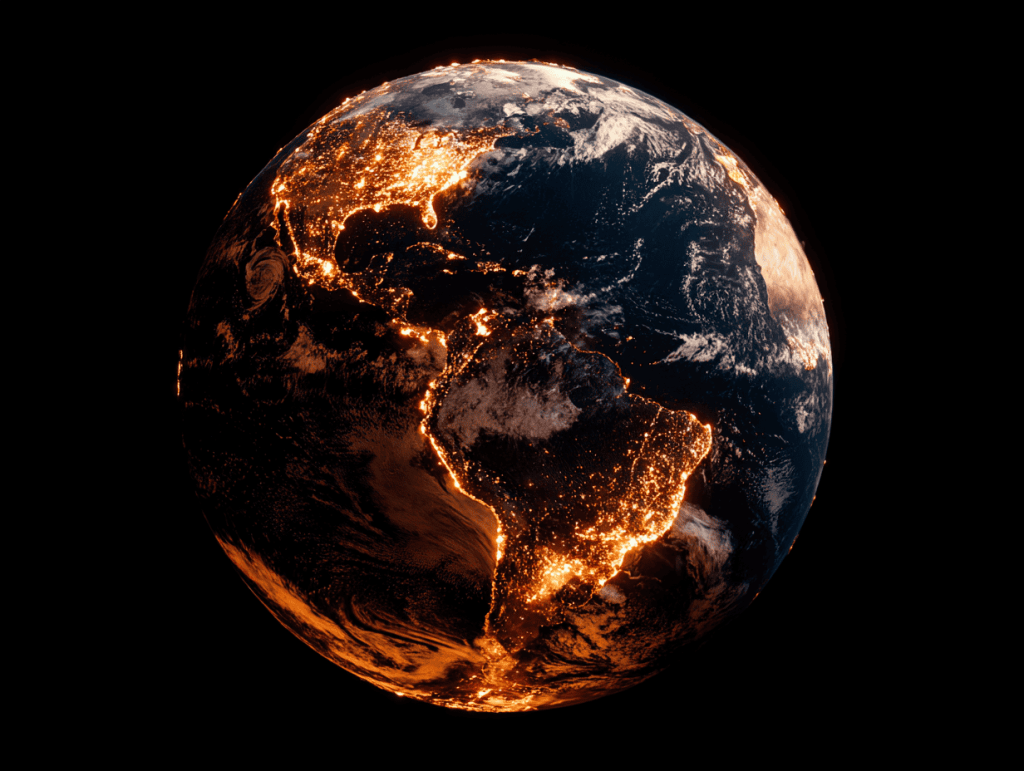
The Ultra-Rich Know What’s Coming: What Billionaires’ Behavior Signals About the Future

If the world burned tomorrow, most people would turn on the news.
The ultra-rich would head straight for the bunkers they already built.

For years, billionaires were obsessed with Mars colonies, metaverses, and the next big moonshot. But something has shifted. Their behavior is no longer driven by flashy ambition — it’s driven by caution. And in their world, caution is rarely for nothing.

Look closely at what they’re actually doing. Jeff Bezos has been liquidating billions in Amazon stock, even as the company continues strong. Elon Musk has repeatedly cashed out Tesla shares despite claiming unshakable confidence in the company. Google’s founders, once famous for holding tight through every storm, have quietly sold off major stakes. These aren’t panicked moves — they’re strategic. The richest people in the world are prioritizing liquidity, not loyalty. Money you can move is more valuable than money trapped inside a volatile future.

At the same time, the wealthiest are no longer buying luxury — they’re buying resilience. Mark Zuckerberg’s Hawaii compound is rumored to include secure underground areas, and it’s not the only one of its kind. New Zealand officials have publicly complained about billionaire land grabs fueled by interest in remote safety havens. Private islands, secured estates, hardened shelters — these are not status symbols. They are continuity plans.

And while the public is encouraged to build stock portfolios and “trust the system,” the ultra-rich are buying the system’s fundamentals. Farmland. Water rights. Critical infrastructure. Supply chain choke points. Bill Gates has quietly become the largest private farmland owner in the United States — not for fun, and not for scenery. Food and water are power in a future defined by scarcity.

They are acting like the next decade will not look like the last.

Not because they have a secret prophecy. Because they have the best data on the planet — from geopolitical threat forecasting to climate trend modeling to macroeconomic stress indicators. They see pressure building in every direction: automation threatening jobs faster than new ones appear, global supply chains stretched to breaking, political institutions struggling to contain polarization and distrust, and climate events shifting from rare to routine.

Stability was a privilege of the past. Volatility is what’s next.

Your financial advisor tells you to buy the dip. Billionaires are making sure they don’t fall with it. They aren’t scared of losing wealth — they’re scared of losing control, safety, and autonomy. So they’re preparing for a future where those things are no longer guaranteed by governments, markets, or society.

The truth is simple: the ultra-rich aren’t smarter, just earlier. They act before everyone else realizes what’s happening. If their behavior looks unusual, it’s because the future they see coming isn’t business as usual.

Most people will wait to react until the headlines make the danger obvious. The people with the most to lose — they’re reacting now.

The Covid-19 Virus Has Just Reset The Global Economy!

President Trump claimed that the Covid-19 pandemic was “unforeseen”, or as Harvard’s Professor Jeffrey Frankel suggests, political leaders are seeing it as a ‘black swan’ event. That’s an event that nobody saw coming. The last one of these was the financial crash of 2008.

Perhaps countries’ responses might have been more organised had governments listened more carefully to leading epidemiologists who have been warning about the dangers of a global pandemic for decades. However, as with any event like this, hindsight is a wonderful thing. We are where we are, and we must deal with it.

There isn’t one person who cannot be aware of the effects that the coronavirus epidemic will have on the economy, because so many are already afraid of the future already due to the immediate loss of employment that came in the wake of each country’s lockdown restrictions. At the very beginning of Spain’s lockdown, unions said more than 100,000 people risked losing their jobs, and economists have warned that these temporary layoffs could become permanent. These figures refer to the big companies such as Seat, Iberia and Burger King, not the small businesses, such as bars and cafes, which have also been forced to close. And then there are the self-employed. This scenario is being replicated across Europe and in the USA.

Three scenes of impact

I believe there are three possible scenarios in relation to the economic impact:

Containment

This hasn’t happened. Economies would have had a better chance of staying stronger if we had managed to contain the infection rate to less than 500 per million. However, if you look at the average rate in the most affected countries, you are looking already at 1600 cases per million. So, it’s too late for that.

Government funding

Massive injections of emergency funding is another route. The USA is pouring an historic two trillion into the economy to shore up retail supply chains, and other countries are taking similar measures, mostly to ensure that its citizens have some income. However, there is a clear problem with this approach. Government loans will only work in the short term for businesses, for two or three months at most, and then businesses will have to let staff go. This will be fine if the economy can return to business as usual by the end of April perhaps, but if it goes on longer, there will be problems.

Herd immunity

Then there is the ‘herd immunity’ approach. The UK government suggested taking this approach when the first cases appeared, and allowing 60% of the country to become infected. They said it was what the science said, but the British people weren’t quite so keen on the idea, and it was only a matter of days before the British government stopped talking about herd immunity, and followed other countries’ actions. If a country followed the ‘herd immunity’ concept, it is likely that the crisis would continue into September/October, by which time a blanket of economic depression would have fallen over the entire world. Two-thirds of the population would be infected and the death toll would be enormous.

The economy would grind to a halt, and even a powerful economy like that of the USA wouldn’t be able to bail out businesses. The result would be a real life horror film, with social unrest, looting and crime at record heights due to unemployment. Hospitals would close their doors to all coronavirus patients, and uninfected people would fear those who were infected and violent hate acts would follow. The most vulnerable citizens, that is our elderly, would have to be moved to safe areas, while criminals would happily take advantage of the situation. Indeed, it would be like sunshine for them, as law enforcement resources would be focused on dealing with the social unrest arising from unemployment. If it sounds like one of those zombie apocalypse films that is because it is pretty close to one.

Currently we are all trying to stop the spread, but as you can see from the above scenarios, none of them guarantees us a return to the economic certainties we knew just a month ago. There will be many more predictions as the days and weeks pass: let’s hope they paint a brighter picture.

However, be warned: We are entering a new era that we might as well call ‘Global Elite Centralization’ and Covid-19 was the reset button that triggered it.

China’s bid for world domination

The rumour that China plans to dominate the world has been circulating for decades. Its isolation from the West for a significant period of time made it even easier to turn the country into a Bogey Man. Some argued that it was a misunderstood country, whilst others held firmly to the view that China could never be trusted. These days, with greater media coverage of the world’s most populous country, we perhaps have a clearer view of its ambitions, and it seems some of the old rumours contain more than a grain of the truth.

Global expansionism is one of China’s tools. John Glynn writes that Beijing’s ‘Going Global’ strategy emerged in 1999, and it signalled the end of the “Mao-era mindset of self-reliance.” China suddenly started taking advantage of a boom in world trade and global market investments. Glyn says, “The idea that one government could commandeer sub regions in Asia, Europe and Africa, which account for 64 percent of world population and 30 percent of world GDP, might sound ludicrous. But try telling this to the Chinese government.”

Glyn also warns in his article that President Xi is engaged in an ideological and economic venture, and that it is clear the country has massive global ambitions, if its investments are anything to go by: “Between 2005 and 2017, the combined value of China’s global investment in construction was $1.8Trillion.”

What does it construct? The Chinese Government is making a concerted effort to increase infrastructural, economic, and political connectivity between China and the other countries of Asia, Africa, and Europe. Glyn calls it a “Belt and Road” initiative. But as he also says, it is essentially a new Silk Road connecting China to the rest of the world.

Glyn also remarks, “While other countries find themselves consumed by petty squabbles, Beijing officials discuss square footage, potential monetary gain, and militaristic strategies.”

It has invested widely in Energy, Transport, Real Estate and Metals — the key ingredients for developing infrastructure, and this has worried the Western governments, particularly the Trump presidency. That’s why he’s so keen to buy Greenland, an island mass that is rich in rare earth metals.

It is also the case that China has been involved in lending large amounts to other countries, and some fear that part of its strategy is to saddle these countries with “unimaginable levels of debt.” Furthermore a lot of this debt is “hidden” and that is especially worrying. Hidden debt means that the borrowing isn’t reported to or recorded by official institutions. A Kiel Institute study found that other countries’ debt owed to China has soared ten-fold since 2000, and it stated, “This has transformed China into the largest official creditor, easily surpassing the IMF or the World Bank.”

Much of this money is going to emerging markets. This is not because China wants to help grow these economies, but because it allows China to put those countries in a position of “indentured servitude.”

It is also looking to expand its military bases internationally. The US defence department expects China to add military bases around the world to protect its investments in its One Belt One Road initiative. Currently Beijing currently has just one overseas military base, in Djibouti. However, officials are planning others, including one in Pakistan.

This repressive regime has global ambitions and they are closer to being a reality than ever. Can China be stopped? The answer would appear to be — NO!

Economic Predictions And Trends For 2017

Trend watching, especially when it comes to what is happening in the economy is always interesting, sometimes very exciting and occasionally a bit of a let down. In 2017 we’ve been highly focused on political news, and the new trend of what is fake and what is not, and the economies have been in something of a state of flux as a result, but here are some directions that we’ve been going in that may continue into next year.

top

American expansion

The soothsayers predicted that the sustainable expansion seen during the Obama era would suddenly see expansion with the election of Trump. Was that because he is a businessman rather than politician? Perhaps, but Donald’s big boom hasn’t yet happened, although there is some growth.

The Brexit Effect

Many foresaw that the UK leaving the EU would bring uncertainty to the UK economy, and guess what, it has done just that. Every time a statement is made from Downing St. about the state of the exit negotiations, the markets either have a moment of hope, or take a nosedive. Expect to see more of this.

The EU

Euro-sceptics said that the Netherlands, France and Germany would surprise everyone with a vote against membership of the EU. So far, elections in France and the Netherlands have shown strong support for the EU and it is now hard to imagine that Germany will show any inclination to leave.

Chinese stability

China’s economy is looking increasingly stable and its deflation pressures are easing. Lowered interest rates will ease the country’s high debt levels and this helps the global community as well.

Watch Trump

It has been quite a year of watching Trump and what he tweets, and then watching how stock markets and other governments respond. He was very bullish about China and imposing high tariffs on their goods during his election campaign, but so far any anti-trade action has been subdued, perhaps due to the fact he is now more preoccupied with North Korea. But Trump and China is still one to watch.

Interest rates

As predicted in 2017, the USA has hiked interest rates twice this year so far. This is a show of confidence in the U.S. economy thanks to a rise in employment levels. Will this continue? We have yet to see. The UK by contrast has been extremely cautious with its interest rates and a speech by Mark Carney, Governor of the Bank of England on 19th September 2017, suggested that any rises would be “limited and gradual.” This gave sterling a very slight advantage over the dollar during trading following the announcement, and the pound has been bouncing up and down all day and the FTSE 100 went into the red. What will happen with sterling and the dollar by December is the question everyone would like an answer to.

Higher stock prices

In 2017, stock prices have looked extremely solid and have followed an upward trajectory as predicted in 2016. We can expect to see this continue into 2018.