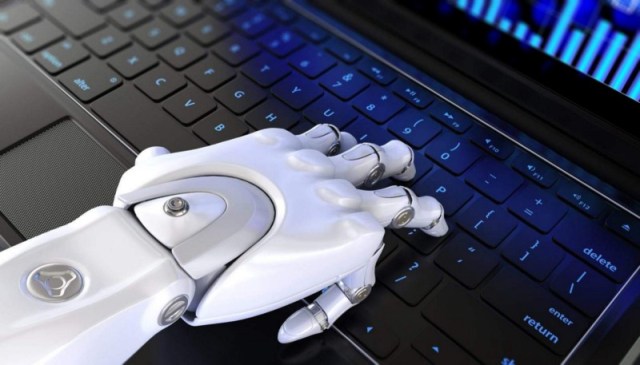
Don’t be afraid of robots, says World Bank

The World Bank has published a report annually since 1978. Each report focuses on a detailed analysis of one aspect of economic development and for 2019 the topic is robots and automation and how it is impacting on the world of work.

Bloomberg interviewed Pinelopi Koujianou Goldberg, the World Bank’s Chief Economist, about the report and one of her first statements was: “This fear that robots have eliminated jobs — this fear is not supported by the evidence so far.”

The fear arises from the fact that in the first world a substantial number of jobs have been lost in the industrial sector, while in East Asia the there has been a rise in employment in industry. The World Bank report notes the anxiety about job losses, but claims “the number of jobs lost to automation is about equal to the number of jobs created, even if technology is changing the nature of those jobs in several ways.”

In the World Development Report 2019: The Changing Nature of Work, World Bank Group President Jim Yong Kim said:

“The nature of work is not only changing — it’s changing rapidly. We don’t know what jobs children in primary school today will compete for, because many of those jobs don’t exist yet. The great challenge is to equip them with the skills they’ll need no matter what future jobs look like — skills such as problem-solving and critical thinking, as well as interpersonal skills like empathy and collaboration. By measuring countries according to how well they’re investing in their people, we hope to help governments take active steps to better prepare their people to compete in the economy of the future.”

Koujianou Goldberg also commented on the changing nature of work, telling Bloomberg: “This is the fourth industrial revolution, there have been three before, and in each case we managed to survive so it’s not the case that machines completely eliminated humans.”

However, not everyone agrees with the World Bank’s assessment of the situation with regard to a radical change in the types of jobs available. Gizmodo argues that the World Bank has not considered the quality of the jobs available, or the social and cultural impact of the loss of certain jobs and responds to the idea of robotics bringing a fourth industrial revolution as an idea to be treated with caution. Gizmodo also says, “There is a reason that many of the regions hit hardest by automation voted in the largest numbers for Trump.”

It also points out that reports like the one from the World Bank are useful as a window into how elites — i.e., those doing a lot of the automating — view mechanization.

What is clear that there are good arguments from both viewpoints and that what we need is dialogue between the two, so that we plan for an industrial revolution that is less harmful to those communities most affected by automation than in the past.

Every search you make…is being watched

That moment when we all went out and bought smartphones was a game changer for our personal privacy as Tyler Elliott Bettilyon discusses on Medium.

We never imagined at the time how these expensive gadgets would impact on our lives; all we could see that they made our lives easier, but at what cost?

In China, surveillance apparatus is increasingly sophisticated. There is facial recognition technology connected to CCTV cameras and police officers will soon have cameras inside their sunglasses. There may also be drones disguised as birds. Worse still, Chinese citizens are being asked (demanded) to install software in their phones that tracks their downloads and if you’re Chinese and visit a site banned by the government, you lose points from your “social credit score.”

But that’s China, you’re probably thinking. This is a Communist regime that has always controlled how people act and think. It isn’t like that in more democratic countries. Unfortunately the response to that is, “Don’t be so sure.”

Take a look at the surveillance tools the USA has. The NSA’s PRISMprogramme collects masses of data about internet traffic — including yours! That’s why Edward Snowdon blew the whistle on it and revealed how the NSA might be breaking the rules of privacy.

And Europe is no more private. It also has an array of online surveillance tools that it uses in the name of ‘security’. And if you keep sending out the message that we are all in danger, then the citizens of Europe give governments a free pass to collect whatever data they want. They don’t consciously allow it; they passively accept it.

And, online censorship is on the rise as the world becomes more authoritarian. A 2017 report Freedom on the Net details how our freedoms are being curbed year after year. It says: “Nearly half of the 65 countries assessed in Freedom on the Net 2017 experienced declines during the coverage period, while just 13 made gains, most of them minor. Less than one-quarter of users reside in countries where the internet is designated Free, meaning there are no major obstacles to access, onerous restrictions on content, or serious violations of user rights in the form of unchecked surveillance or unjust repercussions for legitimate speech.”

But it isn’t just governments that are watching you; it’s Facebook, Google and the like who are analysing your every move in order to push adverts at you. The Cambridge Analytica scandal showed us how the data they collect can be ‘weaponised’ for political ends.

Perhaps you are very security conscious about your personal data and take all the recommended steps (and more) to protect yourself. But, the web has many vulnerable points you may pass through without your knowledge and that leaves you exposed. These include your friends keeping texts from you, photos of you taken by friends stored on Facebook and Google keeping track of your search history. Yes, you can turn Google tracking off — if you can actually find where to do that. However, ultimately the only way to stay secure is never to send your data via the internet. Or, get yourself a Tor browser. This is a system that attempts to hide source and destination IP addresses by using several proxies. And even then there are still vulnerabilities.

Finally, personal actions to protect our personal data will never be enough: it will require collective action to overcome the Big Brother machinations of the large agencies like the NSA. Bringing the issues to the attention of more internet users is vital to achieve this, then perhaps we can start to solve the problem and pack up our paranoia.

The Tech Giants Growing Behind China’s Great Firewall

The Tech Giants Growing Behind China’s Great Firewall

The Chart of the Week is a weekly Visual Capitalist feature on Fridays.

Every day, your feeds are likely dominated by the latest news about Silicon Valley’s biggest tech giants.

Whether it’s Facebook’s newest algorithm changes, Amazon’s announcement to enter the healthcare market, a new acquisition by Alphabet, or the buzz about the latest iPhone – the big four tech giants in the U.S. are covered extensively by the media, and we’re all very familiar with what they do.

However, what is less commonly talked about is the alternate universe that exists on the other side of China’s Great Firewall. It’s there that four Chinese tech giants are taking advantage of a lack of foreign competition to post explosive growth numbers – some which compare favorably even to their American peers.

BIZARRO WORLD

Like the “Bizarro Jerry” episode of Seinfeld, the Chinese-based tech giants look recognizably familiar – but markedly different – to the ones we know so well.

ALIBABA

Likely the best known of China’s tech giants, Alibaba is the dominant online retailer in the country. The company had revenues of $25.1 billion in 2017 and is seeing that revenue grow at impressive speeds. In its most recent quarterly results (Q3, 2017), the company noted a 56% jump in revenue.

Amazon’s tough sell: Amazon does exist in the Chinese market, but it just has trouble competing with Jack Ma’s creation. Amazon has less than a 1% share of the e-commerce space in China, after a decade of trying to get a foothold. Further, Alibaba also runs AliCloud, which provides direct competition to Amazon’s AWS.

BAIDU

Baidu is the largest search engine in China and also a leading player in AI. It’s the most visited website in China, and ranks #4 globally. The company will announce 2017 annual results in the coming weeks, after reporting a 29% jump in revenue in Q3 2017.

Google’s searching for a way in: Google was blocked in China in 2010 after refusing to filter search requests. However, since then, the giant has been able to take very small steps in entering the Chinese market – even though its signature search engine is still blocked, Google now has at least three offices in the country.

TENCENT

Tencent has recently been in the news for its rapidly surging stock. The company, which owns the dominant social platform in China (WeChat), is now valued at over $500 billion. For those keeping tabs, Facebook is currently worth $550 billion.

It’s complicated: Facebook remains blocked by China, meaning that Zuckerberg and company can’t take advantage of a 1 billion plus market of people with growing buying power. Even if it found its way in, there are multiple social platforms in China and competition would be stiff.

XIAOMI

Dubbed as “China’s Apple”, Xiaomi is one of the world’s most valuable private companies. Things have been hot and cold for the ambitious smartphone manufacturer, but recently reports have surfaced that Xiaomi will IPO in the second half of 2018 for upwards of $50 billion.

Are ‘no fee’ exchanges becoming a trend?

An article in yesterday’s Fortune magazine alerted me to what may be an emerging trend. I’m talking about ‘no fee ‘ exchanges. The latest one to arrive on the scene is Voyager and it’s bringing the competition to RobinHood, which is the best-known exchange to day that doesn’t charge commission fees.

It is Uber-funded

Voyager has some big names behind it that are bound to give it plenty of publicity and create trust as well, unless you really dislike Uber, for example, because Oscar Salazar, the co-founder of Uber, and Philip Eytan, one of Uber’s biggest investors are Voyager’s founders. And you see what they did — they called it ‘Voyager’, this connecting the exchange with transport. The CEO is Stephen Ehrlich who came from his position as CEO and founder at Lightspeed Financial, a retail brokerage.

Will Voyager have the same power as Uber?

So, the focus is on no fee trading, and it’s interesting that Voyager has opted to join RobinHood in this niche market sector that aims to reduce the cost of trading cryptocurrencies. However, given the business background of Voyager’s investors it makes perfect sense. Uber disrupted the global taxi market (well, almost globally) and once it opened that market up there has been no going back. ‘Uber’ is so popular, it is probably a verb by now, as in “Are you Ubering tonight?” — just like “Google it!”

What is Voyager offering?

Initially, Voyager will list 15 cryptocurrencies, drawn from the list of the 25 best-performing networks, including bitcoin, ethereum and bitcoin cash, among others. The new CEO also told Fortune that it is considering listing tokens like XRP and Stellar’s lumens, because those aren’t listed on any major U.S. exchange. He also said, “If you see it being traded today by some of the most prominent players, we will definitely have those plus some.”

How will it make money if there are no fees? Ehrlich explained, “In lieu of trading fees, Voyager will make up the difference in revenue by beating the average price of the coins at the point in time we execute the trade.” Basically, Voyager believes it can consistently execute buy and sell orders at better prices than customers would often get by just visiting one exchange, such as Coinbase or Binance.

The platform goes into beta testing this week and an app should be available by late October and it also intends to add crypto news and analysis to help its customers make buy/sell decisions, as well as additional tools for the institutional investor segment to its platform.

Currently the team is hard at work securing licenses in a number of U.S. states including California, Massachusetts, Missouri, New Hampshire and Montana. Its goal is to operate in at least 40 U.S. states. Could this be the start of a ‘no fee’ exchange trend, or will Voyager simply make the space its own — just like Uber?