The surprising ways mining crypto can be profitable

Crypto miners are rewarded for processing transactions. All you need to be a miner is a rack of high-speed computers and access to electricity. Of course, a lot has been said about the latter: the consumption of energy needed to run the software and hardware on a large scale is astronomical in cost. In fact, some mining outfits are consuming the same amount of electricity as a small country. That’s why so many are based in the cold wastes of the Arctic Circle where lower temperatures keep the machines cooler and therefore reduce energy consumption.

When mining started, people could do it on machines at home, but that didn’t last long. The potential to make big bucks meant that competition increased and miners purchased massively powerful computers while scaling up their operations to remain profitable.

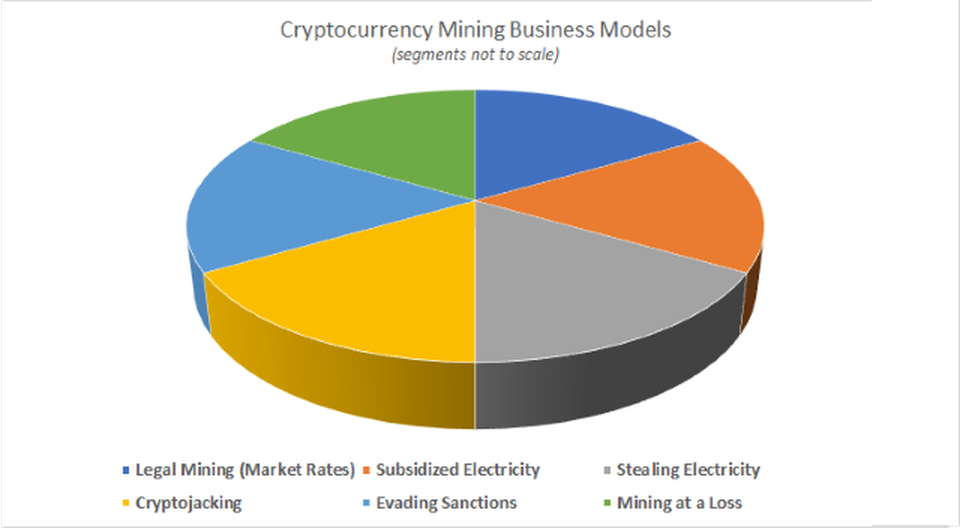
Then bitcoin crashed and this reduced the ability of miners to make a profit, and legal crypto mining using electricity at market rates is now becoming increasingly unfeasible, even in those places like Iceland.

Mining can still be profitable

But there are still opportunities for profitable mining. One way is to find subsidised electricity. For example, In Washington State, hydroelectric power generates far more energy than locals can consume, thus attracting a booming business in crypto mining. Instead of exporting it to other states, miners could buy it. This is a legal model. The other forms of profitable mining are certainly not.

The first of the illegal mining options is to steal electricity. That is what used to happen in the early days, but energy companies have got wise to that and there have been some prosecutions for theft in China and the USA.

Another mining model is cryptojacking. This has outperformed ransomware as a form of obtaining crypto. How does it work? A hacker introduces crypto mining software onto a target victim’s computer without their knowledge, thus generating crypto for the hacker while stealing processor cycles and electricity from the victim.

And there we have the current crypto mining scenario. As Jason Bloomberg writes at Forbes: “For all the crypto fanatics out there, therefore, there is a reason to take heart — there’s no way crypto values will ever drop far enough for mining to cease. Organized crime wouldn’t let that happen.”


Coinbase counsel predicts crypto regs push in 2019

Marcus Hughes, the British lawyer and lead counsel for San Francisco-based crypto exchange Coinbase, predicts that 2019 is going to be the year that we see big changes in bitcoin regulations.

Hughes remarked, “Within the next year or two, we’ll see big developments, and regulation will take shape this year, particularly in Europe.”

He pointed to the fact that the United Kingdom’s Financial Conduct Authority (FCA) is in the process of carrying out a consultation regarding crypto derivatives. This could see a ban on the sale of derivatives based on cryptocurrencies such as bitcoin. Furthermore, the British government has pledged to empower the FCA to oversee all crypto assets.

An article in the UK’s Daily Telegraph at the end of 2018 also revealed that the FCA is investigating 18 companies “in connection with cryptocurrency transactions amid escalating concern over the threat posed by Bitcoin and other digital assets to the integrity of financial markets.” But that is not all: the FCA has opened 67 inquiries since November and is clearly stepping up its scrutiny of all firms involved with crypto in any manner.

Nicky Morgan MP, who hairs the influential Treasury select committee, said, “t is clear that the government and the FCA share the committee’s concerns on crypto-assets, including the lack of regulation, minimal consumer protection and anonymity aiding money laundering … The committee will keep a close eye on these consultations and will continue to press for regulation.”

And the European Banking Authority is calling for standardised regulations for cryptocurrency operations within the European Union. This is to remove the potential for “unfair regulatory arbitrage while protecting bitcoin and cryptocurrency investors across the bloc.”

Hughes said about this scenario: “We could end up with E.U. member states creating their own crypto laws, but it’s certainly possible we’ll get a unified approach in Europe. It would make life for companies like Coinbase a lot easier.”

He also has his own views on the future of bitcoin, which also reflect those of Coinbase: “We need to move beyond the speculation phase of bitcoin and cryptocurrency to the utility phase. The utility phase will mean bitcoin and crypto becomes more widely accepted and understood.”

He also commented on the arrival of institutional investors in the crypto sphere, saying: “I would be surprised if other traditional financial services executives didn’t make the move across to the bitcoin and cryptocurrency world. As the industry matures and is better regulated it will need the talent and experience to manage it.”


Online Lenders vs The Banks

The financial crisis of 2008 has spawned a number of innovations in the world of finance. Cryptocurrency and fintech startups are two of them, but these were preceded by a new wave of online lenders.

The truth is, and it remains so, that the Big Banks failed to respond to the financial crisis in a meaningful way for consumers. They caused the problem, but they remained in denial about the effects on the person in the street who needed access to credit. Furthermore, the banks simply didn’t want to take on more risk. The banks instead of thinking about people, concerned themselves with regulatory challenges and stuck to technology that first saw the light of day in the 1960s.

Online lenders get VC support

Enter the online lenders, supported by venture capitalists who could hear the money dropping into their coffers. Lending money appeared to be an easy and profitable game, however it wasn’t all plain sailing.

Still, online lenders had their customers well figured out: they knew what they wanted and what they didn’t want: they wanted instant access to loans and they didn’t want to visit a physical branch and discuss every detail of their lives with somebody in a suit. That aspect of it all went well.

Online lenders at a disadvantage

However, the economies of lending have been another matter. As fintech expert, Ben Cukier writes, “Loan profitability is driven by the spread (the cost difference between the interest charged on the loan, less the cost of funding those loans), the cost of acquiring the loan, and the default rates of those loans.” From the outset online lenders were at a disadvantage when compared with the traditional banks, because the old-school bankers uses low cost deposits to fund loans. By contrast, the new online lenders had to rely on “raising debt or even more expensive equity,” as Cukier points out..

Enter Big Data

Plus, customers knew the bank brands, whereas the newcomers had to invest a lot in raising brand awareness. But they did have a weapon that the banks did not posses: the newcomers had Big Data. They talked up their Big Data platforms, which use disparate data to better underwrite credit risk in ways common credit scores did not. And, they leveraged this data to target specific consumers on social media, and then used the data they mined from customer behaviour on social media enabled them to dictate borrowing terms.

Fintech is the real financial innovation

This gave the banks a wake-up call, and now bank customers can interact with their banks through apps and even get quick credit approval. Plus the banks offer a range of products, whereas online lenders only offer loans. Then fintech startups came along and offered more help to the big banks. Mark Hookey, CEO of Demyst Data says, “Fintech innovators demonstrated that a data focus matters, however banks can apply that insight at a far greater scale to know their customers and launch new products.”

In the end it is these fintech companies, rather than the online lenders, that offer the promise of a real revolution in lending.

Protecting humanity as AI grows

Artificial Intelligence (AI) is going through the process of evolution. To date we have seen the emergence of artificial narrow intelligence (ANI), and artificial general intelligence (AGI) to artificial super intelligence (ASI). Those working in the field predict that it won’t be long until AI is able to “combine the intricacy and pattern recognition strength of human intelligence with the speed, memory and knowledge sharing of machine intelligence,” as Jayshree Pandya writes in his recent Forbes article.

One of the upshots of this progress is that people feel less insecure and fear what this may mean for their future, particularly with regard to employment. After all if AI can replace most manual and mundane work that will affect a significant number of people in manufacturing industries. As Pandya points out, “with all these new digital assistants and decision-making algorithms assisting and directing humans, more complex day-to-day work for humans is being greatly lessened.” It would be nice to think that this will mean humans can put their feet up and relax, but who will fund that? The robots won’t pay for sure.

Of course, there is hope for humans, because no mater how much AI technology is hyped, it simply can’t replicate the human brain, because elements like memory and conscience are as yet a long way off and are only a part of some computer scientist’s dream of a human-like artificial intelligence.

Super scary Super ASI

Pandya believes that the “potential development of artificial super intelligence points to a frankly scary scenario in the coming years.” He thinks that the processing power of the human brain may not be able to match that of ASI in the long-term, which is indeed a frightening thought. It may well be inevitable that AI will reach a point where it will be able to improve its own software design and capabilities far beyond what its designers envisioned: like the monster that Dr Frankenstein could not control.

Will AI overtake human intelligence?

Another concern is that human intelligence may dumb down as AI takes over tasks. If the human brain is not allowed the opportunities to learn new skills, how will its development suffer? That is a tough question to answer. And the answer to it may define the future of humanity, which has for all of recorded history relied on the sophistication of human natural intelligence for survival. Pandya says, “the question everyone across nations needs to evaluate today is whether our efforts should be towards enhancing human intelligence or artificial intelligence.”

We need to start planning now for the future when our intelligence may be seen as inferior to that of AI. It sounds like science fiction, but we can no longer dismiss it as a scenario created by a novelist or Hollywood.