Can the blockchain block spam marketing?

Blockchain.jpg

Spam mail is a downside of the Internet that we have come to accept. Nobody likes it and web-based mail hosts like Hotmail developed spam folders to siphon off the rubbish from the ‘real’ communications. It’s a flawed system, but it does reduce the problem of having your inbox filled with offers of every dubious kind. Less easy to handle is the cold callers who want to sell you something, usually some kind of financial product these days.

For blockchain watchers the announcement that the Telecom Regulatory Authority of India (Trai) is planning to use blockchain to prevent unsolicited telemarketing communications is an interesting one.

The report in the Business Standard says that Trai is turning to the blockchain after years of being unable to control this type of call, because by using the new decentralised technology it will be possible to track spammers very speedily through data matching even when they use normal 10-digit phone numbers. To date, 230 million subscribers have reportedly registered for Trai’s “Do Not Disturb” registry, which came into effect in 2010, but the registry has so far failed to crack down on telemarketers.

India has a large population and Trai estimates that “some 30 billion commercial messages are sent out every month, of which many may be unsolicited, making telemarketing a brisk business opportunity.” To date, it has proved very difficult to track the spammers as they have been using the 10-digit mobile number and not the special numbering series allotted for telemarketing. Trai says that a blockchain-enabled digital record will show the entire communication between the various entities, and thus make them traceable.

The blockchain-based rules will record all communication between subscribers and entities, with the most important element being “capturing customer consent for information and authorised telemarketing agencies.” Currently Trai is debating the draft regulations and trying to decide how explicit consent should be given with regard to unsolicited commercial communication. The organisation also believes that the consent should be reviewed periodically.

Trai Chairman RS Sharma stated that Trai is “probably the first organisation” to implement blockchain as a RegTech(regulatory technology) “on such a large scale.”

In light of the recent General Data Protection Regulation (GDPR) that came into effect in Europe last week, it will be interesting to see how storing personal data on the blockchain interacts with the GDPR regulations. Perhaps we will learn something from Trai’s use of blockchain for its Telecom Commercial Communications Customer Preference Regulations 2018.


 

4 reasons to invest in Bitcoin this year

shutterstock_688113943

Yes, Bitcoin price has lost almost 70% of its all-time highs. But the technology itself continues to develop, becoming stronger than ever! Here are 4 main aspects which help Bitcoin to remain a wise way to invest (despite of any corrections).

1⃣Transactions fees have dropped to their lowest levels in seven years 
Not since 2011 was it was so cheap to use Bitcoin, and it promises to become even cheaper in the future. Increasing expansion of the Lightning Network is expected to push fees below 1 satoshi per byte, so long-term transaction would cost nearly negligible amount.

2⃣Bitcoin’s hashrate climbed to its largest in history in May
Data from Blockchain republished on Twitter by trader and commentator CryptoYoda impressed users with theories including miners mining at a smaller profit in order to generate long-term holdings.

3⃣SegWit transactions
This year witnessed mass uptake of Segregated Witness (‘SegWit’) technology, which for Bitcoin users also means lower fees and faster confirmation times. SegWit transactions now make up a greater proportion of the total sent each week than ever before – almost 40%.

4⃣Worldwide bank system lacks trust
Italy and the Eurozone under political pressure and Australia and New Zealand lenders both suffering mass technical outages which cut customers off from their funds. By comparison, the Bitcoin network has experienced 99.9923% uptime since it was launched in 2009. Decentralized cryptocurrency becomes more and more attractive for investors, and that means, that Bitcoin market cap is destined to grow!

The crypto world is a blossoming to be a real game-changer that could change the way we do things. As we speak, applications are being developed to disrupt the current status quo, for the better. Imagine having transparent access to government or organizational activity at your fingertips, or allowing part of your computing power to be shared in the advancement of key scientific and medical projects. A decentralized system allows the masses to leverage each other’s resources and qualities to uplift the community. It is a force of good. Additionally, you can also get very rich investing in the ecosystem too. So what are you waiting for? If you think that it may be too late to invest, have a read here: Is it Too Late to Buy Bitcoin and Is It too Late to Invest in Cryptocurrency?

Is the blockchain magic dust?

20180117194441-GettyImages-896355786

The hype around the blockchain suggests that it can do anything you want it to; that it’s like magic dust that will save the world. Is it as fantastic as the blockchain messiahs claim it is, or does it actually have some limitations?

What is the blockchain?

It’s a series of linked blocked and each block is composed of a series of transactions. Think of a train where you have a series of carriages that are coupled together, or any item that has units linked together.

In the case of the blockchain, the transactions there are specific rules about how you input the data about the transactions (consistency), you can’t overwrite data that is already inputted (immutable) and each transaction has an identifiable owner. Added to this, there is a consensus about what is in each block without the need for a central party controlling it (decentralisation).

Decentralisaton is the perceived ‘magic’ of the blockchain, because this factor guarantees that there is “no single point of failure.” In other words, nobody can mess with your transaction on the blockchain. You also don’t have to trust a central body; hence it is called ‘trustless’. This is the element that gets everyone most enthusiastic.

What’s the downside of the blockchain?

Creating the system described above is not so easy. Building in consistency and preventing bugs corrupting the data is a real challenge and one that needs to be taken slowly, because if you don’t, the chances are you will lose consistency and then the blockchain is worthless.

Think of it this way: if you have a centralised database and something goes wrong, you fix it by starting over. But, you can’t do that with a decentralised system. And the reason for that is, you need consensus, or the agreement of all players in the system, in order to change the database. The blockchain is a public source with no central ownership. That is its big claim to fame, but also one of its weak links.

When it comes down to it, decentralised systems are very difficult to work with, expensive to maintain, hard to upgrade and a pain to scale. It would be much easier to stick with a centralised system, but where’s the ‘brave new world’ feeling in that?

What’s the upside of the blockchain?

In a nutshell, it removes a single point of failure or control. It is answering problems in sectors where IT infrastructure is outdated, such as healthcare, logistics and financial services. For many blockchain believers, the main appeal was that it would remove government control and prove to be a liberation movement, but as we’ve seen in the last few months, it is extremely hard to bypass governments and their regulatory bodies.

It is also proving hard to scale the blockchain for sectors where that is needed; money being the exception. As Jimmy Song writes in Medium: “Immutability and difficulty in changing the rules is a positive for money and not a detriment. This is why blockchain is the right tool for the job when it comes to Bitcoin.”

But, for other business sectors with specific IT requirements, it is not the case that a blockchain solution will cure all your ills, but that is how the blockchain is being sold. Being wary doesn’t necessarily mean that you need to turn your back on the blockchain completely, it just means “Caveat emptor” (let the buyer beware) as the Romans used to say.


The State Of Digital Business Transformation, 2018

These and many fascinating insights are from the IDG’s 2018 State of Digital Business Transformation (12 pp., PDF, no opt-in). The study’s goals are to gain a better understanding of how organizations are evolving to a digital business model in regards to how they are revising technology strategies, changing organizational structures and processes, and innovating to provide a unique customer experience. Respondents were selected from CIO, Computerworld, CSO, InfoWorld, ITworld and Network World tech buyer audiences. The majority of respondents are IT executives and professionals. Please see page 10 of the study for additional details regarding the methodology. “Technology has been a driving force in business transformation for years, but the pace at which new technologies are launching has reached its fastest speed. Now is the time to create efficiencies and differentiate through the customer experience,” said Brian Glynn, chief revenue officer, IDG Communications, Inc.

Key takeaways from the study include the following:

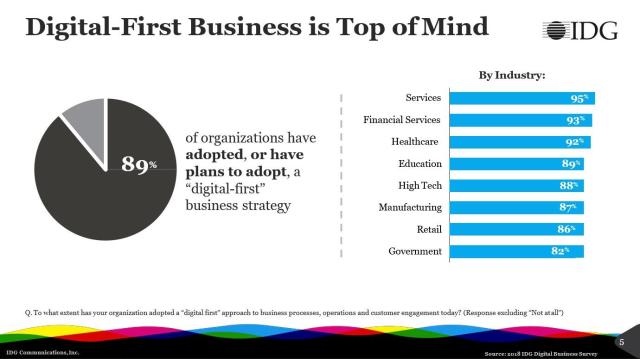
  • 89% of enterprises have plans to adopt or have already adopted a digital-first business strategy with Services (95%), Financial Services (93%) and Healthcare (92%) leading all industries. Education, high-tech, manufacturing, retail, and government are also quickly adopting digital-first strategies to improve process efficiencies and meet and exceed customer expectations.

Digital-First-By-Industry

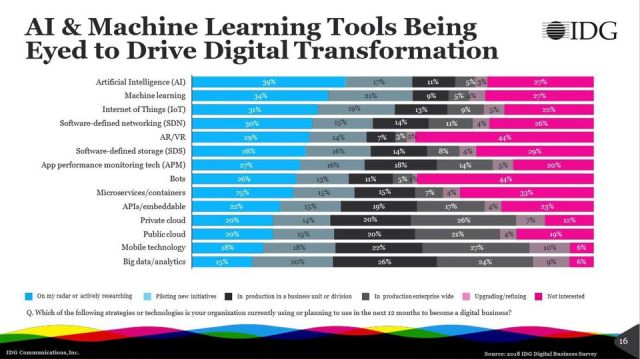
  • Big Data/Analytics (58%), mobile technologies (59%), private cloud (53%), public cloud (45%) and APIs and embeddable technologies (40%) are the top five technologies already implemented. Additional technologies currently in production include Application Performance Monitoring (APM) (18%), microservices and containers (15%), Software-defined storage (SDS) (14%) and Software-defined networking (SDN) (14%). Artificial Intelligence (39%), machine learning (34%), and the Internet of Things (31%) are the top three technologies enterprises are researching today.

https_blogs-images.forbes.comlouiscolumbusfiles201804AI-and-machine-learning-lead-interest

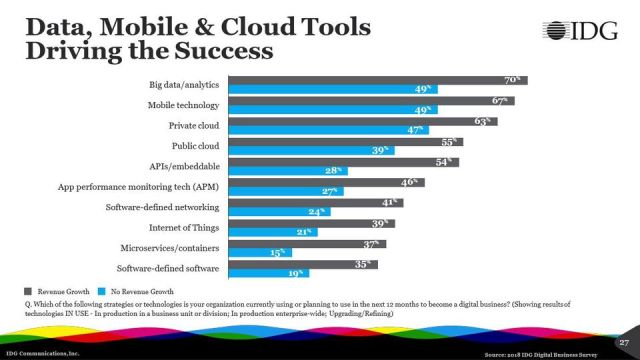
  • Big Data/Analytics, mobile technologies, and private cloud contribute most to an organization’s revenue growth. IDG analyzed which technologies are contributing most and least or revenue growth. With 49% of enterprises saying excelling at managing business performance through data availability and visibility is what defines their digital business, it’s understandable why Big Data/Analytics is perceived by 70% of IT executives as contributing to revenue growth.

https_blogs-images.forbes.comlouiscolumbusfiles201804Data-Mobile-and-Cloud-Tools-Driving-The-Success

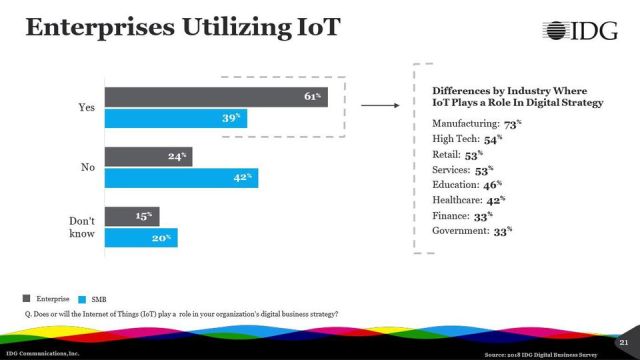
  • 61% of enterprises say IoT plays a role in their digital business strategies with manufacturing and high-tech leading all other industries. Just 39% of small & medium businesses (SMBs) say IoT plays a role in their digital business strategies today. Finance and government industries are the least likely to adopt IoT as part of their digital business strategies due to legacy systems being very difficult to change or integrate with and security concerns.

https_blogs-images.forbes.comlouiscolumbusfiles201804enterprises-utilizing-IoT

  • 73% of manufacturing executives or IT decision makers (ITDM) says IoT plays a role in their digital business strategy, with 69% saying IoT is used to monitor equipment and machinery today. 24% of manufacturing IT executives interviewed say IoT is in production in a business unit or division. Creating a business case in manufacturing for IoT begins by looking at how quality, time-to-market and production performance can be improved. The manufacturing metric Overall Equipment Effectiveness (OEE) is one of the primary catalysts driving real-time monitoring including IoT adoption across manufacturing today.

https_blogs-images.forbes.comlouiscolumbusfiles201804IoT-Is-A-Core-Component-of-Manufacturing

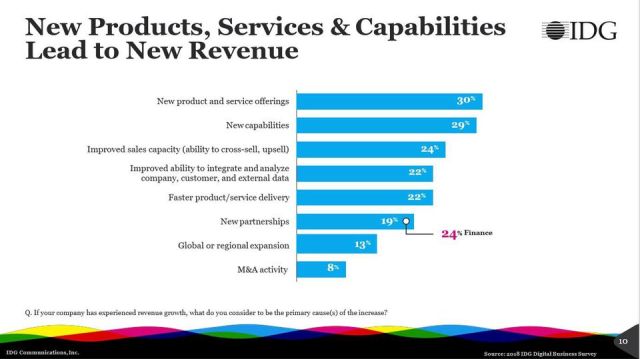
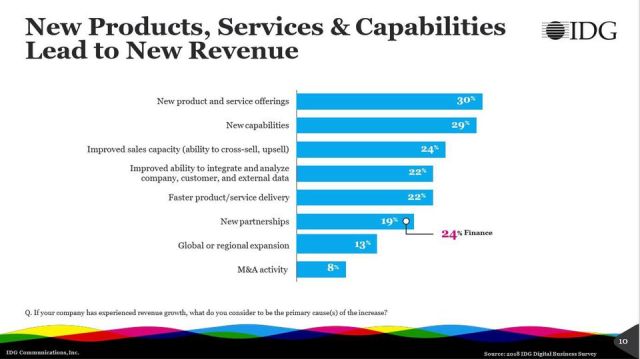
  • Start-ups can increase revenue by 34% relying on digital-first strategies, with all enterprises increasing revenue by 23% with new product and service offerings being the largest contributor to revenue growth across all companies. 30% of all enterprises interviewed by IDG say that new product and service offerings are the primary sources of revenue growth for their companies, followed by adding new capabilities inside the company and improving sales capacity to cross-sell and upsell. 22% say that their improved ability to integrate and analyze company, customer and external data is contributing to increased revenue. 22% also credit digital business strategies with the ability to increase product and service delivery speeds. New partnerships, global or regional expansion and M&A (merger & acquisition) activity are the remaining factors driving revenue growth. Multiple responses were allowed to the original survey.

https_blogs-images.forbes.comlouiscolumbusfiles201804New-products-drive-the-greatest-revenue

  • Enterprises’ definition of a digital business varies from enabling worker productivity to meeting customer experiences. 52% of enterprises say enabling worker productivity through tools such as mobile, data access, and AI-assisted processes are the essence of their digital business strategy. 49% say better managing business performance through data availability, and visibility is what defines their digital business, and 46% say meeting customer experience expectations using digital technologies is the center of their digital business.

https_blogs-images.forbes.comlouiscolumbusfiles201804New-products-drive-the-greatest-revenue

  • 62% say delivering an excellent customer experience as measured by customer satisfaction scores defines success as a digital-first business. The intensity to gain high customer satisfaction scores in retail is high, with 79% saying this is by far their most important benchmark of a successful digital-first business. 70% of manufacturers define the digital-first business strategies as successful when they improve process efficiency through automation. 53% of services companies and 51% of finance companies define digital-first business success by their ability to accelerate time-to-market.

https_blogs-images.forbes.comlouiscolumbusfiles201804New-products-drive-the-greatest-revenue

Contributor: Louis Columbus – Source