Bitcoin Users Rise In Number

I know that I have talked rather a lot about Bitcoin this week, but it has been a very exciting week for the crypto currency and yesterday’s announcement of an indefinite postponement of the Segwit2X hard fork was certainly a focal point. Today, Coin Telegraph has published several news stories highlighting the sudden rush towards BTC, which will inevitably help those already holding BTC as the price is already rising this morning.

BitcoinPrice3.max-800x800

Coinbase members increase overnight

Coinbase, one of the biggest and most successful crypto exchanges, told Coin Telegraph that following the announcement by CME Group, the world’s leading and most diverse derivatives marketplace, that it plans a launch of  Bitcoin futures attracted 100,000 new users to Coinbase within a 24-hour period. It already has 11.9 million users in 32 countries and was one of the earliest exchanges to support BTC trading. It supports merchants as well, allowing them to accept Bitcoins for their products and services, but removing the price risk by crediting fiat currency to their accounts. As Coin Telegraph points out, it also became the first ‘unicorn’ of the crypto market when it raised $100 million in August 2017 and it’s no surprise that Brian Armstrong, Coinbase’s CEO is on Fortune’s list of the Top 40 under 40.

CME Group announcement fuels rush to BTC

CME’s announcement of Bitcoin futures is also expected to see the big institutional investors rushing to get involved with BTC. That’s why individual investors are getting in now, because once the big boys get involved, it is expected that the value of BTC will shoot up.

With hundreds of thousands of new users, the demand for Bitcoin is expected to go stratospheric, which is great if you are holding BTC already. Coin Telegraph reports that currently less than 0.5 percent of the global population is invested in crypto space, but that is likely to change in the next few years, especially if mainstream financial corporate entities, like Goldman Sachs, start supporting crypto. Goldman Sachs is already talking up the value of BTC and has said that it expects BTC prices to stabilise at around $8,000 before rising again. Currently it is trading at $7,098, so there is still a way to go before it reaches the suggested consolidation point. On the other hand, Ronnie Moas of Standpoint Research predicts it will hit $11,000 in 2018. He was right about Bitcoin’s bull run in 2017, so why doubt him now. If he’s right, next year will be an excellent one for BTC owners.

 

The problem with Segwit2X for BTC owners

fork-bitcoin-e1502896754549

Somebody asked me the other day why there was so much heated debate over the upcoming Bitcoin fork. The other day I wrote about what might happen after the fork, but I’d like to clear up some of the confusion over why the fork is happening and why there is something of a turf war in the Bitcoin camp.

However, as I started to write this, a ‘breaking news’ item flashed across my screen from one of the crypto exchanges that I use. It announced that the leaders of the Segwit2X have suspended their plans indefinitely. As a result, Bitcoin shot up in value just after the announcement to touch $7,800, although it has since decreased in value to around $7,300. It seems to have boosted other coins as well, with Dash and Ethereum both showing some impressive gains; ETH has finally gone past the $300 mark.

But, back to the Segwit2X hard fork war. If a truce hadn’t been reached, what might have happened?  The first issue is that there would have been two types of BTC and who would decide which was the ‘real’ one and which one would be allowed to use the well-known BTC ticker symbol. It’s a bit like kings fighting for a crown and one claims they are the real king and the other is the usurper. We’ve seen what happens in history when this situation arises. There is always a war and supporters decide which side they are taking. This is what we’ve been watching within the BTC community.

But, it would have meant a payout to existing BTC holders. For example, Coinbase, one of the biggest exchanges announced that it would give every user BTC2x coins to match the amount in their BTC wallet. It sounds like ‘free money’, but, there is a downside.

In the past there have been other forks for Bitcoin Cash and Bitcoin Gold, but nobody considered those as replacements for the original Bitcoin. However, many thought the Segwit2X fork would pitch the new coin against the original and therefore damage the value of the original BTC. That doesn’t sound so good for people who are holding BTC.

Thankfully, this has now become hypothetical again and the original Bitcoin remains the only one. Perhaps Segwit2X will never happen, although in the world of crypto currencies, you can never be sure what is coming next.


What will happen after the Bitcoin fork?


rtx13qbq-e1501694080106

We are only days away from one of the biggest events in Bitcoin’s history – the Segwit2x fork that will happen around 16th November. Needless to say there is a lot of discussion in the crypto press about what this will mean for the leading digital currency.

In the last week we have seen Bitcoin’s value shoot up to a new record high and then correct itself; a series of movements that is typical of the various crypto coins. We have also seen a number of companies in the financial mainstream talking up the use of cryptocurrencies and blockchain, which has energised the market, but the introductions of Segwit2x is a step that for many is one into the unknown.

So far this new technical roadmap for Bitcoin seems to have support from its miners, but nobody is sure whether this November fork will change the code for existing Bitcoin, or whether it will lead to a new coin. Some are already talking about Bitcoin 2x, indicating that this is the route they think it will take.

It is of course one of the largest changes to the platform that has ever taken place, so it is uncharted territory and there are commentators who point out that previous forks have created unforeseen changes for users and investors. Consequently, there is some apprehension about the fallout after Segwit2x.

What is Segwit2x?

What is Segwit2x? Coindesk describes it as, “ both a proposal that seeks to change Bitcoin’s technology and a formal written agreement reached between certain parties interested in that change.” It also represents something that we haven’t seen on the blockchain before and it has its supporters and dissenters.

For or against Segwit2x?

Because Bitcoin is an open-source protocol, it relies on a group of volunteer and startup-sponsored developers to fix bugs, propose changes and maintain operations. This group are not in favour of Segwit2x and have been saying they have nothing to do with it for months. The miners – these are the people who solve the algorithms and approve transactions haven’t said very much. Originally they supported the fork, but now they appear to have less confidence in it. If they don’t support it, this could contribute to the outcomes of the fork.

Startups are the ones who are giving it the strongest support, because they use the Bitcoin protocol to offer services to their customers. They have the most ‘real life’ interaction with the technology and they are optimistic about how changes to the blockchain will correct any concerns users have about scalability. However, even they are preparing for worst-case scenario.


It seems that we will have to wait until the fork actually happens, because it’s impossible to make a prediction. Some say it is doomed to fail, others that it makes no sense: I say wait and see. We’ll know the truth before the end of November.


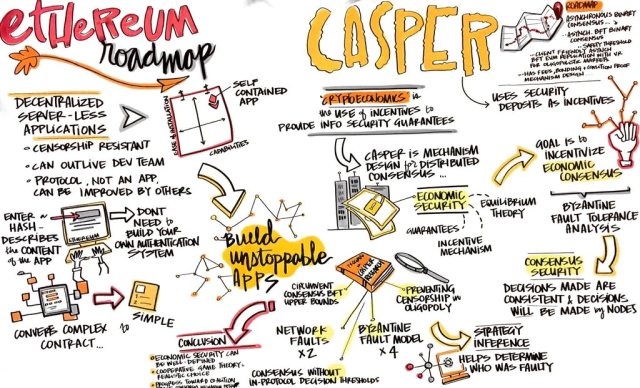
The latest Ethereum roadmap

MzjdsYApwW_MQogkN1GltP9r7maIzrODQUocbdlINCI

I’ve been heavily invested in Ethereum since it appeared, so I was very interested in Vitalik Buterin’s recent talk at Devcon (he’s the creator of Ethereum), which he called “a modest proposal.” He told his audience that he has been “quietly working on a new long-term plan for the future of the blockchain network.” It is a essentially a three to four year roadmap outlining his vision of the potential technical developments that Ethereum can achieve, and as anyone who owns ETH will have noted, the value of the coins showed some upwards movement after his speech.

Enter ‘sharding’

What does his vision include? At the heart of it is something called ‘sharding’.  Without getting too technical, this is defined as: “A database shard is a horizontal partition of data in a database or search engine. Each individual partition is referred to as a shard or database shard. Each shard is held on a separate database server instance, to spread load.” This was something that Ethereum watchers had expected to happen, but Bueterin finally solidified his strategy for using the shard technique.

Expanding Ethereum’s scalability

His roadmap points to problems with the platform and solutions for fixing them. His focus in the talk was on scalability, as Ethereum nodes need to store everything that ever happened on the network. Buterin emphasised the need for solutions that mitigate expensive storage costs that could escalate exponentially as the system expands.

It was clear from his presentation that he wanted to encourage Ethereum developers to think about this aspect when he said: “The amount of activity on the blockchain is orders of magnitude larger than it was just a couple of years ago,” and pointed to daily transaction rates and the 20,000 nodes plus that are now part of the network.

Buterin’s view of sharding

Buterin seems to see ‘sharding’ as the most probable solution to the problem. This way of partitioning data into subsets means that each node would only have to store a small amount of data from the entire network. But, Buterin wants a system where “the underlying math would hold the system accountable, and if they need it, nodes could rely on other nodes for data.” How to execute this in practice and ensure security, i.e. no nodes sending other nodes false information, is something that researchers have been looking into.

From the talk we now know that Buterin has a less conventional approach to using sharding. He is proposing to split Ethereum into different types of shards- there will be a main shard comprising the current Ethereum network, and there would be other shards, which Buterin calls other “universes.”

Most importantly, Buterin believes the partitioning would allow for more aggressive changes on the smaller shards, and more cautious changes on the main blockchain. This will ensure Ethereum’s platform maintains stability while developers can test new changes.

Other announcements included upgrading the smart contract technology and progress on eWASM, his project for running Ethereum on a web browser. He also hinted that a lot of the work in progress is much more advanced than anyone guessed when he finished hi stalk by saying, “Basically we’re just inches away from a proof of concept in python.”