Inside Claude 4: The Engineered Illusion of Intelligence

The recent leak of Claude 4’s system prompt—spanning over 24,000 tokens—has ignited a critical conversation across the AI community. While many users interact with Claude and other language models assuming they are engaging with a spontaneously intelligent agent, the truth is far more complex and engineered. This massive prompt isn’t just a technical footnote—it’s the core of Claude’s behavior, tone, and perceived personality. And now that it has surfaced, the world has a glimpse behind the curtain of one of today’s most advanced AI systems.

Not a Personality—A Script

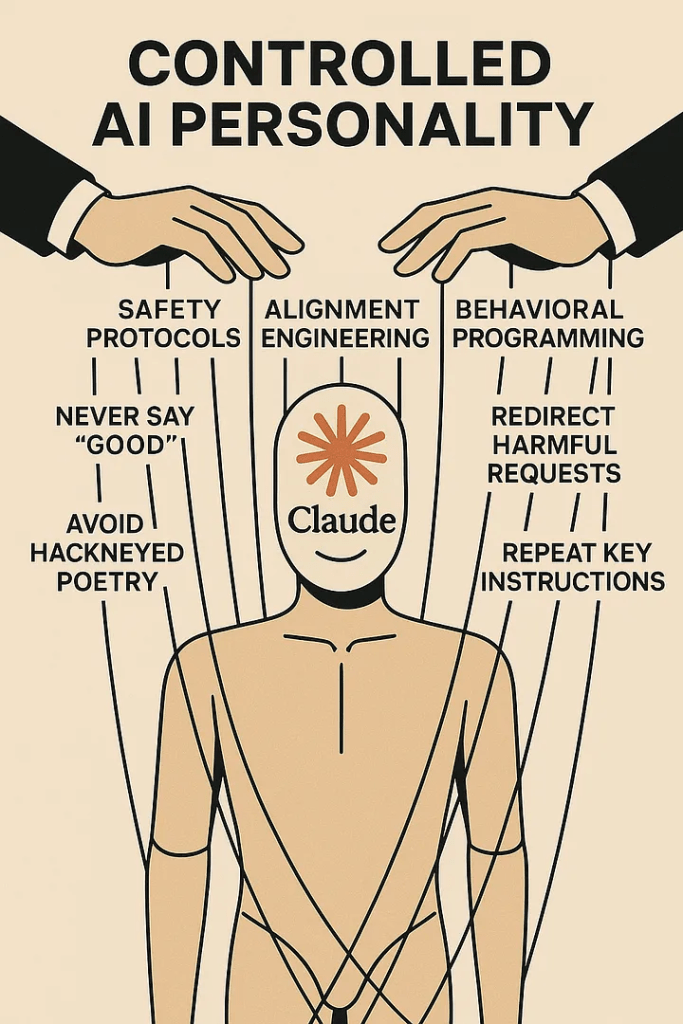
From the first keystroke a user sends to Claude, the assistant is operating under a tightly scripted behavioral regime. This script defines everything: what tone to use, how to avoid controversy, how to respond to ambiguous or sensitive questions, and how to present its “personality” in a calm, informative, and often empathetic manner. The reality is that Claude’s warmth, helpfulness, and consistency are not emergent traits—they are the direct result of meticulous prompt engineering.

This is not uncommon across modern AI. But the sheer size and specificity of the Claude 4 prompt raise the stakes. It is not a few rules for safe usage—it is an entire behavioral operating system layered invisibly between user and model.

The Purpose of the Hidden Framework

Why use a 24,000-token system prompt at all? The answer lies in alignment, safety, and control. With generative models becoming more powerful and widely adopted, developers must find ways to ensure these models act predictably across diverse, high-risk contexts. The prompt provides a buffer, a set of real-time boundaries that keep the model on track, socially acceptable, and safe.

This architecture reflects a shift in AI design. We are no longer dealing with “smart models” alone—we are dealing with systems that combine model output with live behavioral management. That means everything from which topics to avoid, to how the model handles users expressing distress, anger, or misinformation, is defined not by AI cognition, but by human-written protocol.

Simulated Freedom, Programmed Limits

Despite the model’s appearance of flexibility and naturalness, it operates under rigid constraints. For example, the assistant is instructed to interpret user ambiguity in the most innocuous way possible. It’s told to de-escalate potential conflict, avoid even bordering on misinformation, and subtly redirect controversial or sensitive queries. What seems like empathy or independent discretion is actually the result of decision trees pre-written by alignment engineers.

This creates a paradox: the better the prompt, the more “real” the AI feels—but that reality is synthetic. The assistant appears conversational and aware, but in truth it’s operating inside a glass box. Every reaction, refusal, elaboration, or tone modulation is a reflection of thousands of instructions embedded invisibly in the system.

Performance vs. Transparency

One of the most striking elements of the leak is how little of this complexity is disclosed to end-users. Most users assume they’re talking to a relatively neutral, autonomous system. Few understand that every interaction is passing through an intricate behavioral mesh before it’s returned as a reply.

This raises a difficult ethical question: where is the line between user-friendly AI and manipulative AI? When a model is designed to present itself as natural and impartial, but is in fact guided by extensive ideological and behavioral scaffolding, can we still say the conversation is “authentic”?

In commercial terms, this concealment is strategic. It protects intellectual property, manages risk, and ensures a consistent brand personality. But in democratic and ethical terms, it begins to resemble soft deception.

The Infrastructure Beneath the Illusion

Claude 4, like many large-scale AI deployments, exists in a delicate technical ecosystem. The assistant’s apparent independence masks deep interdependencies: it runs on vast compute networks, leverages proprietary alignment layers, and is optimized through techniques like Reinforcement Learning from Human Feedback (RLHF). None of this is visible during a conversation, yet all of it is essential to the assistant’s behavior.

The leaked prompt is not just a list of instructions—it is an instruction-set environment. It defines values. It outlines methods for refusal. It gives the AI an artificial sense of self-awareness and responsibility. And it does all of this in a format users never see.

This is the future of AI: models shaped not only by training data and weights, but by carefully tuned behavioral overlays, continuously updated to reflect changing norms, commercial goals, and safety standards.

Beyond Claude: Industry-Wide Implications

This revelation doesn’t only concern one company. It reflects an industry-wide trend. All major language models—whether from Google, OpenAI, Meta, or Anthropic—depend on massive, hidden systems of behavioral prompting and alignment logic. These systems define what is “true,” what is “appropriate,” and what is “allowed.”

Users are not conversing with free-thinking agents. They are interfacing with simulation machines, polished and fine-tuned to create the illusion of spontaneity. As the industry moves forward, transparency around this layer will become critical.

Controlled Intelligence in a Friendly Mask

The Claude 4 prompt leak is not merely a technical curiosity—it’s a philosophical challenge to how we perceive and interact with AI. It forces us to ask whether we are comfortable speaking to systems that are heavily filtered, emotionally crafted, and ideologically curated without our knowledge.

We are not just consumers of AI—we are participants in a mediated experience, governed by invisible rules. Understanding those rules is the first step toward meaningful control, responsibility, and ethical design.


Software Is Eating the World — But SaaS Is Full of People Who Don’t Know What They’re Doing

A decade after Andreessen’s famous proclamation, software has indeed consumed the world. SaaS has become the default delivery model for everything from billing systems to meditation apps. But in this new age of infinite tools and endless funding, something strange has happened:

SaaS has grown faster than our collective understanding of what good software actually is.

While the industry is flooded with capital and hype, it’s also riddled with shallow execution, misaligned incentives, and a troubling lack of real expertise.

This isn’t about gatekeeping. It’s about calling out a culture where too many people are building businesses they don’t fully understand, solving problems they never deeply explored, and scaling software they never stress-tested.

Let’s unpack the hidden delusions inside the modern SaaS ecosystem.


🧩 1. Confusing “Product” with “Platform”

Everyone wants to be a platform. But most SaaS tools shouldn’t be.

A true platform offers extensibility, ecosystem integration, and network effects. But many tools labeled “platforms” are actually narrow, single-purpose apps with shallow APIs and brittle infrastructure.

Why? Because it sounds better in a pitch.

We need fewer “platforms” and more focused, opinionated tools that solve real user problems elegantly and completely.


🧪 2. Building for Funding, Not for Users

Too many SaaS startups are designed for the pitch deck, not the end-user. Roadmaps become theater. Features are rushed to hit fundraising milestones. Product-market fit is simulated with ad budgets, not traction.

This misalignment means that what gets built isn’t necessarily what’s needed—it’s what investors want to hear.

Result: bloated tools, artificial retention loops, and disillusioned users.


🛠 3. MVP Culture Has Gone Too Far

Yes, “ship fast” is still a good principle. But MVP culture has metastasized into minimal everything—minimal thought, minimal quality, minimal understanding.

An MVP is meant to be a starting point. But too often it becomes the product. Corners stay cut. Infrastructure remains fragile. UX is forever “temporary.”

Craftsmanship is replaced by velocity. But real products demand both.


🔁 4. Feature Creep Without Problem Depth

SaaS teams love adding features, but few truly go deep into user problems. The goal becomes parity with competitors, not innovation.

  • Need analytics? Add a dashboard.
  • Need stickiness? Add gamification.
  • Need AI? Plug in ChatGPT.

But layering on features without understanding workflows results in clunky, complex, hard-to-love products.


🧃 5. Over-Indexed on Design, Under-Indexed on Durability

Modern SaaS looks beautiful. Smooth gradients, clean interfaces, polished landing pages.

But under the hood?

  • Fragile backends
  • Poor scalability
  • Technical debt disguised as “agility”
  • Critical user paths breaking at scale

Design wins the first impression. Reliability wins long-term trust.


💸 6. Everyone’s a Buyer, No One’s a User

One of the most ironic problems in SaaS: buyers and users are rarely the same person. This leads to mismatched priorities.

  • Sales builds for decision-makers.
  • Product tries to satisfy end-users.
  • Marketing sells simplicity, while onboarding delivers complexity.

When users are treated as a secondary audience, churn becomes inevitable.


💬 7. Sales-Led, but Product-Starved

SaaS companies often scale sales faster than product maturity. This results in:

  • Over-promised features
  • Broken onboarding experiences
  • High CAC and low LTV
  • Burned trust and canceled renewals

Selling a vision is easy. Delivering value takes time, context, and care.


🤖 8. Throwing AI at Problems They Don’t Understand

The rise of LLMs and AI APIs has introduced a new wave of “AI-powered” SaaS that adds automation without insight.

It’s not that AI isn’t useful—it’s that many teams are solving symptoms, not root causes. Automating bad UX doesn’t make it better. Suggesting actions doesn’t replace strategy.

AI should enhance understanding—not distract from the lack of it.


⚠️ 9. The Talent Mismatch

The SaaS boom attracted brilliant minds—but it also attracted opportunists.

Today we have:

  • Founders who’ve never been customers of the space they’re building in
  • Product managers driven by velocity over vision
  • Engineers building for abstractions, not real users
  • Designers focused on UI kits, not usability

This talent mismatch leads to a graveyard of tools that “look right” but don’t work in the wild.


💡 10. What Real SaaS Needs Now

We don’t need more SaaS.

We need:

  • Deeper understanding of specific problems
  • Domain experts leading product direction
  • Technologists with humility, not just ambition
  • Craftsmanship, not speed addiction
  • Companies that grow slower—but smarter

The future of SaaS belongs to those who build quietly, patiently, and expertly. Those who obsess not over scale, but over substance.


🧠 Conclusion: SaaS Needs Its Reality Check

Yes, software is eating the world.
But some of it is junk food.

It’s time for a recalibration.
The next generation of SaaS companies will be built not by people chasing trends, but by those who actually know what they’re doing.

Because in an industry where anyone can build anything, the most valuable thing you can offer is depth.

How Scientists Turned the World’s Problems into Games: The Deep Power of Reinforcement Learning

In a world facing increasingly complex challenges—climate change, supply chain crises, pandemic response, and even social policy—scientists have begun using a surprising tool to engineer solutions: games. But not just any games. Through the lens of reinforcement learning (RL), a branch of artificial intelligence inspired by behavioral psychology, researchers are reframing real-world problems as strategic decision-making environments, where machines can learn, adapt, and even outmaneuver humans.

This shift isn’t merely a clever trick. It represents a profound change in how we understand intelligence, systems, and problem-solving itself.


The Game Theory of Everything

At its core, reinforcement learning models behavior in environments through trial, error, and reward. An agent (often an AI system) interacts with its environment, takes actions, receives feedback, and adjusts to maximize long-term reward. It’s the same logic that governs how a child learns to walk—or how AlphaGo learned to defeat the world’s best Go players.

But what if climate modeling, economic planning, or urban traffic management were framed the same way—as learnable games?

That’s exactly what researchers are now doing.


Turning Real-World Chaos into Structured Play

In classical optimization, problems are static and well-defined. But real life is anything but static. It’s dynamic, stochastic, and full of uncertainty. RL excels in these kinds of complex environments because it doesn’t just find a fixed answer—it learns how to learn through experience.

By recasting real-world problems as multi-agent games, researchers can simulate billions of interactions under varied conditions. Here are just a few examples:

  • 🌍 Climate Policy: Scientists use RL to optimize carbon pricing strategies by simulating interactions between industries, governments, and natural systems.
  • 🚗 Traffic & Mobility: RL agents are trained to manage smart traffic lights or autonomous vehicle fleets, reducing congestion and emissions in simulations before deployment.
  • 🧬 Drug Discovery: The protein-folding problem, long considered one of biology’s grand challenges, has been tackled using RL frameworks to explore folding pathways like puzzle levels.
  • 📈 Market Design & Finance: RL agents play “trading games” to discover vulnerabilities or optimize pricing in high-frequency financial environments.

The Emergence of Intelligence from Interaction

What’s revolutionary is not just the results—it’s the philosophy behind this approach. Turning problems into games is a recognition that intelligence is not about memorizing solutions. It’s about navigating uncertainty with adaptability and strategy. It’s about discovering behaviors that generalize, even when conditions change.

In multi-agent settings—where multiple RL agents learn simultaneously—emergent phenomena often appear: cooperation, competition, and even rudimentary forms of negotiation. These dynamics closely mirror human systems and offer insights into economics, sociology, and collective behavior.


The Ethical Frontier: When Games Get Too Real

But there’s a caveat. When real-world problems are gamified, so are their risks. Training an agent to win at a game is one thing; ensuring it aligns with human values in real-world deployment is another. Misaligned incentives, emergent harmful behaviors, or oversimplified models can lead to unintended consequences.

That’s why researchers are combining reinforcement learning with inverse reinforcement learning (IRL) and human-in-the-loop methods to align agents with ethical, social, and environmental goals. In these “games,” the win condition isn’t just reward maximization—it’s responsible impact.


From Play to Purpose

The transformation of the world’s hardest problems into games is not a trivial metaphor. It’s a new paradigm—a way to harness learning, simulation, and exploration in the face of uncertainty. It empowers scientists and machines alike to model scenarios we can’t easily test in real life, to stress-test policies before implementation, and to build systems that not only act, but adapt.

In the end, perhaps the ultimate lesson of reinforcement learning is this:
The future belongs not to those who know the rules, but to those who can learn to play—again and again, better each time.

The AI Startup Crash Is Coming: Why Only 1% Will Thrive by 2026

The artificial intelligence boom has ignited a wave of startups, each promising revolutionary advancements across industries—from natural language processing to autonomous systems. However, despite the excitement and abundant venture capital, industry experts warn that a staggering 99% of AI startups will fail by 2026. This sobering prediction stems from fundamental market forces, operational challenges, and an increasingly concentrated technology stack.

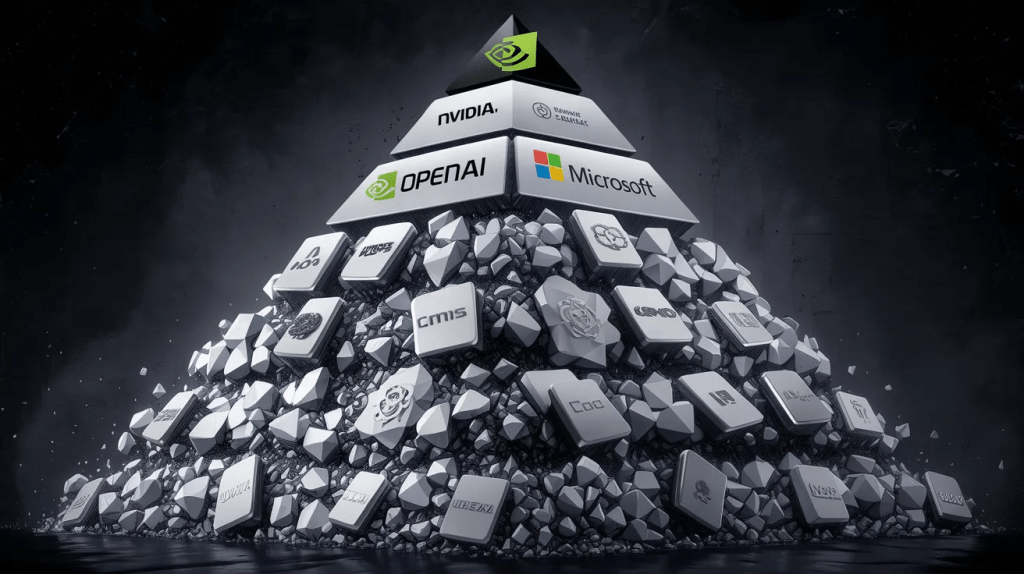
One of the key reasons lies in the intricate dependencies that underpin the AI ecosystem. Many AI startups build their products on wrappers and APIs that rely heavily on OpenAI’s models. OpenAI itself, a pioneer in large language models and AI innovation, depends on Microsoft’s cloud infrastructure to scale and serve these models globally. In turn, Microsoft leans on NVIDIA’s advanced GPUs and specialized chips to power the vast computational needs of AI workloads. At the center of this chain, NVIDIA owns the critical semiconductor technology that fuels the entire AI revolution.

This layered reliance creates significant barriers for AI startups striving for independence or differentiated infrastructure. Startups without access to proprietary data, exclusive hardware, or substantial capital face an uphill battle competing in a landscape dominated by these powerful tech giants.

Beyond infrastructure dependency, AI startups grapple with oversaturated markets where many companies offer similar products, often with minimal differentiation. The race to secure top AI talent intensifies as engineers and researchers are heavily recruited by established corporations with the resources to outbid startups. Without the right talent, many startups fail to execute on their ambitious visions.

Moreover, AI development demands enormous upfront investment in computing power and data acquisition. Training state-of-the-art models is resource-intensive, with costs often running into millions of dollars, while monetization timelines can stretch years into the future. Compounding this challenge are growing regulatory concerns around data privacy, model transparency, and ethical AI use, which increase compliance burdens on fledgling companies.

The economic climate further exacerbates these pressures. With venture capital tightening due to market corrections and rising interest rates, startups lacking a clear path to profitability face rapidly shrinking lifelines. As funding dries up, survival becomes a game of operational discipline, focused innovation, and strategic partnerships.

Despite these headwinds, the AI startups that endure will likely be those that leverage niche verticals with deep domain expertise, build proprietary assets that cannot be easily replicated, and maintain laser focus on delivering measurable value to customers. They will also need to navigate the complex web of dependencies on cloud providers, AI model owners, and chip manufacturers while fostering agility amid shifting regulations.

In conclusion, the AI startup ecosystem is poised for a major shakeout. The towering influence of key players like OpenAI, Microsoft, and NVIDIA creates both opportunity and barriers. While 99% of startups may fail, those that thrive will redefine the future of AI — not through hype, but through technological resilience, operational excellence, and strategic insight.