Is Google making the blockchain searchable?

I came across an interesting article on Forbes the other day by Michael del Castillo. He tells a story about data scientist Allen Day, a former Google employee, who while looking at some of the tools he developed there, saw something puzzling. What he saw was “a mysterious concerted usage of artificial intelligence on the blockchain for Ethereum.”

Day was able to look into its blockchain and see a “whole bunch” of “autonomous agents” moving funds around “in an automated fashion.” Although Day has no idea who created the AI, he suspects “they could be the agents of cryptocurrency exchanges trading among themselves in order to artificially inflate ether’s price.”

Day also remarked that he didn’t believe this was the work of a single exchange, but is rather a group effort. Part of Day’s job is anticipating demand for a product before it even exists, and in the light of what he has seen, he believes that making the blockchain more accessible is the next big thing.

Let’s not forget that Google made the Internet more usable, bringing it billions in revenue, and if Day is correct in his predictions it could have another major pay day by making the blockchain searchable. Del Castillo says if it does, “the world will know whether blockchain’s real usage is living up to its hype.”

Day has already been working on this with a team of open-source developers, who have been loading data for bitcoin and ethereum blockchains into Google’s big data analytics platform called BigQuery. And, with the help of lead developer Evgeny Medvedev, he created a suite of sophisticated software to search the data.

Day is hoping that his project, known as Blockchain ETL (extract, transform, load) will bring Google’s revenues from cloud computing services up to the level of Amazon and Microsoft. Google is some way behind both of them, but it will struggle to match Amazon’s revenues of $27 billion from cloud services, because Amazon has been in the blockchain game since 2018 with a suite of tools for building and managing distributed ledgers. And Microsoft got into the space in 2015, when it released tools for ethereum’s blockchain. These two companies are focused on making it easier to build blockchain apps, whereas Day wants to reveal how blockchains are actually being used, and by whom.

Day has been demonstrating how his Blockchain ETL could function by examining the hard fork that created bitcoin cash (BCH) from bitcoin. “I’m very interested to quantify what’s happening so that we can see where the legitimate use cases are for blockchain,” Day says. “Then we can move to the next use case and develop out what these technologies are really appropriate for.”

Day is now expanding beyond bitcoin and ethereum. Litecoin, zcash, dash, bitcoin cash, ethereum classic and dogecoin are being added to BigQuery.

It seems Google is waking up to blockchain and is now powering ahead by filing numerous patents related to the blockchain. The company is also encouraging its developers to build apps on the ethereum blockchain, and GV, Google’s investment division has made some investments in crypto-related startups.

Is the crypto community just smoke and mirros?

You’ve probably noticed that ‘community’ is a buzzword in the crypto sphere. There isn’t an ICO that doesn’t refer to building its ‘community’, which is really another way of talking about their investors, because that is what they are. But ‘community’ sounds warm, fuzzy and friendly when compared with the ‘investor’, which instead suggests neutrality, detachment and anonymity.

Why crypto geeks chose ‘community’

In the traditional world of business it is very important to build loyalty among clients and customers; that’s one of the functions of great branding, but the crypto startups focused on the concept of ‘community’ at the start, in my opinion because they were operating on the fringes and therefore wanted to use a word that suggested a coming together of like-minded people, as well as a sense of equality between those who developed the crypto projects and those who basically crowdfunded them.

In the early days of crypto, this rather ‘liberty, equality and fraternity’ approach served a good purpose; it strengthened belief in a new technology by making everyone feel they had skin in the game, even if an individual’s financial commitment to a new project was $100, let’s say. However, as the ICO took off and every project wanted to build followers who would buy into it, what had been a collection of believers turned into, as Michael K. Spencer writes in his article for Medium, “communities more prone to pump and dump” who were never really loyal followers.

Now crypto projects need to get real

Spencer’s argument is, and I agree with him, is that the so-called ‘communities’ built up by ICOs on Telegram and elsewhere are not as useful to projects as they were once thought to be. The reason for this is that the crypto world has moved on significantly since the launch of bitcoin. Crypto projects now need real clients and products with a real world use.

Communities show no loyalty

In short, a project’s community that has come together just for the Airdrop, or whatever freebies a project wants to hand out, is rarely loyal. These marketing tools may build numbers of followers on social media quite rapidly and make a project look as if it has broad support, but most of those people are just there for the giveaways and once they have them, they’ll be off.

Spencer says, “Crypto saying that its community is its best resource, is like Facebook saying it’s valuable because it has over 2 billion users.” Building community is not where crypto projects should be focusing; they should focus more on real world applications, demonstrate utility and by doing so attract loyal clients and investors.

The surprising ways mining crypto can be profitable

Crypto miners are rewarded for processing transactions. All you need to be a miner is a rack of high-speed computers and access to electricity. Of course, a lot has been said about the latter: the consumption of energy needed to run the software and hardware on a large scale is astronomical in cost. In fact, some mining outfits are consuming the same amount of electricity as a small country. That’s why so many are based in the cold wastes of the Arctic Circle where lower temperatures keep the machines cooler and therefore reduce energy consumption.

When mining started, people could do it on machines at home, but that didn’t last long. The potential to make big bucks meant that competition increased and miners purchased massively powerful computers while scaling up their operations to remain profitable.

Then bitcoin crashed and this reduced the ability of miners to make a profit, and legal crypto mining using electricity at market rates is now becoming increasingly unfeasible, even in those places like Iceland.

Mining can still be profitable

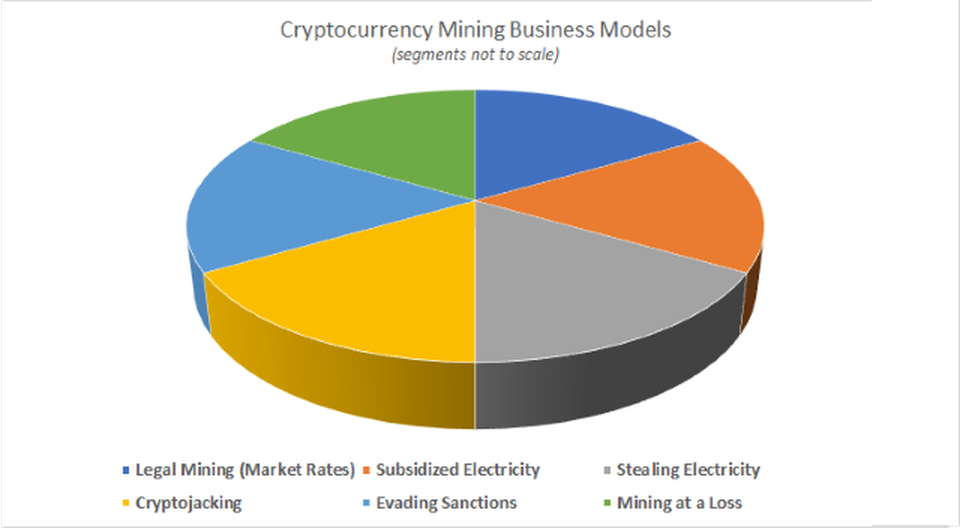
But there are still opportunities for profitable mining. One way is to find subsidised electricity. For example, In Washington State, hydroelectric power generates far more energy than locals can consume, thus attracting a booming business in crypto mining. Instead of exporting it to other states, miners could buy it. This is a legal model. The other forms of profitable mining are certainly not.

The first of the illegal mining options is to steal electricity. That is what used to happen in the early days, but energy companies have got wise to that and there have been some prosecutions for theft in China and the USA.

Another mining model is cryptojacking. This has outperformed ransomware as a form of obtaining crypto. How does it work? A hacker introduces crypto mining software onto a target victim’s computer without their knowledge, thus generating crypto for the hacker while stealing processor cycles and electricity from the victim.

And there we have the current crypto mining scenario. As Jason Bloomberg writes at Forbes: “For all the crypto fanatics out there, therefore, there is a reason to take heart — there’s no way crypto values will ever drop far enough for mining to cease. Organized crime wouldn’t let that happen.”

Online Lenders vs The Banks

The financial crisis of 2008 has spawned a number of innovations in the world of finance. Cryptocurrency and fintech startups are two of them, but these were preceded by a new wave of online lenders.

The truth is, and it remains so, that the Big Banks failed to respond to the financial crisis in a meaningful way for consumers. They caused the problem, but they remained in denial about the effects on the person in the street who needed access to credit. Furthermore, the banks simply didn’t want to take on more risk. The banks instead of thinking about people, concerned themselves with regulatory challenges and stuck to technology that first saw the light of day in the 1960s.

Online lenders get VC support

Enter the online lenders, supported by venture capitalists who could hear the money dropping into their coffers. Lending money appeared to be an easy and profitable game, however it wasn’t all plain sailing.

Still, online lenders had their customers well figured out: they knew what they wanted and what they didn’t want: they wanted instant access to loans and they didn’t want to visit a physical branch and discuss every detail of their lives with somebody in a suit. That aspect of it all went well.

Online lenders at a disadvantage

However, the economies of lending have been another matter. As fintech expert, Ben Cukier writes, “Loan profitability is driven by the spread (the cost difference between the interest charged on the loan, less the cost of funding those loans), the cost of acquiring the loan, and the default rates of those loans.” From the outset online lenders were at a disadvantage when compared with the traditional banks, because the old-school bankers uses low cost deposits to fund loans. By contrast, the new online lenders had to rely on “raising debt or even more expensive equity,” as Cukier points out..

Enter Big Data

Plus, customers knew the bank brands, whereas the newcomers had to invest a lot in raising brand awareness. But they did have a weapon that the banks did not posses: the newcomers had Big Data. They talked up their Big Data platforms, which use disparate data to better underwrite credit risk in ways common credit scores did not. And, they leveraged this data to target specific consumers on social media, and then used the data they mined from customer behaviour on social media enabled them to dictate borrowing terms.

Fintech is the real financial innovation

This gave the banks a wake-up call, and now bank customers can interact with their banks through apps and even get quick credit approval. Plus the banks offer a range of products, whereas online lenders only offer loans. Then fintech startups came along and offered more help to the big banks. Mark Hookey, CEO of Demyst Data says, “Fintech innovators demonstrated that a data focus matters, however banks can apply that insight at a far greater scale to know their customers and launch new products.”

In the end it is these fintech companies, rather than the online lenders, that offer the promise of a real revolution in lending.