Challenge to Ethereum smart contracts

It had to happen sooner or later; a new programming language for smart contracts has emerged to challenge Ethereum’s dominance in the market.

Ethereum-city

Ivy, the smart contract programming language developed by CHAIN, which is a blockchain development platform, will write smart contracts for Bitcoin’s blockchain. This might cause some upset for Ethereum, which is the platform everyone associates with smart contracts and the main system for ICOs, where it has something of a market monopoly.

CHAIN announced Ivy this week and explained that it has always been possible to write smart contracts on the Bitcoin blockchain, but that up until the arricval of Ivy, the Bitcoin Script was low level and had limited functionality. In its announcement, CHAIN said: “Bitcoin script development is considered somewhat esoteric,” and whilst some wallets, exchanges and payment platforms have used it successfully, it just wasn’t fit for purpose when it came to smart contracts.

Ivy by contrast is a much higher level language that make sit easier to write contracts for the Bitcoin network. CHAIN described it thus: “Ivy helps you write custom, SegWit-compatible Bitcoin addresses that enforce arbitrary combinations of conditions supported by the Bitcoin protocol including signature checks, hash commitments and timelocks.”

However, even Bitcoin developers are not convinced that this presents a threat to Ethereum. Jimmy Song told Cointelegraph: “Ivy makes SCRIPT easier to handle. It doesn’t change Bitcoin fundamentally, just makes coding it easier. ETH is Turing complete, which BTC cannot have without some sort of soft fork at a minimum. I don’t see the “smart contracting” ability of ETH as a “feature”, but more as a vulnerability. The attack surface on the ETH smart contracting platform is much greater. The fundamentals haven’t changed, this is more like a nice tool for developers.”

This is an interesting perspective, because it suggests that the Bitcoin blockchain still has a long way to go to catch up with Ethereum, However, there are those who are feeling more positive about Ivy, such as Matej Michalko, the CEO of Decent commented in Cointelegraph: “Ivy is an excellent example of the multifaceted development of blockchain products. Cross chain referencing is proliferating and it is on its way to dominate the ecosystem. Bitcoin can now be on par with Ethereum as a great smart contracts prototyping tool for a full range of Blockchain applications. Both platforms, however, remain fundamentally different in their architectures and market adoption. It remains to be seen what blockchain use cases and platforms are going to be adopted by masses. Scalability will be one of the decisive factors. 2018 is going to be a Blockchain year.”

Who will win the battle of the smart contracts? We will have to wait and see.

Crypto adoption booms in November 2017

p2p-bitcoin-trading-slows-in-china-booms-in-hong-kong-and-south-america-1600x1200-16-10-2017-15-07-28

The last weekend of November 2017 may prove to be an historical point on the cryptocurrrency timeline. It is too early to say just yet how important it will prove to be, as we have seen a number of spikes in investor activity with Bitcoin since it appeared. However, this felt like an important moment and I’m not the only person watching cryptocurrency and other blockchain products who felt the same way.

Jon Buck, one of the expert commentators who I follow, wrote that this period of November signposts the fact that adoption of cryptocurrencie is increasing massively. He even goes so far as to say, “trading numbers from last weekend indicate that the volume of cryptocurrency trades exceeds that of many US equities trading markets.” And, the volume of Bitcoin traded exceeded $5 billion, which was more than business on the Chicago Stock Exchange as well as other exchanges.

It has been quite a dramatic month all round with the “will they, won’t they” situation with Segwit2X, which eventually didn’t happen and then the clash between Bitcoin and Bitcoin Cash. It looked like Bitcoin was going to be the loser, but it came back with some force to inspire renewed confidence in prediction that it will reach $10,000 by the end of the year.

That alone produced a spike in Google search volumes for ‘Bitcoin’ and the exchange Coinbase added another 100,000 users. The increased adoption we are witnessing is placing Bitcoin, Ethereum and Litecoin, which also traded very strongly at the weekend to reach milestone values, even more firmly in the spotlight. Jon Buck commented that it was surprising that the other altcoins had done so well, because a bull run on Bitcoin usually takes money away from the other altcoins and makes their prices drop. Instead we are seeing them growing together and this indicates that new money is flowing into digital currency.

Finally, news just on from Japan reveals that Bitcon has just broken through the 1,000,000 Yen price point. Like the $10,000 in the U.S., this level represents the breaking of a psychological price barrier. Some even believe that the weekend’s BTC bull market started in Japan and reports state that the yen is responsible for an impressive 59.6% of all Bitcoin trades worldwide. The Japanese government exempted BTC from an 8% consumption tax on BTC trading and this has made it very popular with the Japanese people who are now keen to own Bitcoin. Watch Japan, because its behaviour is influencing the global BTC economy. Their bullishness is encouraging others and a $10,000 BTC for Christmas—or even this coming weekend — is pretty much inevitable.


A shift in the ICO landscape

IMG_1627-e1498048643609

There is no doubt that the ICO landscape is changing these days. As a Coin Telegraph writer pointed out, some 75% of recent ICOs have failed to reach their soft cap, which is indicative of an important turnaround in this sector. One of its effects is to squeeze out the scammers and introduce a new generation of ICOs that go way beyond the need to simply raise money for a startup.

According to Nick Ayton, a London-based Fintech journalist, there are “several forces shaping the ICO market.” He is right to point out that 2017 has been the year that the ICO really took off, but like many he is curious about what 2018 will bring. Will it be very different? For example, will ICOs get bigger in terms of the deal, but fewer in number? And, will the pre-ICO sale be a thing of the past?

There are lots of factors to consider. For a start, Bitcoin has had a rocky few months over the Segwit2X fork, now abandoned, and Ethereum seems to be still trying to work out how to handle scalability for all the ICOs that are using its network. But, crypto is still gaining ground and Ayton predicts that it will reach a $500 million market cap early on in 2018.

ICOs overtake venture capital

In October 2017, ICOs reached a peak number and overtook venture capital as a source of funding. However, just to put this into some perspective, it must also be remembered that some ICO funds were hacked and money stolen (CoinDash is one example) and some ICOs have had to return money to token buyers, because the project didn’t meet its soft cap. There has been a lot of discussion over just how many ICOs were scams, which has inevitably led to the arrival of regulation.

The arrival of regulations

It is fair to say that ICOs must now consider not only existing banking and payment regulations, they are aware that there are new ones coming down the pipeline, although quite what they will be nobody knows, which is another issue. Some governments, particularly in southeast Asia want to ban ICOs, whilst others are embracing them, like Russia and Japan.

Places like the UK are keeping their powder dry. We’re not sure how it will position itself on ICOs in 2018, although it already has a regulatory framework in place with its eMoney Laws and Collective Investment Scheme rules. We do know that the FCA has created a sandbox to test out various propositions, and that the USA would love to dictate what happens with crypto worldwide.

ICO costs will explode

One thing we can be fairly certain of is that the ‘bootstrapping’ ICO is coming to an end. In the future, launching an ICO is likely to cost in the region of $250k – $500k, which is a price that will

The latest Ethereum roadmap

MzjdsYApwW_MQogkN1GltP9r7maIzrODQUocbdlINCI

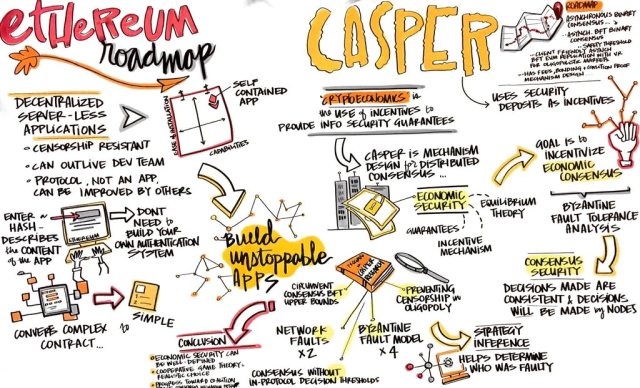
I’ve been heavily invested in Ethereum since it appeared, so I was very interested in Vitalik Buterin’s recent talk at Devcon (he’s the creator of Ethereum), which he called “a modest proposal.” He told his audience that he has been “quietly working on a new long-term plan for the future of the blockchain network.” It is a essentially a three to four year roadmap outlining his vision of the potential technical developments that Ethereum can achieve, and as anyone who owns ETH will have noted, the value of the coins showed some upwards movement after his speech.

Enter ‘sharding’

What does his vision include? At the heart of it is something called ‘sharding’.  Without getting too technical, this is defined as: “A database shard is a horizontal partition of data in a database or search engine. Each individual partition is referred to as a shard or database shard. Each shard is held on a separate database server instance, to spread load.” This was something that Ethereum watchers had expected to happen, but Bueterin finally solidified his strategy for using the shard technique.

Expanding Ethereum’s scalability

His roadmap points to problems with the platform and solutions for fixing them. His focus in the talk was on scalability, as Ethereum nodes need to store everything that ever happened on the network. Buterin emphasised the need for solutions that mitigate expensive storage costs that could escalate exponentially as the system expands.

It was clear from his presentation that he wanted to encourage Ethereum developers to think about this aspect when he said: “The amount of activity on the blockchain is orders of magnitude larger than it was just a couple of years ago,” and pointed to daily transaction rates and the 20,000 nodes plus that are now part of the network.

Buterin’s view of sharding

Buterin seems to see ‘sharding’ as the most probable solution to the problem. This way of partitioning data into subsets means that each node would only have to store a small amount of data from the entire network. But, Buterin wants a system where “the underlying math would hold the system accountable, and if they need it, nodes could rely on other nodes for data.” How to execute this in practice and ensure security, i.e. no nodes sending other nodes false information, is something that researchers have been looking into.

From the talk we now know that Buterin has a less conventional approach to using sharding. He is proposing to split Ethereum into different types of shards- there will be a main shard comprising the current Ethereum network, and there would be other shards, which Buterin calls other “universes.”

Most importantly, Buterin believes the partitioning would allow for more aggressive changes on the smaller shards, and more cautious changes on the main blockchain. This will ensure Ethereum’s platform maintains stability while developers can test new changes.

Other announcements included upgrading the smart contract technology and progress on eWASM, his project for running Ethereum on a web browser. He also hinted that a lot of the work in progress is much more advanced than anyone guessed when he finished hi stalk by saying, “Basically we’re just inches away from a proof of concept in python.”